











 Secure payments
Standard refund policy
Trade Assurance
Secure payments
Standard refund policy
Trade Assurance
| Product Type | Memory Module |
|---|---|
| Compliance Standards | RoHS |
| Memory Capacity | 4 GB |
| Memory Technology | DDR3 |
| RAM Speed | 1333MHz |
| RAM Standard | DDR3-1333/PC3-10600 |
| Error Identifying | Non-ECC |
| Signal Type | Unbuffered |
| Column Access Strobe (CAS) | CL9 |
| Rank | Dual Rank x8 |
| Quantity of Pins | 240-pin |
| RAM Genre | UDIMM |
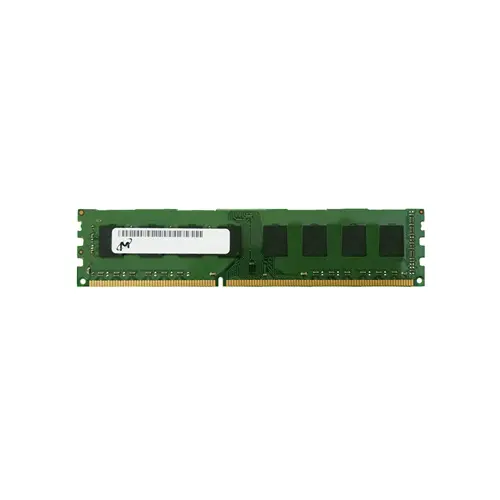
This unbuffered, non-ECC DDR3 UDIMM is designed for value-oriented desktop platforms, making it a practical upgrade for general productivity and light content creation workloads. Its dual-rank x8 architecture improves memory bandwidth efficiency, and the CL9 latency provides a balanced response profile for legacy systems running standard DDR3-1333 memory.
1. Unbuffered signal type allows the memory controller to communicate directly with the DRAM chips, shaving off signal regeneration delays for faster command execution in competitive gaming scenarios.
2. A 4GB capacity comfortably buffers operating system overhead and lightweight creative applications, preventing pagefile swapping that can stutter content editing workflows.
3. Operating at 1333MHz, this module drives enough bandwidth to keep legacy gaming titles consistently above playable frame rates without bottlenecking a discrete graphics card.
4. CL9 column access latency tightens the interval between data requests and delivery, giving rhythm games and action titles the split-second precision needed for accurate inputs.
5. Dual Rank x8 organization interleaves access across two internal rank groups, maximizing sustained throughput that stabilizes frame pacing during multistream video playback or streaming.
When you drop the MT16KTF51264AZ-1G4K1 into your desktop, you are not just adding capacity—you are engineering responsiveness. This 4GB DDR3-1333 UDIMM runs at a CAS latency of just 9 cycles, meaning the memory delivers data to your CPU with virtually no hesitation. In a AAA gaming scenario, that difference translates to fewer micro-stutters when an explosion fills the screen and textures stream in real time; every frame is assembled without the memory-induced lag that ruins immersion. While you frag, the dual-rank x8 organization keeps the command pipeline saturated, exploiting interleaving to sustain high throughput without idle cycles.
That same parallel efficiency shines in video rendering. When your timeline scrubs through 4K footage or you apply layered effects, the unbuffered architecture reacts instantly to the memory controller’s requests—there is no register buffering overhead to dilute performance. Non-ECC operation prioritizes speed over server-grade correction, exactly what a creative workstation demands. You get deterministic, low-latency access that keeps your render engine fed and your creative flow uninterrupted. This module turns every clock cycle into productive work, giving your desktop the edge where it counts most: in the moments that define your game or get your project delivered on time.
Gaming Build
For an entry-level gaming rig using these 4 GB DDR3-1333 UDIMMs, prioritize dual‑channel operation to reduce memory latency. A 16 GB configuration (four modules filling all DIMM slots) is achievable and provides smooth frame delivery in modern titles at medium settings. While a 32 GB kit is beyond the reach of 4 GB sticks, pairing two 8 GB kits would be recommended, but sticking to a 4×4 GB layout remains a cost‑effective enhancement over single‑channel 8 GB setups.
Content Creation
Large‑scale video editing and 3D rendering ideally require 64 GB, which cannot be met solely with these 4 GB modules. For light 1080p projects, however, populating four slots with these sticks yields 16 GB—enough for basic timeline work in applications like Premiere Pro. Users targeting 64 GB should replace the entire kit with 16 GB or 32 GB DIMMs, but the dual‑rank x8 nature of these modules helps maintain decent bandwidth for moderate Photoshop and After Effects tasks when fully utilized.
General Productivity
Cost‑conscious office and multitasking builds benefit from a 2×4 GB dual‑channel setup, delivering 8 GB at an affordable price point. This capacity handles web browsing, document editing, and video conferencing with ease under Windows 10 or light Linux distributions. Adding a third module breaks dual‑channel symmetry, so a matched pair is preferred; for heavier spreadsheet work, a 4×4 GB (16 GB) configuration extends the life of legacy DDR3 platforms without unnecessary expense.
Rigorously tested for desktop compatibility: Dell OptiPlex 390, HP Compaq 8200 Elite, Lenovo ThinkCentre M72e.
Q: Can I mix this MT16KTF51264AZ-1G4K1 with other memory modules of different brands or speeds?
A: Mixing different brands or speeds may cause instability. For reliable dual-channel operation, we recommend installing identical DDR3-1333 CL9 modules with the same capacity and rank configuration.
Q: Is this memory compatible with my desktop system using an Intel 6/7 series or AMD 900 series motherboard?
A: Yes, this DDR3 240-pin UDIMM is compatible with desktop boards supporting 4GB unbuffered non-ECC modules at 1333MHz. Please consult your motherboard's QVL list to confirm support for dual-rank x8 DIMMs.
Q: What is the recommended DIMM population order for optimal performance?
A: For dual-channel performance, populate identical modules in the same-colored slots, typically DIMM A2 and B2 first. Always refer to your motherboard manual for the correct channel configuration.
Q: Does this module support overclocking or XMP profiles?
A: No, this is a JEDEC-compliant standard DDR3-1333 module without XMP support. It operates at fixed timings of CL9 and is not designed for overclocking.
Q: What warranty and typical failure rate can I expect?
A: This module includes a 1-year warranty. The typical annualized failure rate (AFR) remains below 0.5% under normal operating conditions, reflecting industry-standard reliability.