











 Secure payments
Standard refund policy
Trade Assurance
Secure payments
Standard refund policy
Trade Assurance
| Product Type | Memory Module |
|---|---|
| Compliance Standards | RoHS |
| Memory Capacity | 4 GB |
| Memory Technology | DDR3 |
| RAM Speed | 1333MHz |
| RAM Standard | DDR3-1333/PC3-10600 |
| Error Identifying | Non-ECC |
| Signal Type | Unbuffered |
| Column Access Strobe (CAS) | CL9 |
| Rank | Dual Rank x8 |
| Quantity of Pins | 240-pin |
| RAM Genre | UDIMM |
This DDR3-1333 UDIMM is a standard desktop memory module ideal for upgrading older systems used in everyday productivity, light content creation, or budget gaming builds. Its dual-rank x8 organization improves interleaving efficiency, and the CL9 latency at 1333 MHz delivers responsive performance in non-ECC desktop platforms where data integrity is managed by the memory controller.
1. Unbuffered signal type eliminates additional latency from register chips, delivering the direct CPU-to-memory path that competitive gamers need for lower input lag and smoother frame delivery.
2. 4 GB capacity provides a sweet spot for mainstream productivity and older gaming titles, ensuring reliable multitasking without the cost or compatibility headaches of oversized kits on legacy platforms.
3. DDR3 technology offers broad compatibility with a vast installed base of desktops, making it the go-to drop-in upgrade to revive aging systems for web browsing, office work, and HD media streaming.
4. 1333MHz speed hits the efficient frequency band where everyday content creation and light photo editing feel fluid, keeping budget builds responsive without pushing the thermal or power envelope.
5. CL9 low latency reduces the wait time for the processor to access active data, sharpening in-game responsiveness and giving enthusiasts a tangible feel of acceleration during fast-paced scenes.
6. Dual Rank x8 organization interleaves two internal memory banks, boosting bandwidth utilization for improved multitasking fluidity when running streaming apps, voice chat, and a game simultaneously.
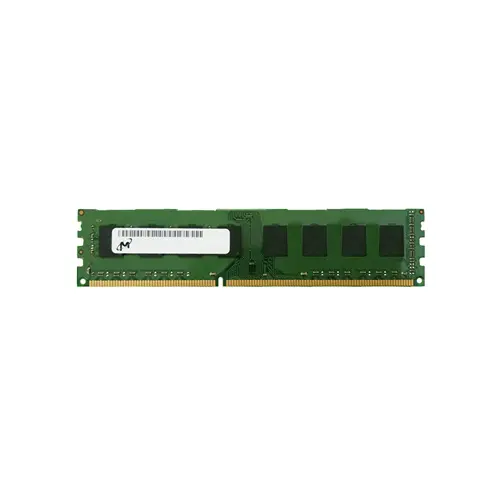
Designed as a standard 240-pin UDIMM, the Micron MT16JTF51264AZ-1G4 is unmistakably a desktop memory module, where its unbuffered, non-ECC architecture aligns perfectly with consumer platforms that prioritize raw speed and responsiveness over server-grade data integrity. For desktop users, four characteristics of this DDR3-1333 module directly shape real-world experience.
First, the unbuffered signal type and non-ECC operation eliminate the extra latency and controller overhead that registered or ECC memory imposes, meaning every command from the CPU is executed without delay—critical when you need instant reactions in competitive 3A gaming or when scrubbing through a high-bitrate video timeline. Second, the CL9 Column Access Strobe latency, combined with 1333MHz frequency, delivers snappy access to active data sets, preventing the micro-stutters that can ruin immersion in open-world titles and shaving seconds off render previews in Premiere Pro. Third, the dual-rank x8 organization interleaves two sets of memory banks, increasing effective bandwidth by allowing the memory controller to issue read and write commands in rapid succession; this markedly improves multitasking fluency when you are simultaneously assembling 4K footage, applying filters, and handling background app updates. Finally, the universal 240-pin UDIMM form factor and JEDEC-compliant DDR3-1333 standard guarantee drop-in compatibility across a vast range of desktop motherboards, making it a risk-free upgrade path that breathes new life into an aging tower without configuration headaches. For budget-conscious enthusiasts and home studio owners, these four attributes translate directly into smoother gameplay, faster project completion, and a responsive system that never gets in your way.
Gaming Build
For dual-channel performance, install two of these 4 GB DDR3‑1333 UDIMMs (8 GB total). Although 8 GB meets minimum requirements for many older titles, a smoother experience on modern mid‑range games demands 16 GB — populate all four DIMM slots with these modules. On motherboards limited to four slots, this is the maximum obtainable; aim for 16 GB to reduce stuttering during background tasks.
Content Creation
Video editing and 3D rendering thrive on capacity. Four of these modules yield 16 GB, which can handle 1080p timelines comfortably but struggles under 4K workloads with complex effects. For serious workstations, maximizing to four DIMMs (16 GB) is mandatory; however, users needing 32 GB or more must migrate to higher‑density DDR3 sticks, as the 4 GB limit of these modules restricts future headroom in prosumer film and CAD projects.
General Productivity
A single 4 GB module suffices only for lightweight operating systems and a few browser tabs. The cost‑effective sweet spot is two modules (8 GB dual‑channel), enabling fluid multitasking across email, documents, and video calls. Users running heavy spreadsheets or large databases should install four modules (16 GB) to prevent swap‑file slowdowns, keeping the system responsive throughout the workday.
Strictly tested, this desktop DDR3 module fits Dell OptiPlex 7010, HP Elite 8300, Lenovo M92p.
Q: Can I mix this MT16JTF51264AZ-1G4 with other memory modules of different brands or speeds?
A: Mixing is possible but not recommended. All modules will operate at the lowest common speed and timings, possibly causing instability. For best reliability, use identical modules with matching speed, CAS latency, and voltage.
Q: Is this memory compatible with my system?
A: This 240-pin DDR3 UDIMM is compatible with desktop motherboards using Intel 6/7-series or AMD 900-series chipsets that support DDR3-1333. Please verify your board supports non-ECC unbuffered memory and 4GB capacity per slot.
Q: What is the recommended DIMM population order for optimal performance?
A: For dual-channel platforms, install matching modules in same-colored slots (typically slots 2 and 4 first). If using only this single 4GB module, place it in the primary DIMM slot (usually DIMM_A2) as specified by your motherboard manual.
Q: Does this module support overclocking or XMP profiles?
A: No, this is a standard JEDEC-compliant DDR3-1333 module at CL9. It does not feature XMP profiles or support overclocking. It will reliably run at its rated 1333MHz speed with default timings on supported platforms.
Q: What warranty and typical failure rate can I expect?
A: This module includes a 1-year warranty. Typical annualized failure rate (AFR) for DDR3 UDIMMs is very low, generally under 0.5%, offering stable long-term operation in desktop environments with proper handling and cooling.