











 Secure payments
Standard refund policy
Trade Assurance
Secure payments
Standard refund policy
Trade Assurance
| Product Type | Memory Module |
|---|---|
| Compliance Standards | RoHS |
| Memory Capacity | 4 GB |
| Memory Technology | DDR3 |
| Product Voltage | 1.5V |
| RAM Speed | 1333MHz |
| RAM Standard | DDR3-1333/PC3-10600 |
| Error Identifying | ECC |
| Signal Type | Registered |
| Column Access Strobe (CAS) | CL9 |
| Rank | Dual Rank x4 |
| Quantity of Pins | 240-pin |
| RAM Genre | RDIMM |
This RDIMM is a server-class memory module engineered for virtualization, in-memory databases, and mission-critical workloads where data integrity is paramount. Its registered signal buffering ensures stable operation across densely populated memory channels, while the dual-rank x4 organization and ECC error correction deliver enhanced bandwidth utilization and automatic single-bit correction for maximum system reliability.
1. Registered signal type buffers command and address lines, enabling the deployment of large-capacity memory arrays without signal degradation, which is essential for maintaining uptime in multi-slot enterprise servers.
2. ECC error correction actively detects and corrects single-bit memory errors, significantly reducing the risk of silent data corruption in transactional databases and long-running virtualization hosts.
3. Dual Rank x4 organization maximizes interleaving potential, sustaining high bandwidth utilization across multiple DIMM channels to prevent bottlenecks during peak VM density operations.
4. DDR3-1333 speed provides a balanced throughput ceiling for legacy scale-out server nodes, ensuring consistent application responsiveness without the thermal overhead of overclocked memory.
5. 1.5V operating voltage standardizes power delivery across dense rack configurations, minimizing electrical stress on voltage regulator modules and improving long-term reliability in 24/7 data center environments.
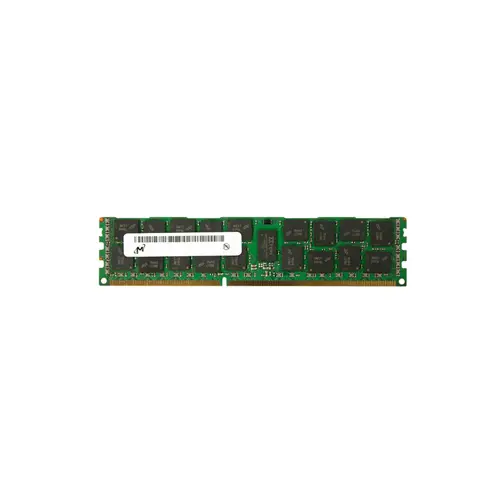
The Micron MT36JSZF51272PY-1G41 is a DDR3 Registered ECC RDIMM engineered for enterprise servers. Its four critical attributes—ECC, registered signaling, dual-rank x4 architecture, and 1333MHz CL9 operation—resolve real-world data-center challenges. In virtualization farms, a single undetected bit-flip can cascade into corrupted guest filesystems and unplanned downtime. The built-in ECC seamlessly corrects single-bit errors, safeguarding data integrity across all running VMs without performance penalty. Registered buffering minimizes the electrical load on the memory controller, enabling fully loaded DIMM slots in multi-socket servers while preserving signal integrity—vital for memory-hungry hypervisor hosts. For in-memory databases such as SAP HANA, the dual-rank x4 design alternates data access between two internal rank groups, elevating bandwidth and lowering access latency during simultaneous query storms. The 1333MHz frequency with CL9 timing delivers ample throughput and response time while keeping a 1.5V power envelope that curbs thermal stress in dense racks. These capabilities directly mean continuous uptime, consistent response, and lower TCO.
General Virtualization
This 4 GB DDR3-1333 RDIMM is suited for entry-level hypervisor hosts running light workloads. In a dual-socket server using balanced memory configuration, populate at least six identical modules per CPU (12 total) across three memory channels to maintain bandwidth. For modest virtualization with 10–15 light VMs, aim for 48–96 GB total by installing 12–24 modules evenly across all available channels.
In-Memory Database
For in-memory databases like Redis or Memcached, low latency and data integrity are critical—the ECC Registered design helps prevent silent corruption. Maximize capacity within thermal limits by fully populating all DIMM slots with these 4 GB modules; a 24-slot server yields 96 GB of reliable cache. Prioritize uniform rank populations per channel to avoid performance penalties, keeping all channels populated for optimal throughput.
High-Performance Computing (HPC)
HPC workloads demand maximum memory bandwidth per core. Use fully balanced configurations with one or two dual-rank RDIMMs per channel to sustain 1333 MT/s speeds. For a dual-processor node with three channels each, install 12 modules (48 GB) to enable triple-channel interleaving. This configuration balances cost per GB with the bandwidth needed for tightly coupled MPI tasks and scientific simulations.
Server memory validated for Dell PowerEdge R410, R510, R710, HP DL380 G7, IBM x3650 M3. Rigorously tested.
Q: Can I mix this MT36JSZF51272PY-1G41 with other memory modules of different brands or speeds?
A: Mixing RDIMMs of different brands or speeds is not recommended. It may cause signal integrity issues and system instability. For mission-critical servers, always use identical part numbers to ensure reliable operation.
Q: Is this memory compatible with my system?
A: This DDR3-1333 Registered ECC module suits servers with Intel Xeon 5500/5600 or AMD Opteron 6100 series platforms. Verify your motherboard's memory QVL list to confirm compatibility with 1.5V, 240-pin RDIMMs.
Q: What is the recommended DIMM population order for optimal performance?
A: Populate identical DIMMs per channel starting from the first slot (usually A1). Follow your server manual for balanced configurations to enable memory interleaving and maximize throughput. Avoid mixing ranks within a channel.
Q: Does this module support overclocking or XMP profiles?
A: No. This is a JEDEC-compliant server RDIMM designed for stability at standard 1333MHz. It does not support overclocking, XMP, or any non-standard timing profiles. Reliable operation is prioritized over performance tuning.
Q: What warranty and typical failure rate can I expect?
A: This module includes a 1-year warranty. As an enterprise-grade registered memory with ECC, its AFR is typically below industry average, ensuring high MTBF suitable for 24/7 data center deployments.