











 Secure payments
Standard refund policy
Trade Assurance
Secure payments
Standard refund policy
Trade Assurance
| Product Type | Memory Module |
|---|---|
| Compliance Standards | RoHS |
| Memory Capacity | 4 GB |
| Memory Technology | DDR3 |
| RAM Speed | 1600MHz |
| RAM Standard | DDR3-1600/PC3-12800 |
| Error Identifying | Non-ECC |
| Signal Type | Unbuffered |
| Column Access Strobe (CAS) | CL11 |
| Rank | Dual Rank x8 |
| Quantity of Pins | 240-pin |
| RAM Genre | UDIMM |
This unbuffered, non‑ECC DDR3‑1600 UDIMM is tailored for mainstream desktop platforms running productivity, content creation, and gaming workloads. Its dual‑rank x8 organization improves memory interleaving for higher sustained bandwidth, and the CL11 column access strobe latency delivers a responsive timing profile that benefits multitasking and frame‑time consistency.
1. The unbuffered UDIMM form factor ensures straightforward compatibility with a vast range of consumer desktop boards, making it an effortless upgrade path for everyday users.
2. With enough capacity for a basic OS and essential applications, this module keeps budget-oriented desktop systems responsive for daily productivity and media consumption.
3. Operating at a frequency that strikes a sweet spot for older DDR3 platforms, the module delivers stable memory bandwidth to prevent stutters in classic games and HD video playback.
4. A tight column access latency minimizes communication delays, translating to quicker system reaction times that casual gamers and home office users will appreciate.
5. Thanks to a dual-rank organization, memory accesses are interleaved, boosting sustained bandwidth which aids in smoother multitasking and faster rendering in entry-level content creation.
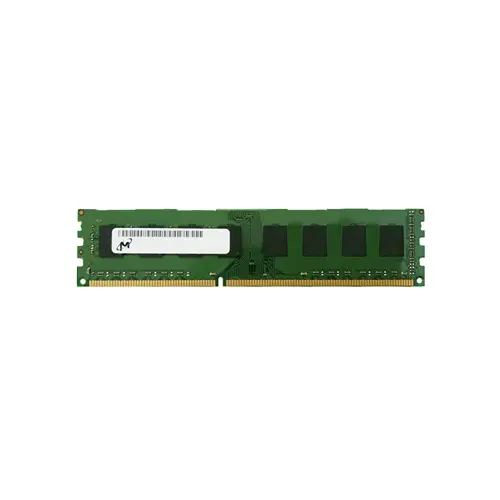
Based on its UDIMM form factor, 240-pin interface, and Non-ECC Unbuffered architecture, the Micron MT16JTF51264AZ-1G6 is unequivocally a desktop memory module. It is purpose-built for PC enthusiasts and creative professionals who demand tangible, real-world responsiveness, not just specification sheets.
The Non-ECC, Unbuffered design strips away the validation overhead found in server memory, directly translating to lower absolute latency for your processor. In a triple-A gaming scenario, this means tighter frame-time consistency and fewer micro-stutters when rapid-fire visual data is streaming from system memory to the GPU. The DDR3-1600 speed with a column access strobe latency of 11 cycles provides a responsive sweet spot for data lookups, allowing your CPU to retrieve critical textures and game logic without perceptible lag. Meanwhile, the Dual Rank x8 organization leverages bank interleaving: while one rank is flushing data, the other can begin a new access, effectively maximizing the 12.8 GB/s peak bandwidth. During a demanding 4K video render, this interleaving keeps all CPU cores fed with sequential instructions, preventing pipeline stalls and significantly shortening export times. For desktop users upgrading a legacy workstation, this memory delivers precisely the snappy multitasking and computational efficiency needed to turn a system into a reliable, budget-friendly production asset.
This non-ECC, unbuffered DDR3 240-pin UDIMM is a desktop memory module. Below are capacity planning recommendations for typical desktop workloads.
Gaming Build
For reliable dual-channel performance, populate all four DIMM slots with these 4 GB modules to reach 16 GB. This configuration eliminates mismatched latencies and handles modern titles comfortably. A 32 GB setup would require eight modules, which is impractical on most consumer boards; therefore, upgrading to a 2×16 GB DDR3 kit is advised if higher capacity is necessary.
Content Creation
Professional video editing and 3D rendering demand 64 GB or more, which cannot be assembled from 4 GB modules alone. The maximum practical arrangement with these DIMMs is 16 GB across four slots—only a baseline for light creative work. To build a full 64 GB workstation, replace them with higher‑density 8 GB or 16 GB unbuffered DIMMs across all available slots.
General Productivity
A cost‑effective dual‑channel setup using two identical 4 GB modules (8 GB total) provides smooth multitasking for office suites, web browsing and media streaming. Users who routinely run many applications or keep dozens of browser tabs open can later add another matched pair to reach 16 GB, gaining extra headroom without a complete overhaul.
Rigorously tested desktop UDIMM, compatible with Dell OptiPlex 7010, HP EliteDesk 800 G1, Lenovo ThinkCentre M92p.
Q: Can I mix this MT16JTF51264AZ-1G6 with other memory modules of different brands or speeds?
A: Mixing is possible, but for maximum stability we recommend identical speed, timings, and voltage. Different modules may force the system to downclock or cause compatibility issues.
Q: Is this memory compatible with my system?
A: This 240-pin DDR3 UDIMM fits desktops with supporting chipsets, such as Intel 6/7 Series or AMD 9 Series. Please verify your motherboard supports DDR3-1600 and dual-rank x8 modules.
Q: What is the recommended DIMM population order for optimal performance?
A: For dual-channel operation, populate identical modules in the same-colored slots first. Always consult your motherboard manual for the exact slot priority to ensure proper interleaving.
Q: Does this module support overclocking or XMP profiles?
A: No, this is a JEDEC-compliant DDR3-1600 CL11 module without XMP. It runs only at its rated speed and timings, and does not support user overclocking.
Q: What warranty and typical failure rate can I expect?
A: This module includes a one-year warranty. The typical annualized failure rate is exceptionally low, generally below 0.5% when operated within specified environmental and electrical conditions.