











 Secure payments
Standard refund policy
Trade Assurance
Secure payments
Standard refund policy
Trade Assurance
| Product Type | Memory Module |
|---|---|
| Compliance Standards | RoHS |
| Memory Capacity | 4 GB |
| Memory Technology | DDR3 |
| Product Voltage | 1.35V |
| RAM Speed | 1600MHz |
| RAM Standard | DDR3-1600/PC3-12800 |
| Error Identifying | ECC |
| Signal Type | Registered |
| Column Access Strobe (CAS) | CL11 |
| Rank | Single Rank x4 |
| Quantity of Pins | 240-pin |
| RAM Genre | RDIMM |
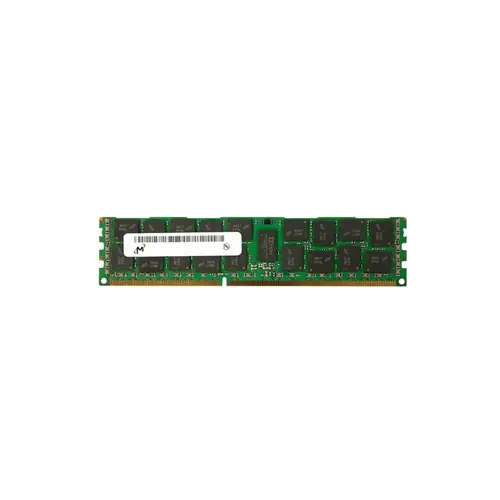
This is a server-grade DDR3-1600 Registered ECC memory module (RDIMM), purpose-built for virtualization, memory-database servers, and other enterprise workloads that demand uncompromising data integrity. The registered signal type with error-correcting code (ECC) eliminates single-bit errors in real time, while the single-rank x4 organization and low 1.35V operating voltage enhance signal integrity and reduce power draw in high-density, thermally constrained rack servers.
1. ECC memory detects and corrects single-bit errors in real time, preventing silent data corruption during long-running financial or database transactions on always-on servers.
2. Registered signal buffering stabilizes command and address lines, enabling fully populated memory channels without sacrificing reliability in dense virtualization clusters.
3. 1.35V low-voltage operation reduces thermal output and energy costs per node, directly improving power-usage efficiency in large-scale rack deployments.
4. 1600MHz speed sustains high throughput for caching and in-memory workloads, lowering query latency under heavy concurrent access by delivering predictable bandwidth.
5. Single Rank x4 organization minimizes electrical loading on the bus, preserving clean signaling and ensuring consistent latency across all DIMMs in a memory-hungry application server.
This module’s RDIMM design, ECC, and registered signaling clearly identify it as server memory built for dependability. The MT18KSF51272PZ-1G6M1FE delivers four enterprise-critical advantages. ECC correction actively prevents single-bit errors from corrupting data. In a virtualization cluster, a rogue bit flip could crash a hypervisor or silently poison a financial transaction—ECC eliminates that risk. The registered buffer decouples the memory bus from the CPU, enabling stable operation even when populating all DIMM slots; this is essential for in-memory databases like Redis, where large capacities and uptime are paramount. The 1.35V DDR3L operation cuts energy draw and heat dissipation, directly lowering total cost of ownership in dense data centers. Moreover, the single-rank x4 architecture at 1600MHz optimizes signal integrity and provides predictable bandwidth for latency-sensitive workloads such as virtualized SQL Server instances. For IT managers, these features translate directly into fewer outages, stronger data fidelity, and higher server efficiency.
General Virtualization
For light to moderate virtualization hosts, 4 GB RDIMMs offer a cost-effective entry point but are insufficient for modern hypervisors. We recommend populating at least six to eight DIMM slots per CPU to achieve 24–32 GB, ensuring enough headroom for multiple VMs without excessive swapping. Always install modules in identical sets across memory channels to maintain balanced interleaving and maximize throughput.
In-Memory Database
In-memory databases like Redis or SAP HANA demand extremely low latency and high capacity, making a single 4 GB DIMM wholly inadequate. Capacity planning should aim for a minimum of 128 GB using 16 GB or 32 GB RDIMMs, populating all channels symmetrically. Using smaller 4 GB modules would drastically increase the module count, consuming more power and reducing maximum attainable density per server.
High-Performance Computing (HPC)
HPC workloads benefit from high memory bandwidth and moderate capacity per core. While 4 GB RDIMMs can be used in very large node counts to achieve a specific GB-per-core ratio, modern clusters typically deploy 16 GB or 32 GB modules to minimize slot usage and power. If 4 GB sticks are repurposed, fill every channel with identical DIMMs to deliver peak bandwidth, and validate that the aggregate capacity meets the dataset size required per node without resorting to disk I/O.
Rigorously tested server RDIMM. Compatible with Dell PowerEdge R720/R620/R820, HP ProLiant Gen8, and Lenovo ThinkServer RD630.
Q: Can I mix this MT18KSF51272PZ-1G6M1FE with other memory modules of different brands or speeds?
A: Mixing is not recommended. RDIMMs require matched ECC characteristics. Combining different brands, speeds, or ranks may cause system instability, POST failures, or silent data corruption in server environments.
Q: Is this memory compatible with my system? I use Intel and AMD server platforms.
A: It is compatible with platforms supporting 1.35V DDR3-1600 ECC RDIMMs, such as Intel C600 series or AMD Opteron 6300/6200 chipsets. Verify your server’s Qualified Vendor List (QVL) for MT18KSF51272PZ-1G6M1FE.
Q: What is the recommended DIMM population order for optimal performance?
A: Follow your server motherboard’s manual. Typically, populate identical DIMMs per channel, starting with the primary slots (often blue or labeled DIMM_A1/B1/C1). Balance load across all memory channels for best throughput.
Q: Does this module support overclocking or XMP profiles?
A: No. This is a qualified server RDIMM adhering to JEDEC DDR3-1600 specifications. It does not support overclocking or XMP profiles, ensuring maximum reliability and data integrity.
Q: What warranty and typical failure rate can I expect?
A: This module is backed by a 1-year warranty. Enterprise-grade DDR3 RDIMMs have a very low annualized failure rate under typical operating conditions, thanks to rigorous component screening and testing.