











 Secure payments
Standard refund policy
Trade Assurance
Secure payments
Standard refund policy
Trade Assurance
| Product Type | Memory Module |
|---|---|
| Compliance Standards | RoHS |
| Memory Capacity | 4 GB |
| Memory Technology | DDR3 |
| Product Voltage | 1.5V |
| RAM Speed | 1600MHz |
| RAM Standard | DDR3-1600/PC3-12800 |
| Error Identifying | ECC |
| Signal Type | Registered |
| Column Access Strobe (CAS) | CL11 |
| Rank | Single Rank x4 |
| Quantity of Pins | 240-pin |
| RAM Genre | RDIMM |
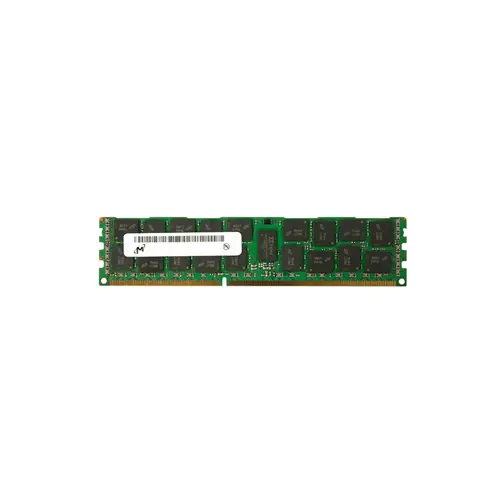
This is a server-class DDR3-1600 Registered ECC DIMM, ideally suited for virtualization hosts and in-memory databases that demand uncompromising data integrity. The single-rank x4 organization and registered signaling deliver stable, high-efficiency operation in multi-DIMM configurations while ECC corrects single-bit errors to prevent costly downtime.
1. ECC protection silently corrects single-bit errors, safeguarding financial transactions and database integrity against silent data corruption that could crash critical workloads.
2. Registered signal buffering stabilizes high-density server configurations, allowing multiple DIMMs per channel without compromising command integrity under sustained memory pressure.
3. A four-gigabyte capacity per stick suits lightweight hypervisor deployments and dedicated caching appliances, balancing density with cost for scale-out node architectures.
4. 1600MHz clock speed delivers solid memory bandwidth for moderate throughput tasks like web serving and mid-tier application processing without creating thermal spikes.
5. Single Rank x4 organization reduces electrical loading on the memory bus, enabling fully populated server nodes to maintain rated speed without throttling back latency timings.
In virtualized clusters, a single bit flip can crash multiple VMs. This 4GB DDR3-1600 RDIMM’s ECC detects and corrects errors instantly, preserving data integrity where real-time correction is non-negotiable. Its registered buffer isolates the memory controller from electrical load, letting you install more DIMMs per channel without signal degradation—vital for large memory pools backing in-memory databases like Redis or SAP HANA, where capacity directly influences transaction throughput. The 1600MHz clock and single-rank x4 architecture deliver 12.8 GB/s bandwidth with reduced bus loading, slashing query latency and speeding page swaps in dense virtual environments. Operating at 1.5V, it minimizes thermal stress for continuous uptime. For your mission-critical servers, this means fewer hardware errors, consistent performance, and a stable, scalable foundation for heavy workloads.
Server Capacity Planning with 4GB DDR3-1600 ECC Registered DIMMs
The specified module—a 4GB DDR3-1600 RDIMM with ECC and CL11—is designed for servers and workstations that require data integrity and multi-channel memory architectures. The following guidance applies to three common server workloads.
General Virtualization
For hypervisors running multiple virtual machines, populate all memory channels evenly with identical modules to enable interleaving and maximize bandwidth. Using six or eight of these 4GB RDIMMs (24–32GB total) on a dual-socket platform comfortably supports 10–15 light VMs. Always balance DIMMs across channels to avoid performance bottlenecks.
In-Memory Database
In-memory databases thrive on capacity and low latency. As 4GB modules limit total capacity, populate every available slot to reach the highest node capacity—for example, 12 modules (48GB) on a three-channel board. This configuration suits small Redis or Memcached instances; for larger datasets, consider higher-density RDIMMs while keeping 1600MT/s and ECC.
High Performance Computing (HPC)
HPC workloads demand maximum memory bandwidth and reliability. Install a 1-DIMM-per-channel configuration (e.g., four modules on a quad-channel platform) to maintain full 1600MT/s speed. A total of 16GB suffices for many compute-bound jobs, and ECC protects against silent data corruption during long-running simulations.
Rigorously tested server memory, compatible with Dell PowerEdge R720, HP DL380p Gen8, and similar systems.
Q: Can I mix this MT18JSF51272PZ-1G6M1 with other memory modules of different brands or speeds?
A: Mixing registered ECC RDIMMs of different brands or speeds is not recommended. Such combinations may cause signal integrity issues, instability, or the system defaulting to the lowest speed, compromising server reliability.
Q: Is this memory compatible with my system?
A: This DDR3-1600 ECC Registered DIMM is compatible with servers using Intel Xeon E5-2600 series or AMD Opteron 6300/4300 platforms. Please verify your motherboard supports 240-pin RDIMMs and 1.5V operation.
Q: What is the recommended DIMM population order for optimal performance?
A: For optimal performance, install identical DIMMs in each memory channel following the server board’s population guidelines. Typically, populate far channels first and match blue or black slots, balancing across CPU memory controllers.
Q: Does this module support overclocking or XMP profiles?
A: No, this is a server-grade registered DIMM. It operates strictly at JEDEC standard DDR3-1600 with CL11 timing and does not support overclocking or XMP profiles. Enterprise reliability is prioritized over enthusiast tuning.
Q: What warranty and typical failure rate can I expect?
A: This module carries a 1-year warranty. As a Micron-quality ECC RDIMM, it demonstrates a very low annualized failure rate, typically well below 0.5%, ensuring exceptional long-term stability in data center environments.