











 Secure payments
Standard refund policy
Trade Assurance
Secure payments
Standard refund policy
Trade Assurance
| Product Type | Memory Module |
|---|---|
| Compliance Standards | RoHS |
| Memory Capacity | 4 GB |
| Memory Technology | DDR3 |
| Product Voltage | 1.35V |
| RAM Speed | 1600MHz |
| RAM Standard | DDR3-1600/PC3-12800 |
| Error Identifying | ECC |
| Signal Type | Registered |
| Column Access Strobe (CAS) | CL11 |
| Rank | Dual Rank x8 |
| Quantity of Pins | 240-pin |
| RAM Genre | RDIMM |
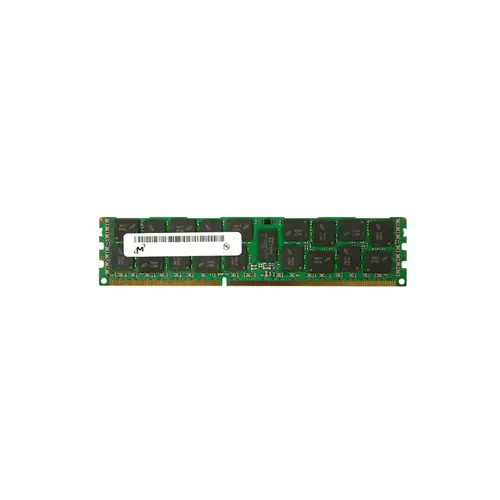
This Micron RDIMM is engineered for server platforms requiring robust data integrity, with ECC and registered signal buffering that enhance stability in memory-intensive workloads such as virtualization, in-memory databases, and multi-tenant hosting environments. Its dual-rank x8 configuration at 1600MHz and low 1.35V operating voltage optimizes channel utilization and thermal efficiency, while CL11 latency and 240-pin DDR3-1600/PC3-12800 compliance ensure reliable, field-tested performance in enterprise-class deployments.
1. ECC protection silently corrects single-bit memory errors, preserving data integrity for mission-critical enterprise workloads and preventing costly server downtime.
2. Registered signal buffering stabilizes command and address lines under heavy load, enabling massive memory populations essential for large-scale virtualization hosts.
3. Dual Rank x8 organization interleaves memory accesses across two internal ranks per channel, boosting effective bandwidth for database queries and in-memory analytics.
4. 1.35V low-voltage operation slashes power consumption per DIMM, directly reducing cooling overhead and energy bills in dense rack deployments.
5. 1600MHz clock speed delivers a substantial peak transfer rate that accelerates concurrent transaction processing and reduces latency in heavily consolidated environments.
The MT18KSF51272PDZ-1G6K1 is a server-class DDR3 Registered DIMM built to solve the real pain points of data centers. Its ECC actively corrects single-bit errors before they become silent corruption. In a VMware vSphere cluster, a cosmic ray flipping a hypervisor memory page can silently cascade through multiple virtual machines, corrupting file systems and triggering unplanned failovers. ECC eliminates this risk, preserving uptime for your virtualized workloads. The registered buffer isolates the electrical load, letting you populate every slot in a high-density node without signal degradation — non-negotiable when a single SAP HANA instance demands hundreds of gigabytes of perfectly stable RAM. Dual Rank x8 architecture leverages bank interleaving to offset the CAS 11 latency, sustaining 1600 MT/s bandwidth under heavy concurrency. For an in-memory database like Redis processing millions of queries, this keeps tail latency predictable and transaction integrity rock-solid. Meanwhile, the 1.35V low-voltage operation cuts memory power draw by roughly 20 percent versus legacy 1.5V modules. In a rack packed with 512 GB of RAM, that saving directly lowers cooling overhead and extends component lifespan, helping you meet efficiency targets without compromising performance. This memory makes data integrity and energy efficiency non-negotiable.
General Virtualization
Populate every memory channel identically using these 4 GB RDIMMs to achieve balanced interleaving and predictable VM performance. For a dual‑socket server with three channels per CPU, six modules provide 24 GB; scaling to twelve (48 GB) or eighteen (72 GB) comfortably hosts 10–20 typical virtual machines. The 1.35 V operation lowers power draw, critical for always‑on virtualization hosts.
In‑Memory Database
Install at least two DIMMs per channel to maximize bandwidth, which directly accelerates in‑memory index scans and transaction commits. A 64 GB working set can be met with sixteen 4 GB modules evenly distributed across four channels, maintaining full 1600 MT/s speed. ECC and registered signaling safeguard data integrity under heavy write loads.
High‑Performance Computing
Configure one 4 GB RDIMM per channel to sustain peak bandwidth with minimum latency variation—ideal for memory‑bandwidth‑bound HPC code. While per‑node capacity stays modest (e.g., 24 GB across six channels), many simulations and solvers prioritize throughput over capacity. The low‑voltage design also reduces thermal burden in dense cluster nodes, improving rack‑level energy efficiency.
Validated server-grade compatibility: rigorously tested with Dell PowerEdge R720, HP ProLiant DL380p Gen8, IBM System x3650 M4, and more.
Q: Can I mix this MT18KSF51272PDZ-1G6K1 with other memory modules of different brands or speeds?
A: Mixing modules is not recommended for servers. Registered ECC DIMMs require matched ranks, timing, and voltage. Mismatched specs may cause instability or force the system to downgrade to the lowest common speed.
Q: Is this memory compatible with my Intel Xeon or AMD EPYC server platform?
A: Compatibility depends on your server's DDR3 memory support and chipset. This RDIMM is designed for Intel Xeon E5-series and legacy AMD Opteron platforms using 240-pin DDR3 slots. Verify your board's qualified vendor list.
Q: What is the recommended DIMM population order for optimal performance?
A: Populate identical DIMMs per channel, starting with the farthest slot from the CPU. Balance capacity across channels and match ranks. Consult your server manual for specific slot numbering to maximize interleaving and bandwidth.
Q: Does this module support overclocking or XMP profiles?
A: No. This is a server-grade Registered ECC DIMM running at standard JEDEC DDR3-1600. It does not support XMP or overclocking, as stability and data integrity are prioritized over frequency adjustment.
Q: What warranty and typical failure rate can I expect?
A: This product includes a one-year warranty. Enterprise RDIMMs typically exhibit an annualized failure rate below 0.5% when operated within specified thermal and voltage ranges. Firmware updates and proper cooling reduce in-field failures.