











 Secure payments
Standard refund policy
Trade Assurance
Secure payments
Standard refund policy
Trade Assurance
| Product Type | Memory Module |
|---|---|
| Compliance Standards | RoHS |
| Memory Capacity | 4 GB |
| Memory Technology | DDR3 |
| Product Voltage | 1.35V |
| RAM Speed | 1600MHz |
| RAM Standard | DDR3-1600/PC3-12800 |
| Error Identifying | ECC |
| Signal Type | Registered |
| Column Access Strobe (CAS) | CL11 |
| Rank | Single Rank x4 |
| Quantity of Pins | 240-pin |
| RAM Genre | RDIMM |
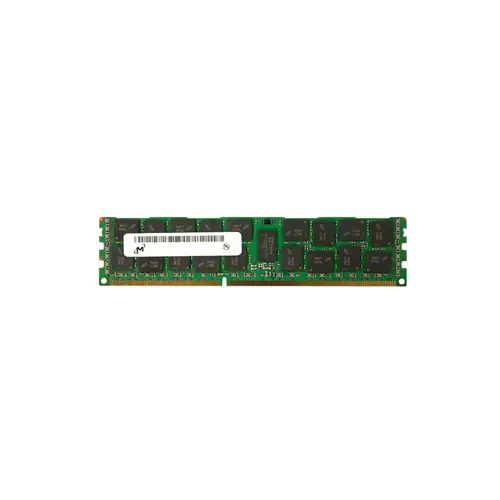
This 4GB DDR3-1600 Registered ECC RDIMM, operating at a power-efficient 1.35V, delivers uncompromising data integrity for server environments running virtualization and in-memory database workloads. Its single-rank x4 configuration and registered signaling reduce electrical loading on the memory bus, improving signal stability and allowing higher module density in enterprise platforms.
1. ECC memory detects and corrects in-flight bit errors, preserving data integrity for mission-critical virtualized workloads where even a single flipped bit can corrupt financial or scientific results.
2. Registered buffering stabilizes address and command signals across fully populated server channels, enabling dense memory configurations essential for high-capacity virtualization hosts.
3. Low-voltage operation slashes per-DIMM power consumption and cooling overhead, directly improving energy efficiency in large-scale rack deployments and lowering total cost of ownership.
4. Fast memory throughput accelerates in-memory databases and cache-heavy applications, reducing transaction latencies when concurrent enterprise users query shared datasets.
5. Single Rank x4 organization minimizes electrical load per rank, giving system builders the headroom to populate all channels at rated speed without compromising signal integrity or clock stability.
The Micron MT18KSF51272PZ-1G6 is a 4GB DDR3-1600 registered DIMM engineered specifically for server environments, and its four defining characteristics directly address the realities of enterprise computing. ECC protection actively corrects single-bit memory errors caused by cosmic radiation or electrical noise, which in a virtualization cluster running dozens of virtual machines means the difference between a silent data corruption that propagates into a backup and a stable, trustworthy hypervisor. The registered signal buffer stabilizes address and command lines when multiple DIMMs populate a server board, allowing you to scale memory capacity without sacrificing signal integrity—critical for memory-hungry in-memory databases like Redis or SAP HANA where every millisecond of latency degrades transaction throughput. Operating at 1.35V instead of the standard 1.5V significantly reduces power consumption per DIMM across a fully populated rack, directly lowering your cooling overhead and operating expenditure in a 24/7 data center. The single-rank x4 organization balances bandwidth and bank utilization, delivering consistent 1600MT/s throughput under the random, small-block access patterns typical of database indexing and OLTP workloads. For IT managers overseeing dense server deployments, this module turns abstract specs into measurable uptime, energy savings, and predictable performance.
Based on the provided specifications—DDR3-1600, ECC Registered RDIMM, 1.35V—this is a server memory module designed for stability and data integrity in enterprise environments. Below is the capacity planning guidance for typical server workloads using this 4 GB module.
General Virtualization
Virtualized hosts rely on ample RAM to avoid resource contention among VMs. Start with a minimum of eight modules (32 GB) for light to moderate consolidation, populating all memory channels evenly to maximise bandwidth. For production clusters, scale to sixteen modules (64 GB) to comfortably run 10–15 average VMs per node while leaving headroom for ballooning and failover.
In-Memory Database
Datasets must reside entirely in RAM for performance, making capacity critical. Consolidate the largest available DIMM count your server supports—typically twelve or sixteen of these 4 GB modules for 48–64 GB—to hold moderate key-value stores or caching layers. For larger datasets, consider higher-capacity RDIMMs, but always enforce ECC protection to prevent in-memory data corruption, which is non-negotiable for transactional consistency.
High-Performance Computing (HPC)
HPC workloads like simulation or finite-element analysis demand both bandwidth and capacity. Populate all memory channels with identical 4 GB RDIMMs to sustain balanced throughput; a dual-socket node with twelve modules (48 GB) suits many parametric sweeps. For dense MPI ranks, double to twenty-four modules (96 GB) per node, monitoring thermal limits and using the 1.35V low-voltage operation to reduce power overhead per compute rack.
Rigorously tested registered DDR3 server memory. Compatible with Dell PowerEdge R720/R620, HP DL380p Gen8, and Supermicro X9 systems.
Q: Can I mix this MT18KSF51272PZ-1G6 with other memory modules of different brands or speeds?
A: Mixing RDIMMs of different brands, speeds, or ranks is not recommended. Doing so may cause signal integrity issues or system instability. For reliable server operation, all modules should be identical in specification and part number.
Q: Is this memory compatible with my Intel or AMD server platform?
A: This DDR3-1600 Registered ECC module is designed for servers supporting Intel Xeon E5-2400/2600 v1/v2 or AMD Opteron 6300 series. Verify your motherboard’s qualified vendor list (QVL) to ensure proper compatibility with 1.35V RDIMMs.
Q: What is the recommended DIMM population order for optimal performance?
A: Follow your server board’s manual for slot numbering. Typically, populate identical DIMMs per channel starting from the farthest slot from the CPU. For example, in a three-channel platform, install in slots A1, B1, and C1 first to maximize bandwidth.
Q: Does this module support overclocking or XMP profiles?
A: No. This is a JEDEC-standard Registered ECC memory. It does not support overclocking, XMP, or any timing enhancements. It operates strictly at the specified 1600MHz with CL11 latency to ensure data integrity in enterprise environments.
Q: What warranty and typical failure rate can I expect?
A: This module includes a one-year warranty. As a rigorously tested enterprise RDIMM, it offers extremely low annualized failure rates, typically less than 0.2%, and a high MTBF, exceeding 2 million hours under specified conditions.