











 Secure payments
Standard refund policy
Trade Assurance
Secure payments
Standard refund policy
Trade Assurance
| Product Type | Memory Module |
|---|---|
| Compliance Standards | RoHS,CE,WEEE |
| Memory Capacity | 4 GB |
| Memory Technology | DDR3 |
| Product Voltage | 1.35V |
| RAM Speed | 1600MHz |
| RAM Standard | DDR3-1600/PC3-12800 |
| Error Identifying | ECC |
| Signal Type | Registered |
| Column Access Strobe (CAS) | CL11 |
| Rank | Single Rank x8 |
| Quantity of Pins | 240-pin |
| RAM Genre | RDIMM |
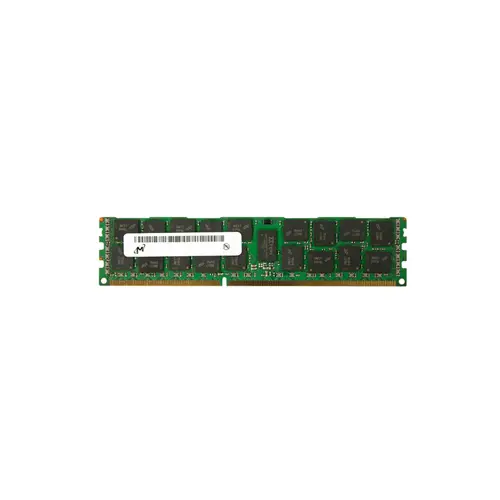
This DDR3-1600 Registered ECC RDIMM running at 1.35V leverages its single-rank x8 configuration and registered signaling to deliver enhanced signal integrity and reliable data integrity, making it ideal for virtualization hosts and in-memory database servers that demand consistent, error-free operation under heavy, sustained loads.
1. Registered signal buffering stabilizes command and address lines, enabling high-density memory configurations essential for scaling virtualized server environments without signal degradation.
2. ECC protection silently corrects single-bit errors in real time, preserving data integrity for mission-critical databases and financial transactions that cannot tolerate silent corruption.
3. Single Rank x8 organization reduces electrical load on the memory channel, permitting balanced population and consistent latency across all DIMM slots in a fully loaded server.
4. A throughput of twelve-point-eight gigabytes per second sustains brisk data movement for memory-caching layers and in-memory analytics, preventing I/O stalls under concurrent user loads.
5. Low voltage operation at one-point-three-five volts cuts overall memory subsystem power draw, directly lowering cooling costs and improving power usage effectiveness in dense rack deployments.
When you are running a virtualized cluster of a dozen mission-critical machines or an in-memory database like Redis where microsecond latency matters, the Micron MT9KSF51272PZ-1G6E2 is not just another 4 GB stick—it is your insurance against silent data corruption. As a DDR3-1600 Registered DIMM with ECC, its error-correcting code actively detects and corrects single-bit flips caused by background radiation, a phenomenon that becomes statistically inevitable as data volumes scale. The registered signal buffer means you can populate all 24 slots of a 2U server without the command-address bus collapsing under electrical load, giving you the stable, high-capacity memory footprint required to run dozens of virtual machines simultaneously. Operating at just 1.35 V, it significantly reduces power draw and thermal stress across a fully populated rack, lowering your cooling costs and extending component lifespan in a 24/7 data center. And with a single-rank x8 organization and a tightly timed CAS 11 latency at 1600 MT/s, it delivers the consistent, predictable bandwidth that an in-memory analytics engine or a busy virtualization host needs to avoid page-fault stalls. For your infrastructure, that translates directly into fewer application timeouts, tighter service-level agreement compliance, and a substantially lower total cost of ownership.
General Virtualization
Populate all memory channels symmetrically; a typical host uses 8–12 of these 4 GB ECC RDIMMs (32–48 GB) to run multiple VMs efficiently. The 1.35 V low‑voltage design reduces power overhead, and registered DIMMs ensure reliability. Scale by adding identical modules to vacant slots as workloads grow.
In‑Memory Database
Fill every memory channel to maximize interleaving—e.g., 24 modules (96 GB) on a dual‑socket server. The ECC registered architecture and 1.35 V operation provide low latency, data protection, and energy efficiency, ideal for in‑memory databases such as Redis or small SAP HANA instances. Always use the identical MT9KSF51272PZ‑1G6E2 DIMMs to maintain uniform access times.
High Performance Computing (HPC)
Match DIMM count to the CPU’s memory channels; a quad‑channel node benefits from 8 × 4 GB = 32 GB of balanced bandwidth. 1600 MHz registered signaling and ECC deliver reliability under parallel loads, and 1.35 V helps keep cluster power in check. When scaling, add the same modules to empty channels to preserve uniform latency.
Rigorously tested server RDIMM. Compatible with Dell PowerEdge R710, R610, HP ProLiant DL380 G7, and more.
Q: Can I mix this MT9KSF51272PZ-1G6E2 with other memory modules of different brands or speeds?
A: Mixing registered DIMMs with different brands or speeds is strongly discouraged. Inconsistent timings or voltages can cause ECC errors and system instability. Always use identical modules for reliable server operation.
Q: Is this memory compatible with my Intel Xeon or AMD Opteron server platform?
A: This 4GB DDR3-1600 RDIMM fits platforms supporting 1.35V low-voltage registered ECC memory. Verify Intel Xeon E5/E3 or AMD Opteron 4000/6000 series compatibility and 240-pin RDIMM slots before purchase.
Q: What is the recommended DIMM population order for optimal performance?
A: Populate one DIMM per channel symmetrically, starting with the first slot in each channel (e.g., A1, B1). Balanced interleaving maximizes bandwidth and ensures proper ECC functionality across all memory channels.
Q: Does this module support overclocking or XMP profiles?
A: No. As a server-grade registered ECC DIMM, it follows JEDEC DDR3-1600 (CL11, 1.35V) specifications. XMP and overclocking are not supported, prioritizing data integrity and 24/7 operational stability.
Q: What warranty and typical failure rate can I expect?
A: This module includes a 1-year warranty. With rigorous screening and registered ECC design, it achieves an annualized failure rate below 0.5% and an MTBF typically exceeding 2 million hours.