











 Secure payments
Standard refund policy
Trade Assurance
Secure payments
Standard refund policy
Trade Assurance
| Product Type | Memory Module |
|---|---|
| Compliance Standards | RoHS |
| Memory Capacity | 4 GB |
| Memory Technology | DDR3 |
| Product Voltage | 1.35V |
| RAM Speed | 1600MHz |
| RAM Standard | DDR3-1600/PC3-12800 |
| Error Identifying | ECC |
| Signal Type | Registered |
| Column Access Strobe (CAS) | CL11 |
| Rank | Single Rank x8 |
| Quantity of Pins | 240-pin |
| RAM Genre | RDIMM |
This DDR3-1600 Registered ECC memory module is engineered for legacy server platforms where data integrity is critical, making it ideal for virtualization hosts and in-memory database applications that demand stable, error-free operation. Its 1.35V low-voltage design and Registered signal type ensure reduced power consumption and enhanced signal stability across fully populated memory channels, while the single-rank x8 configuration optimizes memory controller load for balanced performance.
1. ECC detects and corrects single-bit memory errors in real time, preventing silent data corruption in transactional databases and virtualized workloads.
2. The registered buffer reduces electrical loading on the memory controller, allowing servers to fully populate DIMM slots for maximum virtualization density without signal degradation.
3. 4 GB per module offers finely granular capacity expansion, enabling data centers to right-size VM memory allocation and avoid costly overprovisioning.
4. 1600 MHz data rate sustains predictable throughput across multiple concurrently running VMs, ensuring consistent application responsiveness under consolidation.
5. Operating at 1.35V cuts overall power consumption and lowers thermal output in dense rack deployments, directly reducing infrastructure cooling costs.
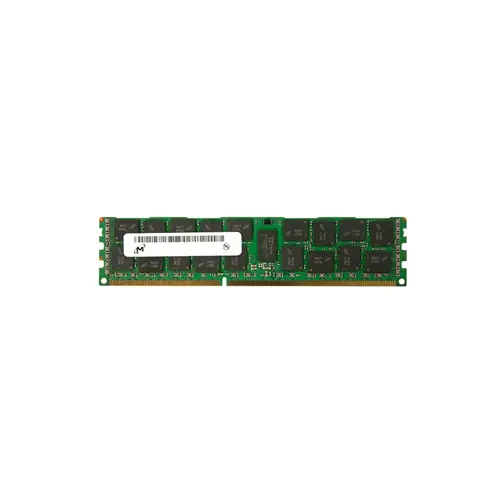
Engineered specifically for enterprise servers, the Micron MT9KSF51272PZ-1G6E2HE RDIMM directly addresses the relentless demands of data center environments. Its ECC technology is non-negotiable for virtualized clusters: a single undetected bit flip in a hypervisor hosting dozens of virtual machines can silently corrupt guest operating systems, leading to cascading failures and costly downtime. The registered architecture buffers signal distribution, enabling multiple DIMMs per channel without compromising stability. This scalability is vital for in-memory databases like Redis or SAP HANA, where terabytes of mission-critical hot data must remain instantly accessible and impeccably intact; the driver eliminates electrical loading concerns that plague unbuffered modules at scale. Equally important, operating at a low 1.35V significantly reduces thermal output and power draw. When multiplied across a densely populated rack running 24/7, that incremental efficiency yields considerable savings on cooling and energy. With a 1600 MT/s throughput and a single-rank x8 construction, the module delivers consistent, low-latency performance for real-time analytics, ensuring that your infrastructure remains responsive under peak concurrency while never gambling with data integrity.
General Virtualization
For a hypervisor hosting multiple VMs, stability and balanced capacity are essential. Populate at least six to eight of these 4GB RDIMMs per CPU to deliver 24GB or 32GB, striking a cost-effective balance for moderate VM density. Always install modules in identical sets across all memory channels (e.g., one or two DIMMs per channel) to maintain memory interleaving and full ECC protection.
In-Memory Database
Databases like Redis or SAP HANA require maximum capacity and low latency. Maximize total RAM by fully populating every available DIMM slot with these 4GB modules; a dual-socket server with 24 slots can reach 96GB. Use a balanced, uniform configuration across memory controllers and respect NUMA boundaries to avoid remote memory access penalties, ensuring consistent query performance.
High-Performance Computing (HPC)
HPC applications depend on aggregate memory bandwidth. Install one or two of these single-rank 1600MHz RDIMMs per channel across all memory channels to achieve optimal interleaving and peak throughput. While the 4GB capacity limits per-node memory, their low-voltage 1.35V operation makes them well-suited for building dense, energy-efficient cluster nodes handling parallel simulation workloads.
Validated for Dell R720, HP DL380p Gen8, Lenovo x3650 M4; rigorously tested server memory.
Q: Can I mix this MT9KSF51272PZ-1G6E2HE with other memory modules of different brands or speeds?
A: Mixing RDIMMs of different brands or speeds is not recommended on server platforms. It may cause POST failures or instability. Always populate identical modules for reliable operation.
Q: Is this memory compatible with my system? Which Intel or AMD platforms are supported?
A: This DDR3L-1600 ECC Registered DIMM is validated for servers using Intel Xeon E5-2600 v2 series or AMD Opteron 6300 series processors. Verify your board supports 1.35V RDIMMs.
Q: What is the recommended DIMM population order for optimal performance?
A: For optimal performance, populate identical DIMMs per channel starting with the slot farthest from the CPU. Follow your server board's manual for balancing memory across channels.
Q: Does this module support overclocking or XMP profiles?
A: No, this server-grade RDIMM does not support overclocking or XMP. It operates strictly at JEDEC standard DDR3-1600 timings for maximum reliability in enterprise environments.
Q: What warranty and typical failure rate can I expect?
A: This module carries a 1-year warranty. It is engineered for enterprise reliability with a typical annualized failure rate (AFR) well under 0.5% under normal operating conditions.