











 Secure payments
Standard refund policy
Trade Assurance
Secure payments
Standard refund policy
Trade Assurance
| Product Type | Memory Module |
|---|---|
| Compliance Standards | RoHS |
| Memory Capacity | 4 GB |
| Memory Technology | DDR3 |
| Product Voltage | 1.35V |
| RAM Speed | 1600MHz |
| RAM Standard | DDR3-1600/PC3-12800 |
| Error Identifying | ECC |
| Signal Type | Registered |
| Column Access Strobe (CAS) | CL11 |
| Rank | Single Rank x8 |
| Quantity of Pins | 240-pin |
| RAM Genre | RDIMM |
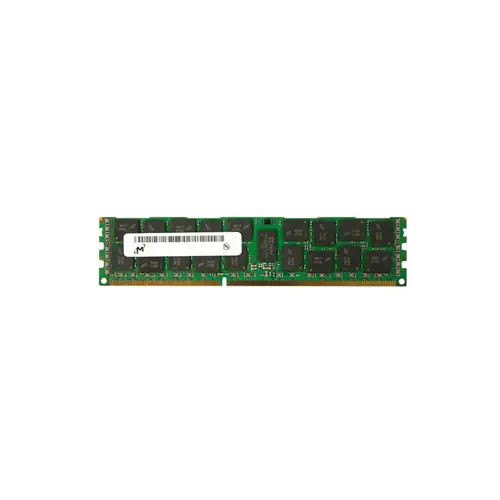
This Micron 4GB DDR3-1600 Registered ECC RDIMM is engineered for entry-level server platforms where data integrity and uptime are critical, leveraging Error Correcting Code (ECC) and a registered signal type to stabilize high-density memory configurations under continuous operation. Its 1.35V low-voltage operation and single-rank x8 organization make it an energy-efficient choice for small-scale virtualization hosts or light in-memory database workloads that demand reliable, consistent performance without excessive power draw.
1. ECC protection actively corrects single-bit errors in real time, safeguarding transactional data integrity for mission-critical databases and financial workloads.
2. Registered signal buffering stabilizes command and address lines at high densities, enabling a server to populate all memory channels without signal degradation during massive virtualization.
3. Low 1.35V operation slashes power consumption across a rack full of nodes, directly lowering cooling costs and improving energy efficiency in always-on data centers.
4. The 1600MHz clock speed delivers a peak transfer rate of 12.8 GB/s, accelerating in-memory caching and reducing latency for read-heavy enterprise applications.
5. A 4 GB capacity module suits lightweight hypervisor deployments or dedicated appliances, where predictable, isolated memory provisioning is more critical than raw density.
When you deploy this MT9KSF51272PZ-1G6P1 RDIMM in your data center, you are not just installing a 4 GB DDR3 module—you are safeguarding business continuity. It is engineered for servers, and four attributes make that real. First, ECC actively corrects single-bit memory errors caused by cosmic radiation or electrical noise, preventing silent data corruption that could crash virtualized clusters or corrupt transactional databases mid-commit. Second, the registered signal buffer stabilizes command and address lines across fully loaded memory channels, meaning you can populate all 24 DIMM slots and run dense virtual machines without timing failures. Third, the single-rank x8 organization paired with 1600 MHz speed delivers the consistent low latency required by in-memory databases like Redis; every nanosecond saved in cache access directly accelerates customer-facing response times. Finally, the 1.35 V low-voltage operation dramatically shrinks power and cooling costs across a fleet of hundreds of nodes, letting you meet sustainability targets while keeping your virtualization platform and real-time analytics workloads rock-solid around the clock.
General Virtualization
For a basic virtualization host, a balanced memory configuration is critical. Deploy these 4 GB RDIMMs in multiples of three or four per channel to leverage triple-channel or quad-channel architectures, starting with 24 GB to 48 GB total. This allows you to allocate 4–8 GB per light to medium VM while keeping a healthy reserve for the hypervisor overhead.
In-Memory Database
In-memory databases demand the lowest latency and absolute data integrity, which ECC registered memory naturally provides. Populate all available DIMM slots with these single-rank modules, typically 12 or 16 sticks for 48 GB or 64 GB, to maximize bandwidth and capacity. Avoid mixing ranks per channel to prevent controller load, and plan for a 1:8 core-to-GB ratio for datasets that must reside completely in RAM.
High-Performance Computing
HPC workloads benefit from fully populating each memory channel with identical 4 GB RDIMMs to sustain maximum memory bandwidth per node. A common build uses eight modules per socket for 32 GB, perfectly matching many dual-socket, medium-scale cluster nodes. For memory-bandwidth-bound simulations, this uniform single-rank configuration reduces access conflicts and ensures predictable, low-latency performance under heavy parallel loads.
Proven compatible after rigorous testing with Dell PowerEdge R720, HP ProLiant DL380p Gen8, Lenovo ThinkServer RD430.
Q: Can I mix this MT9KSF51272PZ-1G6P1 with other memory modules of different brands or speeds?
A: Mixing is strongly discouraged for Registered ECC memory. Mismatched brands or speeds may cause signal integrity issues and system instability. Always install identical modules with the same rank, voltage, and timings for validated reliability.
Q: Is this memory compatible with my Intel Xeon E5-2600 v2 / AMD Opteron 6300 series server?
A: This DDR3-1600 RDIMM is compatible with platforms supporting 1.35V low-voltage Registered ECC memory. It fits Intel Xeon E5-2600 v1/v2 and AMD Opteron 6300/6200 series processors using a C600 or SR5690 chipset. Verify your board supports 240-pin RDIMMs.
Q: What is the recommended DIMM population order for optimal performance?
A: Populate identical DIMMs per memory channel starting with the slot farthest from the CPU. For dual-processor servers, balance memory across both sockets. Follow your server manual’s population guide—typically fill blue slots first, then black, to enable memory interleaving.
Q: Does this module support overclocking or XMP profiles?
A: No. As a JEDEC-compliant server Registered DIMM, it operates strictly at 1600MHz CL11 with no overclocking or XMP support. Stability and data integrity take priority over performance tuning in enterprise environments.
Q: What warranty and typical failure rate can I expect?
A: This module comes with a 1-year warranty. The validated mean time between failures (MTBF) exceeds 2 million hours under normal operating conditions. Field failure rates are typically below 0.3% annually, backed by strict RoHS-compliant manufacturing.