











 Secure payments
Standard refund policy
Trade Assurance
Secure payments
Standard refund policy
Trade Assurance
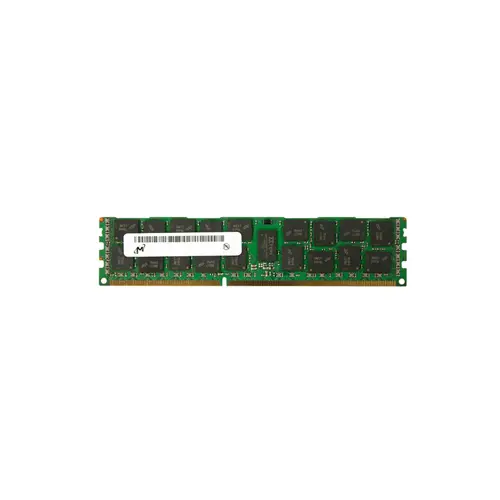
| Model | MT18JSF51272PDZ-1G6K |
|---|---|
| Product Type | Memory Module |
| Compliance Standards | RoHS |
| Memory Capacity | 4 GB |
| Memory Technology | DDR3 |
| Product Voltage | 1.5V |
| RAM Speed | 1600MHz |
| RAM Standard | DDR3-1600/PC3-12800 |
| Error Identifying | ECC |
| Signal Type | Registered |
| Column Access Strobe (CAS) | CL11 |
| Rank | Dual Rank x8 |
| Quantity of Pins | 240-pin |
| RAM Genre | RDIMM |
This Micron 4GB DDR3-1600 RDIMM, with its Registered signal type and ECC, is engineered for legacy server environments where data integrity under sustained loads is critical, such as in virtualization hosts and in-memory databases. Its dual-rank x8 configuration improves memory interleaving efficiency, while the 1600MHz speed at CL11 provides a stable balance between latency and bandwidth for 24/7 operation.
1. ECC protection silently corrects single-bit errors in real time, safeguarding transactional databases from silent data corruption during years of continuous uptime.
2. Registered buffering stabilizes electrical loads on the command bus, allowing dense multi-DIMM populations that maximize virtualization node density without signal degradation.
3. A targeted capacity tier serves firmware-embedded hypervisors or dedicated container hosts efficiently, leaving room for more compute instances per rack while keeping memory overhead strictly partitioned.
4. Dual rank interleaved addressing saturates the memory channel with pipelined operations, eliminating fetch bubbles and sustaining throughput during simultaneous live migration of multiple VMs.
5. Mainstream DDR3 clocking delivers deterministic latency and bandwidth perfectly matched to legacy enterprise middleware, ensuring seamless integration into validated server platforms with zero surprise failures.
For your server infrastructure, the Micron MT18JSF51272PDZ-1G6K 4GB DDR3-1600 RDIMM is not just memory—it is a safeguard for mission-critical workloads. Its four defining traits directly address your real-world pain points. First, ECC continuously detects and corrects single-bit errors, preventing silent data corruption that could crash a virtual machine or compromise a financial transaction in your in-memory database. Second, the Registered buffer decouples the electrical load, letting you populate all channels with maximum DIMMs; in a dense virtualization cluster, this stability sustains hundreds of VMs without signal degradation. Third, the dual-rank organization interleaves access across internal banks, boosting bandwidth efficiency and slashing latency for data-hungry applications like SAP HANA. Finally, the 1600MHz speed with CL11 timing guarantees a predictable, responsive foundation where every microsecond matters during peak query loads. This means fewer application errors, uncompromised uptime, and consistent performance when your business relies on real-time data—translating into trust and operational continuity.
General Virtualization
For a typical virtualization host running multiple lightweight VMs, populate at least six to eight of these 4GB RDIMMs for a total of 24–32GB. Distribute modules evenly across memory channels to maximize throughput and use identical dual-rank DIMMs per channel for stable registered ECC operation.
In-Memory Database
In-memory databases demand both capacity and fault tolerance, so install a full set of 12 or more modules to reach 48GB and beyond. Populate all memory channels symmetrically with this dual-rank x8 RDIMM to sustain low latency under heavy caching and reduce memory-side stalls.
High-Performance Computing
HPC nodes benefit from maximum bandwidth; fill every channel with one of these 1600MHz CL11 DIMMs. A common configuration is 16 modules for 64GB per node, matching the dual-rank design to the memory controller’s interleaving preferences and ensuring ECC reliability during long compute runs.
Tested rigorously for server compatibility with Dell PowerEdge R720, HP ProLiant DL380p Gen8, Lenovo ThinkServer RD630.
Q: Can I mix this MT18JSF51272PDZ-1G6K with other memory modules of different brands or speeds?
A: Mixing is not recommended. Registered ECC modules require matched ranks and timings. Using mismatched DIMMs may cause POST failures or instability. Always populate with identical part numbers for validated server reliability.
Q: Is this memory compatible with my server system? What platforms does it support?
A: This DDR3-1600 RDIMM is compatible with Intel Xeon E5-2600 v2 and AMD Opteron 6300 series platforms using the C602/C604 chipsets. Verify your server board’s Qualified Vendor List (QVL) for this specific 4GB ECC module.
Q: What is the recommended DIMM population order for optimal performance?
A: Follow your server motherboard manual. Typically, populate identical DIMMs per channel starting with the primary slot (DIMM_A1). For dual-rank modules like this, balance memory across memory channels to maintain interleaving and maximum throughput.
Q: Does this module support overclocking or XMP profiles?
A: No. As a server-grade Registered ECC DIMM, it adheres to JEDEC DDR3-1600 (PC3-12800) with fixed CL11 latency. It does not support overclocking or XMP, prioritizing data integrity and 24/7 operational stability.
Q: What warranty and typical failure rate can I expect for this memory?
A: This module is covered by a 1-year warranty. Enterprise RDIMMs like this Micron-based part exhibit very low annualized failure rates under specified voltage and thermal conditions, ensuring robust long-term reliability.