











 Secure payments
Standard refund policy
Trade Assurance
Secure payments
Standard refund policy
Trade Assurance
| Product Type | Memory Module |
|---|---|
| Compliance Standards | RoHS |
| Memory Capacity | 4 GB |
| Memory Technology | DDR3 |
| Product Voltage | 1.5V |
| RAM Speed | 1600MHz |
| RAM Standard | DDR3-1600/PC3-12800 |
| Error Identifying | ECC |
| Signal Type | Registered |
| Column Access Strobe (CAS) | CL11 |
| Rank | Single Rank x4 |
| Quantity of Pins | 240-pin |
| RAM Genre | RDIMM |
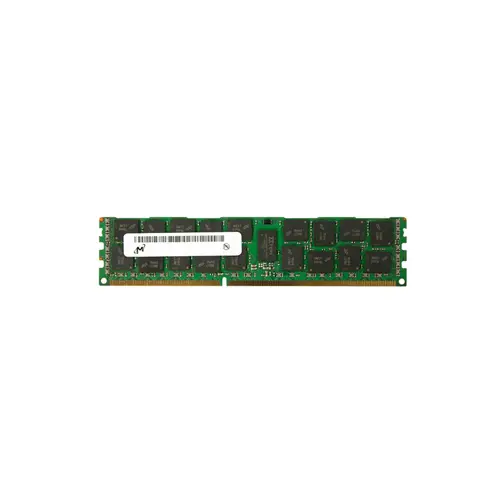
This 4GB DDR3-1600 RDIMM with ECC and registered signaling is purpose-built for server platforms, delivering the data integrity and stability required for virtualization, in-memory databases, and mission-critical workloads. Its single-rank x4 configuration combined with CL11 latency offers a balanced trade-off between memory density and electrical loading, ensuring reliable operation in multi-slot server environments.
1. ECC silently corrects single-bit errors in real time, preserving transactional integrity for virtualized databases and financial services that demand nonstop uptime.
2. Registered buffering decouples command/address signaling from DRAM loading, allowing fully populated server channels to scale memory capacity without signal collapse.
3. A lean capacity module fits perfectly into edge gateways, boot-from-SAN configurations, and lightweight container hosts where overprovisioning would waste power and licensing budgets.
4. Elevated DDR3 throughput keeps agent-based monitoring and web server caches responsive, preventing memory bottlenecks during peak traffic windows.
5. Single Rank x4 organization tightens fault containment and reduces electrical load, delivering the predictable latency required by high-assurance hypervisor clusters.
When deploying a virtualization cluster, a single undetected memory error can corrupt multiple guest machines simultaneously, leading to cascading failures. The MT18JSF51272PZ-1G6K1FG, a 4GB DDR3-1600 Registered DIMM, is engineered to prevent exactly that. Its Error Correcting Code (ECC) continuously detects and corrects single-bit flips, which are increasingly common in dense server farms due to cosmic radiation and silicon aging. This directly safeguards the integrity of your in-memory databases like Redis, where a flipped bit in a cache entry can return wrong pricing or session data.
Combined with its Registered architecture, the module buffers command and address signals, allowing the memory controller to drive large-capacity configurations across multiple DIMMs per channel without signal degradation. This stability is vital when you expand to 384GB or more for heavy virtualization workloads. The single-rank x4 organization further optimizes bandwidth and reduces loading, ensuring consistent 1600MT/s throughput even under the relentless pressure of hundreds of concurrent database queries and live migrations. For IT managers, this module means uninterrupted uptime, data that remains accurate transaction by transaction, and predictable performance in scale-out server environments where memory integrity and reliability are non-negotiable.
Server Memory Identified: This is a registered DDR3-1600 ECC RDIMM (PC3-12800, 1.5V, CL11, single rank x4). Its ECC and registered architecture are essential for data integrity and stability in multi-slot server configurations.
General Virtualization
For light to moderate virtualization with a few dozen VMs, populate at least six to eight of these 4GB modules to provide 24–32 GB of memory. Balance DIMMs across memory channels (e.g., one DIMM per channel) to maximize bandwidth while leaving headroom for overcommitment. Avoid mixing ranks unnecessarily; use identical single-rank x4 modules to ensure uniform access timing.
In-Memory Database
In-memory databases demand low latency and high capacity, so saturate all memory channels with at least two DIMMs per channel (2DPC) to reach 64 GB or more. With this 4GB single-rank module, 2DPC configurations will not overload the memory bus, preserving 1600 MT/s speed. Monitor data temperature and scale out with additional nodes when dataset size approaches physical limits.
High-Performance Computing (HPC)
HPC applications require peak memory bandwidth, so install one DIMM per channel across all available channels (1DPC) to avoid speed downclocking. With 4GB modules this yields modest capacity per node, but memory bandwidth per core is optimized. For memory-bound workloads, consider populating all slots with identical registered DIMMs to maintain uniform thermal and electrical characteristics under continuous load.
This rigorously tested DDR3 RDIMM is compatible with Dell PowerEdge R720, HP DL380p Gen8, and Lenovo RD430 servers.
Q: Can I mix this MT18JSF51272PZ-1G6K1FG with other memory modules of different brands or speeds?
A: Mixing RDIMMs is strongly discouraged. Registered ECC modules require identical ranks, timings, and speed for stable server operation. Mismatched specs may cause POST failures or memory errors.
Q: Is this memory compatible with my system? (Intel or AMD server platform)
A: This 4GB DDR3-1600 Registered ECC RDIMM is compatible with platforms supporting 1.5V RDIMMs, such as Intel Xeon E5-2600 v1/v2 or AMD Opteron 6300 series. Verify your board’s QVL for dual/quad-channel configurations.
Q: What is the recommended DIMM population order for optimal performance?
A: Populate identical RDIMMs in sets matching your CPU’s memory channels, typically 2 or 4 per bank. Start with the farthest slots from the CPU. Consult your server’s manual for specific slot numbering to enable interleaving.
Q: Does this module support overclocking or XMP profiles?
A: No. This is a server-grade Registered ECC DIMM operating at fixed JEDEC latency (CL11). It does not support overclocking or XMP profiles. Designed for 24/7 reliability within standard specifications.
Q: What warranty and typical failure rate can I expect?
A: This module carries a 1-year limited warranty. With enterprise-grade components and JEDEC compliance, its AFR is typically below 0.5% under rated conditions, ensuring stable long-term data center operation.