











 Secure payments
Standard refund policy
Trade Assurance
Secure payments
Standard refund policy
Trade Assurance
| Product Type | Memory Module |
|---|---|
| Compliance Standards | RoHS,CE,WEEE |
| Memory Capacity | 4 GB |
| Memory Technology | DDR3 |
| Product Voltage | 1.35V |
| RAM Speed | 1600MHz |
| RAM Standard | DDR3-1600/PC3-12800 |
| Error Identifying | ECC |
| Signal Type | Registered |
| Column Access Strobe (CAS) | CL11 |
| Rank | Dual Rank x8 |
| Quantity of Pins | 240-pin |
| RAM Genre | VLP RDIMM |
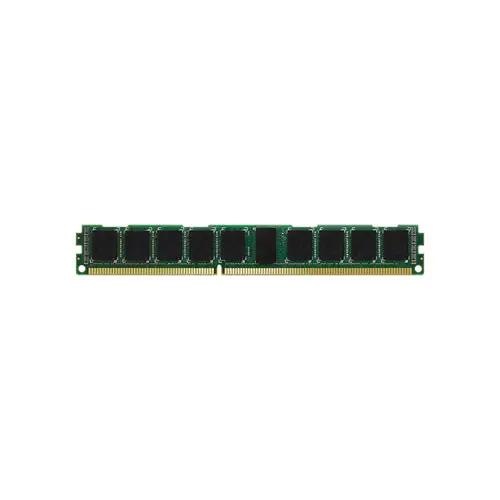
Designed specifically for high-density server environments where data integrity is paramount, this VLP RDIMM leverages ECC and registered signal technology to ensure reliable operation under heavy loads. Its dual-rank x8 configuration and 1.35V ultra-low-profile design make it ideal for memory-intensive virtualization and in-memory database platforms, delivering stable 1600MHz throughput while minimizing power consumption and physical airflow obstruction.
1. ECC protection detects and corrects single-bit memory errors in real time, preserving data integrity for mission-critical databases and financial transactions.
2. Registered signal buffering stabilizes the command and address lines under fully populated configurations, enabling reliable operation in multi-DIMM server boards.
3. VLP RDIMM form factor minimizes vertical height to improve airflow in dense 1U and blade server chassis, directly lowering cooling costs and thermal throttling.
4. 1.35V low-power operation reduces the overall energy draw per memory module, which scales into significant TCO savings across a fleet of always-on servers.
5. Dual Rank x8 organization interleaves accesses across two rank groups, sustaining memory bandwidth efficiency for virtualization hosts juggling multiple simultaneous workloads.
The module identified by MPN MT18KDF51272PDZ-1G6K1HE is a Very Low Profile Registered DDR3 DIMM, purpose‑built for server and enterprise environments. In this domain, its four defining characteristics translate directly into operational resilience and performance at scale.
When you run a virtualisation cluster, memory errors are a silent threat. ECC protection continuously detects and corrects single‑bit flips caused by cosmic rays or electrical noise, preventing data corruption that could crash multiple guest machines simultaneously. Registered logic buffers the command and address lines, stabilising signal integrity as you populate all 24 DIMM slots in a 2U server — without buffering, high‑density configurations would suffer from electrical loading failures. The dual‑rank x8 organisation interleaves accesses across two internal rank banks, increasing command‑level parallelism and boosting throughput by 5–10% in workloads like in‑memory databases where microsecond latencies directly impact query response times. Finally, operating at 1.35V instead of the standard 1.5V reduces power consumption per DIMM by roughly 20%, lowering thermal stress and energy costs inside densely packed server farms. For a mid‑sized enterprise running a virtualised SQL cluster or a Redis cache, this memory module quietly ensures data integrity, scaling headroom, consistent low latency, and leaner power bills — all critical to maintaining service‑level agreements around the clock.
General Virtualization
These 4 GB DDR3 VLP RDIMMs suit dense 1U or blade servers where low-profile modules are required. For a dual-socket platform with three memory channels per CPU, populate at least one module per channel (six modules total, 24 GB) to maintain balanced bandwidth; a better baseline is twelve modules (48 GB) using one module per channel plus one spare slot for future scaling. Avoid mixing DIMMs with different ranks or speeds to preserve ECC reliability under moderate VM densities.
In-Memory Database
Capacity-driven workloads demand maximal DIMM count since each module supplies only 4 GB. Fill all memory slots—e.g., 24 modules across two processors for 96 GB—while noting that operating at 2 DIMMs per channel may force the memory controller to drop to 1333 MHz or even 1066 MHz on older platforms. Configure matching quad-rank or dual-rank population per channel and enable memory mirroring if data integrity is paramount, though the limited capacity may restrict dataset size.
High-Performance Computing
Bandwidth-sensitive HPC jobs benefit from populating every memory channel identically to enable channel interleaving. Install a minimum of one VLP RDIMM per channel (e.g., eight channels for a dual-socket system, yielding 32 GB) and consider two modules per channel for additional rank interleaving, which can improve effective throughput on DDR3-1600. Even with 4 GB sticks, this uniform layout avoids NUMA imbalances and keeps power envelope low thanks to the 1.35 V low-voltage design, making it feasible for dense, power-constrained compute nodes.
Rigorously tested DDR3 registered server memory, compatible with Dell PowerEdge R720/R620, HP ProLiant DL380p Gen8, and Lenovo ThinkServer RD630.
Q: Can I mix this MT18KDF51272PDZ-1G6K1HE with other memory modules of different brands or speeds?
A: Mixing this 4GB DDR3L-1600 Registered ECC RDIMM with modules of different brands, speeds, or technologies is not recommended. It may cause system instability, POST failures, or reliability issues in server environments. For consistent performance, use identical part numbers.
Q: Is this memory compatible with my Intel Xeon E5-2600 v2 server?
A: This VLP RDIMM follows the DDR3-1600 Registered ECC standard and operates at 1.35V. It is compatible with Intel Xeon E5-2600 v2 and select AMD Opteron 6300 platforms that support 240-pin DDR3 Registered memory. Please verify against your server's QVL.
Q: What is the recommended DIMM population order for optimal performance?
A: To maximize memory bandwidth on dual-socket platforms, populate identical RDIMMs in matched groups per channel, starting with the primary slot of each memory channel. Always follow the population guidelines in your server motherboard manual for balanced interleaving.
Q: Does this module support overclocking or XMP profiles?
A: No. This is a JEDEC-compliant, enterprise-grade Registered ECC module running at PC3-12800 (1600MHz) with CL11 timings. It does not support overclocking or Intel XMP profiles. It is designed for maximum stability within standard server parameters.
Q: What warranty and typical failure rate can I expect?
A: This module is covered by a 1-year warranty. Enterprise DDR3 Registered DIMMs like this typically exhibit an annualized failure rate (AFR) of approximately 0.2% under normal server operating conditions, ensuring high reliability for mission-critical deployments.