











 Secure payments
Standard refund policy
Trade Assurance
Secure payments
Standard refund policy
Trade Assurance
| Product Type | Memory Module |
|---|---|
| Memory Capacity | 4 GB |
| Memory Technology | DDR3 |
| Product Voltage | 1.35V |
| RAM Standard | DDR3-1600/PC3-12800 |
| Error Identifying | ECC |
| Signal Type | Registered |
| Column Access Strobe (CAS) | CL11 |
| Rank | Single Rank x8 |
| Quantity of Pins | 240-pin |
| RAM Genre | RDIMM |
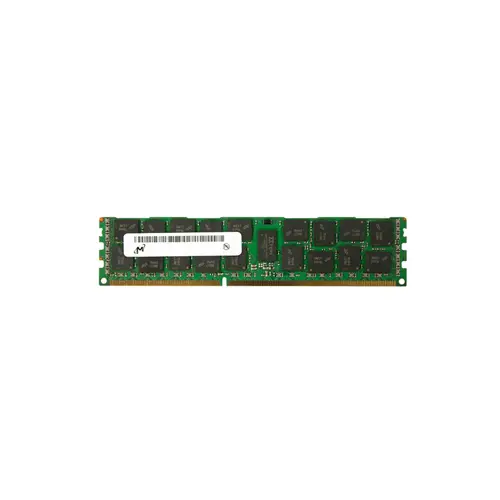
This 4GB DDR3-1600 RDIMM operating at 1.35V with ECC and registered signaling is engineered for entry-level server platforms, making it suitable for light virtualization, small-scale memory caching, and applications where data integrity is non-negotiable. Its single-rank x8 organization and 1.35V low-voltage operation reduce thermal and power overhead in dense configurations while registered logic ensures stable signal integrity across multiple DIMMs per channel.
1. ECC error correction actively prevents single-bit memory faults, preserving data integrity for mission-critical enterprise workloads where unplanned downtime is unacceptable.
2. Registered signal buffering stabilizes high-capacity memory subsystems, ensuring reliable data paths across fully loaded server nodes during sustained virtualization.
3. Low-voltage operation reduces overall datacenter thermal output and power draw, improving energy efficiency and lowering operational costs for large-scale deployments.
4. Mainstream DDR3 bandwidth keeps latency-sensitive applications like in-memory databases and mid-tier web hosting responsive during concurrent user surges.
5. Single-rank organization limits electrical load per channel, delivering consistent memory access latencies that benefit performance-hungry but energy-conscious blade servers.
The Micron MT9KSF51272PZ-1G6E2HG is a server-class DDR3L Registered DIMM, built specifically for datacenter workloads where failure is not an option. Its four key characteristics—ECC error correction, registered signal buffering, 1.35V low-voltage operation, and a DDR3-1600 single-rank design—directly address real-world infrastructure pain points. In a dense virtualization cluster running dozens of VMs per host, ECC silently corrects single-bit memory errors caused by background radiation, preventing bit flips from silently corrupting a financial transaction or crashing an entire guest node. The registered command-and-address buffer preserves signal integrity when a motherboard is fully populated with DIMMs, giving architects the confidence to scale to massive memory capacities without stability degradation. The 1.35V power envelope cuts energy and cooling costs significantly compared to legacy 1.5V modules, materially reducing total cost of ownership across a fleet of servers. For in-memory databases such as Redis or SAP HANA, the 1600MT/s bandwidth and single-rank x8 architecture deliver the predictable low-latency access required for sub-millisecond responses, turning real-time analytics into a competitive advantage. This module translates directly into unshakeable uptime, leaner power budgets, and uncompromising performance where your business logic lives.
This is a server memory module: a 4GB DDR3-1600 registered ECC RDIMM operating at 1.35V. Its ECC and registered design makes it ideal for stable, moderate-density server builds. Capacity planning for typical workloads follows.
General Virtualization
Populate all memory channels evenly with at least 8 identical modules (32GB) for lightweight VM hosting. For denser consolidation, scale to 16 modules (64GB) while keeping the DIMMs balanced per CPU socket to avoid access bottlenecks.
In-Memory Database
Maximize total RAM by filling every available slot—16 modules deliver 64GB, 24 modules provide 96GB. Symmetric distribution across memory controllers ensures uniform latency, and sticking to one DIMM per channel preserves the full 1600MT/s speed. If capacity forces two DIMMs per channel, expect a down‑clock to 1333MT/s while still benefiting from ECC integrity.
High-Performance Computing
For bandwidth-sensitive jobs, install one DIMM per channel (e.g., four modules on a quad-channel board) to maintain peak 1600MT/s throughput. When larger datasets are required, move to two DIMMs per channel (32GB on the same board) and evaluate whether the slight frequency trade‑off is acceptable. Always use identical registered modules for reliability under sustained load.
Extensively tested RDIMM for servers: Dell PowerEdge R720/R620, HP ProLiant DL380p Gen8, IBM System x3650 M4.
Q: Can I mix this MT9KSF51272PZ-1G6E2HG with other memory modules of different brands or speeds?
A: Mixing different brands or speeds is not advised for server RDIMMs. For ECC integrity and platform stability, always use identical modules with matching rank, CAS latency, and voltage.
Q: Is this memory compatible with my system?
A: This DDR3-1600 Registered ECC module targets servers with Intel Xeon E5/E5 v2 or AMD Opteron 6000 series platforms. Confirm your board supports 240-pin RDIMMs and 1.35V operation.
Q: What is the recommended DIMM population order for optimal performance?
A: Follow your server board guidelines. Typically, populate the first slot of each memory channel (e.g., DIMM_A1, DIMM_B1) to enable multi-channel interleaving and maximum ECC performance.
Q: Does this module support overclocking or XMP profiles?
A: No. This server RDIMM adheres strictly to JEDEC DDR3-1600 standards. Overclocking and XMP are unsupported, prioritizing consistent ECC reliability and 1.35V low-voltage efficiency over speed tuning.
Q: What warranty and typical failure rate can I expect?
A: This module includes a one-year warranty. Enterprise DDR3 ECC RDIMMs typically exhibit an annualized failure rate well below 0.5% in properly cooled and managed server environments.