











 Secure payments
Standard refund policy
Trade Assurance
Secure payments
Standard refund policy
Trade Assurance
| Product Type | Memory Module |
|---|---|
| Compliance Standards | RoHS |
| Memory Capacity | 4 GB |
| Memory Technology | DDR3 |
| Product Voltage | 1.5V |
| RAM Speed | 1600MHz |
| RAM Standard | DDR3-1600/PC3-12800 |
| Error Identifying | ECC |
| Signal Type | Registered |
| Column Access Strobe (CAS) | CL11 |
| Rank | Dual Rank x8 |
| Quantity of Pins | 240-pin |
| RAM Genre | RDIMM |
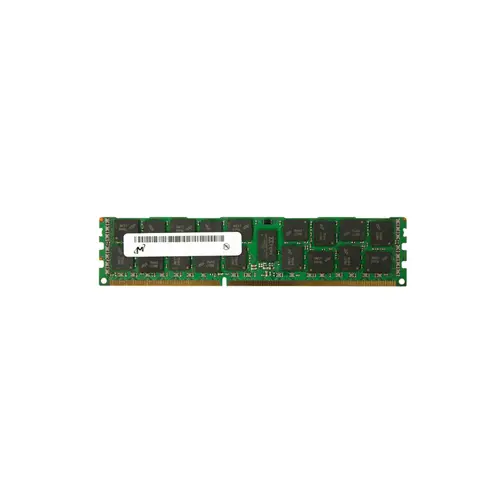
This 4GB DDR3-1600 ECC Registered RDIMM, operating at 1.5V with CL11 latency, is built for server platforms that require uncompromising data integrity, making it particularly suitable for virtualization, in-memory databases, and mission-critical workloads. Its dual-rank x8 organization combined with registered signaling stabilizes heavy memory populations and maximizes throughput, while integrated ECC continuously corrects single-bit errors to prevent data corruption and ensure high availability.
1. ECC error correction silently detects and corrects single-bit memory faults, safeguarding financial transactions and database integrity against costly silent data corruption.
2. Registered signal buffering stabilizes command and address lines, enabling high-capacity memory configurations that keep large-scale virtualization hosts running without signal degradation.
3. Dual Rank x8 organization interleaves memory banks to maximize channel utilization, delivering consistent bandwidth under heavy multi-tenant workloads.
4. 1600MHz clock speed provides fast data throughput, reducing latency in real-time analytics and ensuring responsive application performance across consolidated servers.
5. CL11 column access latency offers a balanced timing profile that complements registered modules, maintaining reliable command-to-data intervals for steady backend operations.
The MT18JSF51272PDZ-1G6M1HF is a server-grade DDR3 RDIMM, engineered for enterprise environments where uptime and data accuracy are non-negotiable. Its ECC capability directly shields your virtualized cluster from silent data corruption. When a memory bit flips due to cosmic radiation or electrical noise, ECC instantly corrects that single-bit error, preventing a compromised hypervisor or a crashed guest VM that could disrupt dozens of business services — meaning you avoid unexplained application failures and late-night emergency recovery. The registered buffer is what lets you populate all 24 DIMM slots on a dual-socket board without signal integrity collapsing; it decouples the memory chips from the bus, so as you scale to accommodate more virtual machines, the platform remains stable rather than suffering mysterious reboot cycles. Inside an in-memory database like Redis or a heavy transactional system, the dual-rank x8 organization drives real throughput. Rank interleaving allows the memory controller to access one rank while the other precharges, effectively overlapping commands and delivering lower latency for concurrent key-value lookups. Paired with a genuine 1600MHz clock delivering 12.8 GB/s of bandwidth, the module keeps your dataset hot and query responses fluid even when thousands of operations per second hammer the server. Together, these traits translate directly into fewer integrity-related outages, predictable performance under virtualization, and a responsive database layer that can actually keep pace with your revenue-critical workloads.
Server Memory Identified
This is a 4GB DDR3-1600 Registered ECC RDIMM (PC3-12800, 1.5V, dual-rank x8, CL11). Its ECC and registered signaling designate it strictly for server-class platforms requiring data integrity and larger memory capacities.
General Virtualization
Begin with six to eight identical modules (24–32 GB) to support a modest number of virtual machines. Deploy in balanced channels (e.g., one DIMM per channel) to maximize memory bandwidth and reduce NUMA latency. Scale by populating all channels symmetrically, leaving headroom for memory overcommitment.
In-Memory Database
Capacity is king; aim for the maximum supported by the platform using the highest-density RDIMMs available, often 16 GB or 32 GB sticks, not this 4 GB module alone. Use a balanced multi-channel configuration (all channels filled identically) to deliver the low latency and high throughput that in-memory datasets demand. ECC is non-negotiable for protecting against silent data corruption.
High-Performance Computing
Populate all memory channels with identical DIMMs—typically one DIMM per channel for maximum frequency or two for greater capacity—to optimize bandwidth-bound workloads. Given the 4 GB density, use eight or sixteen modules for 32–64 GB nodes, ensuring uniform rank distribution across channels. Select registered DIMMs to maintain signal integrity in dense multi-socket configurations.
Strictly tested server memory, compatible with Dell PowerEdge R720, HP DL380p Gen8, Lenovo ThinkServer RD630.
Q: Can I mix this MT18JSF51272PDZ-1G6M1HF with other memory modules of different brands or speeds?
A: Mixing different brands or speeds is not recommended for registered ECC memory. It can cause stability issues. Always use identical modules per channel to ensure reliable server operation.
Q: Is this memory compatible with my system?
A: It is compatible with servers supporting DDR3-1600 Registered ECC DIMMs, such as Intel Xeon E5-2600 v1/v2 platforms or AMD Opteron 6300 series. Verify your motherboard requires 1.5V RDIMMs.
Q: What is the recommended DIMM population order for optimal performance?
A: Follow your server board manual; typically populate the farthest slot per channel first. For dual-rank RDIMMs, balance channels and install identical modules in matching slots to maximize memory bandwidth.
Q: Does this module support overclocking or XMP profiles?
A: No. Enterprise registered memory adheres to JEDEC standards without XMP or overclocking support. It prioritizes data integrity and stability over frequency tuning.
Q: What warranty and typical failure rate can I expect?
A: This module includes a 1-year warranty. Typical annualized failure rate (AFR) is below 0.2% under normal operating conditions, reflecting enterprise-grade reliability.