

 Secure payments
Standard refund policy
Trade Assurance
Secure payments
Standard refund policy
Trade Assurance
| Product Type | Memory Module |
|---|---|
| Compliance Standards | RoHS |
| Memory Capacity | 4 GB |
| Memory Technology | DDR3 |
| Product Voltage | 1.35V |
| RAM Speed | 1600MHz |
| RAM Standard | DDR3-1600/PC3-12800 |
| Error Identifying | ECC |
| Signal Type | Registered |
| Column Access Strobe (CAS) | CL11 |
| Rank | Single Rank x8 |
| Quantity of Pins | 240-pin |
| RAM Genre | RDIMM |
This is a server-grade DDR3 RDIMM with ECC and registered signaling, optimally suited for virtualization platforms and in-memory databases where data integrity and system stability under heavy, multi-DIMM loads are critical. Its single-rank x8 configuration and low 1.35V operating voltage reduce power consumption and thermal stress, while the registered architecture maintains robust signal integrity across densely populated memory channels.
1. Registered DIMM architecture decouples memory chips from the memory controller, enabling high-density server configurations to maintain full operating speed without signal integrity decay.
2. ECC single-bit correction and multi-bit detection prevent silent data corruption in financial transactions and virtualization hosts where data accuracy is non-negotiable.
3. The on-module register buffers command and address signals, drastically reducing bus loading so multiple DIMMs can coexist without compromising stability in always-on server environments.
4. 1600 MHz frequency supplies steady memory bandwidth for concurrent database queries and mid-scale virtualized workloads, preserving responsive application delivery under sustained demand.
5. Single Rank x8 layout minimizes electrical load per DIMM, allowing fully populated server channels to run at rated speed and maximizing memory capacity without trading off performance.
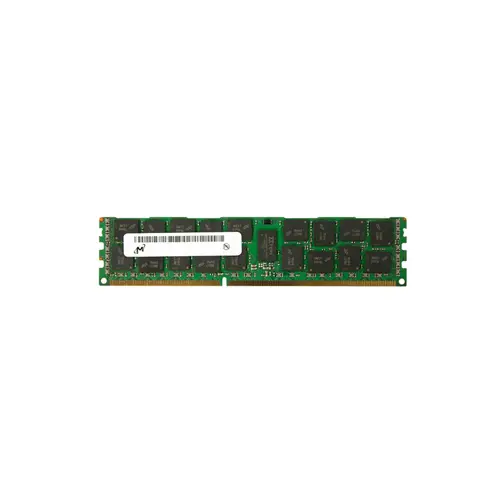
The Micron MT9KSF51272PZ-1G6E2H is a server-class DDR3 RDIMM purpose-built to eliminate the risks that keep IT managers awake at night. Its ECC capability is the first line of defense in virtualized clusters: when a single-bit error silently flips inside a VMware or Hyper‑V host, uncorrected memory can corrupt guest states and force entire workload migrations. With on-the-fly correction, this module prevents a stray cosmic particle from becoming a multi-hour outage. The Registered buffer addresses the scalability challenge directly. As you populate additional DIMM slots to grow a Redis in-memory database or expand container headroom, the register reduces command-address bus load, keeping signals clean so that dense configurations remain stable without sacrificing data throughput. That stability pairs with the 1600MHz speed and CL11 timing to deliver consistent low-latency responses even under heavy key-value querying. Crucially, the 1.35V low-voltage design converts every saved watt into lower cooling opex in a packed rack. For a mid-sized database farm running hundreds of modules, the cumulative power savings translate directly into reduced PDU heat stress and a more predictable TCO. Together, these four characteristics turn a 4GB RDIMM into a reliability asset, not just a component, safeguarding transactional integrity and operational continuity where real revenue depends on uptime.
General Virtualization
For general virtualization hosts using this 4 GB DDR3L-1600 RDIMM, prioritize balanced channel population to maximize memory bandwidth for multiple VMs. Install at least one DIMM per memory channel — on a typical dual-socket server with three channels per CPU, start with six modules (24 GB total) and scale by populating additional identical DIMMs in each channel. The 1.35 V low-voltage operation reduces platform power consumption across dense virtualized environments, and ECC protection ensures data integrity for all guest workloads.
In-Memory Database
In-memory databases demand large capacity and reliability, so fully populate all memory slots with these registered ECC modules to reach the server’s maximum supported capacity — common DDR3 platforms can accommodate up to 96 GB using twenty-four 4 GB DIMMs with four DIMMs per channel. The CL11 latency and single-rank x8 organization help maintain stable signal integrity even at full slot utilization, which is critical for low-latency caching and real-time analytics. Always install identical modules in matched sets to sustain performance under heavy write loads.
High-Performance Computing (HPC)
HPC clusters benefit from the bandwidth of parallel memory channels, so a minimum configuration of one 4 GB RDIMM per channel is essential to avoid bandwidth bottlenecks. For compute-bound workloads, scale by adding a second identical DIMM per channel to enable dual-rank-like interleaving while staying within the power envelope of the 1.35 V specification. ECC and registered signaling stabilize large node counts during week-long simulation runs, and stick to homogenous module population across all nodes to guarantee consistent per-node memory performance.
Verified server memory, rigorously tested, compatible with Dell PowerEdge R720/R620, HPE DL380p Gen8, Lenovo System x3650 M4.
Q: Can I mix this MT9KSF51272PZ-1G6E2H with other memory modules of different brands or speeds?
A: Mixing this ECC Registered RDIMM with non-ECC or unbuffered modules is not recommended. Even with similar RDIMMs, speed and rank mismatches can force the system down to the lowest common frequency, potentially causing instability.
Q: Is this memory compatible with my server?
A: This module is designed for servers using Intel Xeon E5-2400/E5-2600 v2 or AMD Opteron 6300 series platforms. Verify your board supports DDR3 ECC Registered 240-pin DIMMs at 1.35V before purchase.
Q: What is the recommended DIMM population order for optimal performance?
A: For dual-processor servers, balance identical RDIMMs across memory channels for each CPU, starting with blue slots. Refer to your system's population guide; typically, populate one DIMM per channel first to maximize bandwidth.
Q: Does this module support overclocking or XMP profiles?
A: No. As enterprise-grade server memory, this RDIMM runs strictly at JEDEC-standard 1600MHz (PC3-12800) with CL11. Overclocking and XMP are not supported to ensure data integrity and 24/7 stability.
Q: What warranty and typical failure rate can I expect?
A: This module includes a one-year warranty. With an AFR well below 1% under normal server operating conditions and ECC protection, it delivers the high reliability expected in registered server memory.