











 Secure payments
Standard refund policy
Trade Assurance
Secure payments
Standard refund policy
Trade Assurance
| Product Type | Memory Module |
|---|---|
| Compliance Standards | RoHS |
| Memory Capacity | 4 GB |
| Memory Technology | DDR3 |
| Product Voltage | 1.35V |
| RAM Speed | 1600MHz |
| RAM Standard | DDR3-1600/PC3-12800 |
| Error Identifying | ECC |
| Signal Type | Unbuffered |
| Column Access Strobe (CAS) | CL11 |
| Rank | Dual Rank x8 |
| Quantity of Pins | 240-pin |
| RAM Genre | UDIMM |
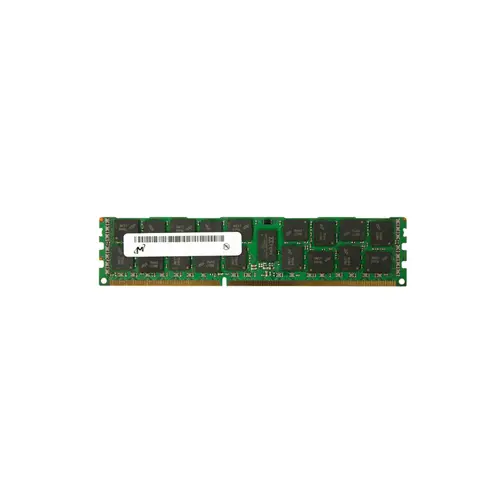
This UDIMM with ECC is a server-grade module ideal for entry-level single-socket servers and workstations running virtualization or light database workloads, where data integrity is critical. Its dual-rank x8 organization enhances memory bandwidth efficiency, while the 1.35V low-voltage DDR3L design reduces power consumption without sacrificing the 1600MHz speed and ECC protection.
1. ECC protection corrects single-bit errors on the fly, eliminating silent data corruption and ensuring uninterrupted operation in always-on server environments where data integrity is the top priority.
2. Operating at 1.35V, the low-voltage design reduces power consumption and heat generation, which helps lower energy costs and improves thermal stability in dense rack deployments.
3. Dual Rank x8 organization allows rank interleaving across the memory bus, increasing effective bandwidth and improving throughput for concurrent virtualized workloads and multi-threaded services.
4. The 1600MT/s transfer rate sustains a consistent 12.8 GB/s peak bandwidth, preventing memory bottlenecks during high transaction loads and keeping latency-sensitive server tasks responsive.
5. A 4 GB capacity per module is well-suited for dedicated edge appliances or lightweight container hosts, where ECC reliability matters more than raw capacity and every watt saved counts in constrained environments.
As a server-grade DDR3L UDIMM with ECC, the Micron MT18KSF51272AZ-1G6K1ZG brings mission-critical resilience to entry-level servers, small virtualization hosts, and network-attached storage appliances. In a hypervisor cluster running multiple VMs, silent bit flips caused by background radiation can corrupt guest operating systems or hypervisor memory tables without warning. The integrated ECC engine actively detects and corrects single-bit errors, ensuring that your virtual machines continue operating cleanly through months of uptime, which directly protects business continuity. When deployed as a cache layer for in-memory databases like Redis or a memory-resident SQL engine, the module’s dual-rank x8 organization drives higher bank interleaving efficiency. This translates into measurably lower latency under concurrent query workloads, letting your application serve more transactions per second without stalling. Operating at 1.35 volts, the module cuts thermal output and power draw compared to standard 1.5-volt DDR3, which becomes a tangible cost saving when racks of servers run around the clock. With a full PC3-12800 bandwidth of 12.8 GB/s and the straightforward compatibility of an unbuffered ECC DIMM, this memory lets you economically upgrade aging platforms that cannot accept registered memory, delivering both data integrity and responsive performance for edge computing tasks, authentication services, or small office virtualized infrastructure.
General Virtualization
This 4 GB DDR3 ECC unbuffered DIMM is best suited for entry-level or micro‑virtualization hosts where total memory is limited. For a basic Type‑2 hypervisor lab, install two modules in dual‑channel to gain 8 GB, which can support a few lightweight Linux VMs. Avoid oversubscription; strict memory overcommit is risky with these small-capacity modules, so plan one 8 GB kit (2×4 GB) per host and rely on fast SSD swap only for idle guests.
In‑Memory Database
In‑memory databases like Redis or Memcached demand low latency, but a single 4 GB stick is far too small for production datasets. A usable test node can be assembled with four identical 4 GB ECC UDIMMs to total 16 GB, enabling small development instances. For any tier above prototyping, migrate to registered DIMMs with higher per‑channel density, as 4 GB unbuffered modules quickly exhaust the motherboard’s slot count and cap capacity.
High‑Performance Computing (HPC)
In memory‑bandwidth‑bound HPC clusters, populate all available channels with identical 4 GB ECC UDIMMs to maximize interleaving. For a dual‑socket compute node supporting quad‑channel per CPU, install eight modules (32 GB total) to feed floating‑point pipelines without stalling. This configuration works for embarrassingly parallel tasks where node memory is modest, while capacity‑intensive workloads should graduate to 8 GB or 16 GB registered ECC DIMMs to avoid slot starvation.
Rigorously tested, compatible with servers like Dell PowerEdge R210 II, HP ProLiant DL320e Gen8, and Lenovo ThinkServer TS140.
Q: Can I mix this MT18KSF51272AZ-1G6K1ZG with other memory modules of different brands or speeds?
A: Mixing is not recommended in server environments. Dissimilar modules may cause instability or disable ECC. For maximum reliability, populate all channels with identical DDR3L-1600 ECC UDIMMs of the same rank and timings.
Q: Is this memory compatible with my system?
A: This is a 4GB DDR3L-1600 ECC Unbuffered DIMM for server platforms. It targets Intel Xeon E3-1200 series and select AMD AM3+/FM2+ motherboards. Verify your board explicitly supports 1.35V UDIMM ECC memory before purchase.
Q: What is the recommended DIMM population order for optimal performance?
A: Populate identical DIMMs in matched pairs per memory channel, following your server board's silkscreen numbering. Typically, install in the farthest slots first for each channel to enable dual-channel mode and maintain balanced memory interleaving.
Q: Does this module support overclocking or XMP profiles?
A: No. This is a JEDEC-compliant server module running at a fixed 1600MHz with CL11 latency. It does not support XMP or overclocking, as stable error-corrected operation requires strict adherence to factory timing parameters.
Q: What warranty and typical failure rate can I expect?
A: Backed by a one-year warranty. In properly cooled server environments, ECC UDIMMs typically exhibit an annualized failure rate (AFR) below 0.5%, delivering dependable long-term data integrity under 24/7 operation.