











 Secure payments
Standard refund policy
Trade Assurance
Secure payments
Standard refund policy
Trade Assurance
| Model | MT9KDF51272AZ-1G6P1 |
|---|---|
| Product Type | Memory Module |
| Compliance Standards | RoHS |
| Memory Capacity | 4 GB |
| Memory Technology | DDR3 |
| Product Voltage | 1.35V |
| RAM Speed | 1600MHz |
| RAM Standard | DDR3-1600/PC3-12800 |
| Error Identifying | ECC |
| Signal Type | Unbuffered |
| Column Access Strobe (CAS) | CL11 |
| Rank | Single Rank x8 |
| Quantity of Pins | 240-pin |
| RAM Genre | UDIMM |
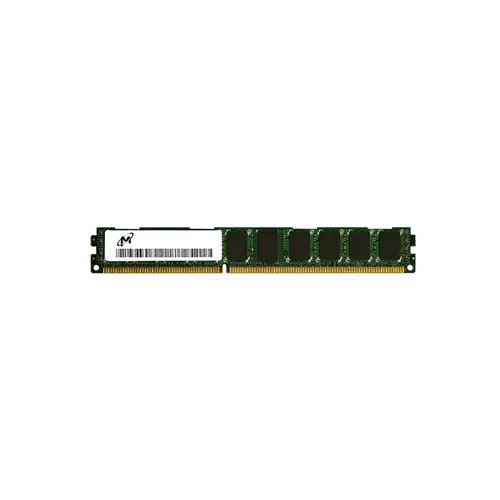
With ECC and unbuffered design, this 4 GB DDR3-1600 UDIMM is tailored for entry-level servers and workstations where data integrity is critical, making it ideal for light virtualization, file services, or memory-sensitive embedded applications. Its single-rank x8 organization and low 1.35 V operating voltage enhance signal stability and reduce power consumption, while the CL11 latency helps maintain responsive performance in always-on environments.
1. ECC protection silently corrects single-bit memory errors, preserving data integrity for financial transactions or critical database entries that demand zero corruption.
2. Unbuffered architecture slices through access latency, giving lightweight virtualization hosts and microservers faster request-to-response cycles without the overhead of register chips.
3. The energy-efficient low-voltage design curbs power consumption per stick, directly lowering thermal strain and electricity costs in dense server deployments.
4. DDR3-1600 frequency delivers a stable bandwidth envelope suitable for consistent request handling in web serving and small-scale content caching environments.
5. A moderate module capacity allows cost-effective node provisioning for containerized workloads where total memory is distributed across many modest but reliable units.
The Micron MT9KDF51272AZ-1G6P1 is a DDR3-1600 UDIMM engineered for entry-level servers and workstations where data integrity, not just raw throughput, is the priority. In a virtualisation cluster hosting a CRM and file server on a single node, a single undetected bit flip in the hypervisor’s memory can corrupt a virtual disk and cascade into hours of recovery. This module’s ECC functionality actively corrects single-bit errors and detects multi-bit faults, turning what would be a crash or silent data loss into a corrected, logged event—your VMs stay up and your data remains consistent. For an in-memory database like Redis or a financial transaction cache, that same protection ensures a flipped bit doesn't become a wrong price or a lost order. Meanwhile, the 1.35V low-voltage operation directly lowers thermal load and power drain in small offices or colocation racks where cooling headroom is tight and every watt impacts the electricity bill. At 1600MHz with a CAS latency of 11 and a single-rank x8 organisation, it delivers predictable, low-latency bandwidth for mixed workloads, letting a departmental server handle concurrent remote desktop sessions and light database queries without memory contention throttling user productivity. Because it is an unbuffered DIMM, it maintains lower access latency than registered alternatives, which matters when a workstation renders 3D models and needs every millisecond of responsiveness—yet you never sacrifice the safety net of error correction.
General Virtualization
Use multiple MT9KDF51272AZ-1G6P1 modules to build a cost‑effective, low‑power virtualization host. A six‑module configuration (24 GB total) allows dual‑channel operation on common single‑socket platforms, comfortably supporting 10–15 light VMs. For higher density, populate all eight DIMM slots for 32 GB, ensuring 1.35 V operation keeps thermal and energy overhead low.
In‑Memory Database
In‑memory workloads demand maximal capacity and error resilience, both delivered by this ECC UDIMM. Install a full 32 GB kit (eight identical 4 GB sticks) across all memory channels to reach the platform’s limit while maintaining data integrity. This setup suits small‑scale Redis or Memcached instances, where every gigabyte directly translates into larger working sets and faster query responses.
High‑Performance Computing
HPC per‑node memory sizing focuses on bandwidth and correct channel population. Pair six or eight modules in a dual‑channel or quad‑channel configuration to saturate memory controllers; for dual‑socket boards, balance DIMMs symmetrically across CPUs. The 1.35 V rating reduces aggregate power draw in dense clusters, making these UDIMMs a smart choice for sustained floating‑point and simulation jobs that require modest capacity but high reliability.
Rigorously tested server memory. Compatible with Dell PowerEdge R210 II, HP ProLiant MicroServer Gen8, Lenovo ThinkServer TS140.
Q: Can I mix this MT9KDF51272AZ-1G6P1 with other memory modules of different brands or speeds?
A: Mixing is not advised. ECC UDIMMs require electrical uniformity. Disparate brands or speeds risk instability, prevent ECC from functioning correctly, and may lead to data corruption in server workloads.
Q: Is this memory compatible with my system?
A: This module is designed for servers and workstations with DDR3 ECC UDIMM support, such as Intel Xeon E3-1200 series or AMD Opteron 3000 series platforms. Verify your board supports 1.35V, 1600MT/s ECC UDIMMs.
Q: What is the recommended DIMM population order for optimal performance?
A: Populate one module per channel starting with the slot farthest from the CPU. For dual-channel, use matching slots (e.g., DIMM_A1 and DIMM_B1) with identical modules to enable ECC and maximize memory bandwidth.
Q: Does this module support overclocking or XMP profiles?
A: No, it is a JEDEC-compliant server UDIMM. No XMP or overclocking support is provided. It runs at a fixed 1600MHz CL11 to guarantee data integrity in mission-critical, always-on environments.
Q: What warranty and typical failure rate can I expect?
A: It comes with a one-year warranty. As a Micron server-grade module, it exhibits an annualized failure rate below 0.5% under normal thermal and electrical operating conditions.