











 Secure payments
Standard refund policy
Trade Assurance
Secure payments
Standard refund policy
Trade Assurance
| Product Type | Memory Module |
|---|---|
| Compliance Standards | RoHS |
| Memory Capacity | 4 GB |
| Memory Technology | DDR3 |
| Product Voltage | 1.35V |
| RAM Speed | 1600MHz |
| RAM Standard | DDR3-1600/PC3-12800 |
| Error Identifying | ECC |
| Signal Type | Unbuffered |
| Column Access Strobe (CAS) | CL11 |
| Rank | Dual Rank x8 |
| Quantity of Pins | 240-pin |
| RAM Genre | UDIMM |
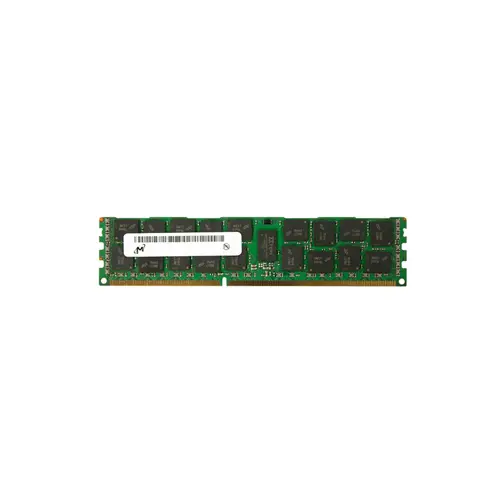
This unbuffered ECC UDIMM is engineered for entry-level servers and small office NAS or workstation platforms where data integrity is critical but registered memory is not required. Its dual-rank x8 organization enhances memory bandwidth via interleaving, while the 1.35V low-voltage DDR3L operation and ECC protection deliver energy-efficient, reliable uptime for light virtualization, file serving, and write-sensitive caching workloads.
1. ECC protection detects and corrects single-bit errors automatically, preserving data integrity for mission-critical server applications where even silent corruption is unacceptable.
2. A modest four-gigabyte capacity suits lightweight dedicated server roles or embedded systems, keeping cost and power draw low while still supporting essential services.
3. The low 1.35V operating voltage reduces overall energy consumption and thermal output in dense rack environments, directly lowering cooling overhead.
4. Operating at PC3-12800 peak bandwidth delivers sufficient throughput for moderate concurrent requests, preventing I/O bottlenecks in file-serving or caching workloads.
5. Dual Rank x8 organization interleaves memory accesses across physical banks, boosting effective bandwidth and sustaining responsiveness when multiple virtual machines contend for resources.
Based on the UDIMM form factor, 240-pin layout, and crucially the ECC support, the MT18KSF51272AZ-1G6M1 is unmistakably a server-grade memory module—specifically an unbuffered ECC DIMM built for single-socket workstations and entry-level servers. This is not a desktop or notebook part; its design addresses acute reliability and uptime demands in small business servers, virtualization nodes, and mission-critical storage appliances.
In a virtualized cluster, a single cosmic-ray-induced bit flip in DRAM can silently corrupt a hypervisor’s memory map, crash multiple guest operating systems, and cascade into unplanned downtime. The module’s hardware ECC engine instantly detects and corrects single-bit errors, transforming a potential data catastrophe into a non-event that your integrity monitoring simply logs. That is the difference between 3 a.m. panic and uninterrupted operations. Meanwhile, the dual-rank x8 organization supplies higher interleaving within the memory channel, which directly accelerates memory database queries and real-time analytics where sub-millisecond latency matters.
Equally significant is its 1.35V low-voltage DDR3L operation. Swapping legacy 1.5V modules for this device across a small server farm yields a cumulative power reduction that lowers thermal stress on voltage regulators and reduces cooling overhead. Unlike registered memory that adds a clock cycle for buffering, the unbuffered architecture eliminates that latency penalty, preserving swift response times in latency-sensitive workloads like online transaction processing. For a ZFS storage server or a lightweight SQL cluster, these four characteristics work together: ECC guards the data you bill clients for, dual rank sustains throughput under concurrent load, low voltage extends hardware longevity in 24/7 environments, and unbuffered design keeps your transactional speed sharp. This is not just a spec sheet—it is a silent promise of economic dependability.
General Virtualization
For a general virtualization host using a single-socket server, populate the board with four of these 4 GB ECC UDIMMs to achieve 16 GB total capacity. This configuration supports a moderate number of low-to-medium resource VMs while retaining memory error correction for stability. Deploy modules in pairs on dual-channel platforms to maintain balanced memory bandwidth and avoid performance penalties.
In-Memory Database
In-memory databases demand both capacity and reliability. Given the 4 GB module size and UDIMM limitations, install the maximum supported configuration—typically four modules for 16 GB on common single-CPU boards—and pair it with fast storage for dataset spillover. For production instances requiring larger working sets, consider a platform that accepts registered DIMMs, as unbuffered ECC memory restricts scaling beyond 32 GB in most servers.
High-Performance Computing (HPC)
HPC nodes often need high bandwidth and error resilience. Populate all memory channels with identical 4 GB ECC UDIMMs, aiming for 16 GB to 32 GB depending on node count and workload footprint. Dual-rank x8 modules improve signal integrity over single-rank alternatives, and the 1.35 V low-voltage operation reduces thermal load in dense clusters. Balance capacity per core to avoid I/O bottlenecks, and ensure identical DIMMs across nodes for consistent MPI job performance.
Rigorously tested server memory; compatible with Dell PowerEdge R210 II, T110 II, HP MicroServer Gen8, and Lenovo TS140.
Q: Can I mix this MT18KSF51272AZ-1G6M1 with other memory modules of different brands or speeds?
A: Mixing ECC UDIMMs of different brands or speeds is not recommended. The system will downclock all modules to the slowest common speed, potentially causing stability issues and negating the benefit of validated ECC operation.
Q: Is this memory compatible with my server?
A: It is compatible with single-socket servers based on Intel Xeon E3/E5 v1/v2 or AMD Opteron/Ryzen PRO platforms using C202/C204/C206 chipsets. Verify your board supports 1.35V DDR3 ECC Unbuffered 1600MT/s UDIMMs with x8 organization.
Q: What is the recommended DIMM population order for optimal performance?
A: For optimal dual-channel performance, populate identical modules in the same colored slots across channels (e.g., DIMMA1 and DIMMB1 first). Consult your server board manual for specific population rules to maintain memory interleaving and ECC integrity.
Q: Does this module support overclocking or XMP profiles?
A: No. This is a JEDEC-compliant server memory module running at a standard 1600MHz latency of CL11. It does not support XMP, overclocking, or voltage adjustments to guarantee 24/7 data integrity and ECC reliability in server environments.
Q: What warranty and typical failure rate can I expect?
A: This module is covered by a one-year warranty. It is built with enterprise-grade components and tested to rigorous standards, resulting in a typical annualized failure rate (AFR) well below 1% under normal operating conditions.