











 Secure payments
Standard refund policy
Trade Assurance
Secure payments
Standard refund policy
Trade Assurance
| Product Type | Memory Module |
|---|---|
| Compliance Standards | RoHS |
| Memory Capacity | 4 GB |
| Memory Technology | DDR3 |
| Product Voltage | 1.5V |
| RAM Speed | 1600MHz |
| RAM Standard | DDR3-1600/PC3-12800 |
| Error Identifying | ECC |
| Signal Type | Unbuffered |
| Column Access Strobe (CAS) | CL11 |
| Rank | Dual Rank x8 |
| Quantity of Pins | 240-pin |
| RAM Genre | UDIMM |
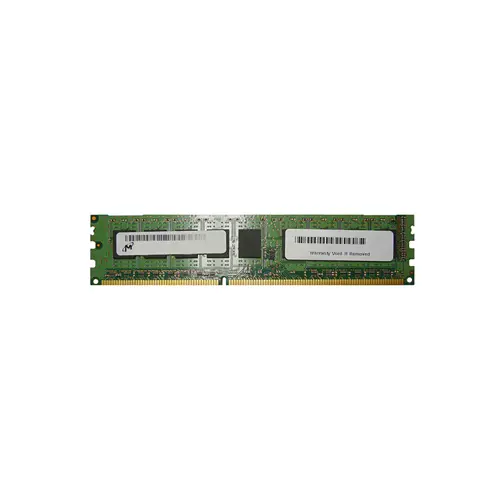
Designed for entry-level servers and workstations that require data integrity without the cost of registered memory, this DDR3-1600 unbuffered ECC UDIMM is ideally suited for small business NAS appliances and virtualization hosts handling light memory-database tasks. Its dual-rank x8 organization enhances interleaving efficiency for improved bandwidth, while integrated ECC reliably corrects single-bit errors to maintain system stability under continuous 1.5V operation with CL11 latency.
1. ECC detects and corrects single-bit errors in real time, safeguarding financial transactions and database integrity against silent data corruption.
2. Dual-rank organization interleaves memory banks to keep the server’s memory channel fully utilized, sustaining consistent throughput under heavy virtualization loads.
3. The 1600 MT/s data rate delivers ample bandwidth for concurrent request handling, ensuring responsive application performance in multi-tenant hosting environments.
4. Unbuffered design eliminates the register latency found in registered modules, giving entry-level micro-servers a responsiveness edge for latency-sensitive edge computing tasks.
5. A modest capacity per stick allows cost-effective, granular memory population, letting IT administrators right-size cache tiers for lightweight container clusters without wasting resources.
The Micron MT18JSF51272AZ-1G6K1ZE is a 4GB DDR3-1600 UDIMM engineered for small-to-midsize servers and entry-level workstations where data integrity meets cost-conscious deployment. Its ECC circuitry is non-negotiable in memory-driven workloads: in a file server or NAS handling financial records, a single-bit upset caused by background radiation can silently corrupt a dataset, yet ECC detects and corrects these errors in real time, safeguarding your business against invisible data decay.
In a virtualized environment running multiple lightweight VMs or containers, the dual-rank x8 organization steps up. Dual rank enables rank interleaving, allowing the memory controller to pipeline requests across ranks and sustain bandwidth under concurrent access patterns—critical when a hypervisor juggles database instances and web services simultaneously. The unbuffered design keeps latency low, avoiding the extra clock cycle penalties of registered memory, while the 1.5V standard voltage keeps thermal load predictable inside compact 1U chassis.
Paired with 1600MHz speed delivering 12.8 GB/s peak throughput, this module lets a small-business server run Redis caching or a ZFS-based storage pool without becoming memory-starved. It is a targeted upgrade for users who cannot tolerate silent corruption but need responsive, affordable ECC protection in constrained hardware footprints.
Capacity Planning Guide for a DDR3-1600 ECC Unbuffered DIMM
This 4GB DDR3-1600 module is an ECC Unbuffered DIMM (UDIMM, 240-pin), which is server memory typically used in entry-level servers, small business servers, and workstations. ECC provides single-bit error correction, essential for data integrity, while the unbuffered design keeps latency low. For capacity planning, this module serves as a building block in various professional workloads.
General Virtualization
Virtualized hosts often consolidate multiple VMs, making memory capacity a primary constraint. For lightweight hypervisors running 4–6 small VMs, populate the server with at least four of these 4GB modules (16GB total) across dual channels to balance cost and multitasking. As VM density increases, scale to 32GB using eight modules, ensuring even distribution across memory channels for optimal throughput.
In-Memory Database
In-memory databases (e.g., Redis, Memcached) demand high capacity and fault tolerance. Start with 32GB (eight 4GB modules) to hold sizable working sets entirely in RAM. For larger datasets, maximize all DIMM slots; the ECC feature is critical here to prevent silent data corruption. Always deploy modules in identical pairs to maintain dual-channel interleaving and consistent latency.
High Performance Computing
HPC nodes require both bandwidth and reliability. Populate all memory channels symmetrically with these 4GB UDIMMs to achieve peak bandwidth from dual-channel architectures. While 4GB per module limits total capacity per node, this configuration suits compute-bound tasks where datasets fit in a 16–32GB footprint and ECC guards against cosmic bit flips during long-running parallel jobs.
Rigorously tested for servers, compatible with Dell PowerEdge R210 II, HP ProLiant MicroServer Gen8, Lenovo TS140.
Q: Can I mix this MT18JSF51272AZ-1G6K1ZE with other memory modules of different brands or speeds?
A: Mixing is possible but not recommended. All installed modules will operate at the lowest common speed and timings. Using mismatched ECC UDIMMs can cause signal integrity issues and compromise system stability in server platforms.
Q: Is this memory compatible with my system?
A: This is a DDR3-1600 ECC Unbuffered DIMM for server and workstation boards with Intel Xeon E3 or AMD Opteron 3000 series. Verify your board supports 1.5V, 4GB ECC UDIMMs and 512Mx8 organization before purchase.
Q: What is the recommended DIMM population order for optimal performance?
A: Install in identical pairs per memory channel to enable dual-channel interleaving. Populate the furthest slot from the CPU per channel first (usually slots A1 and B1). Refer to your server board manual for exact slot numbering.
Q: Does this module support overclocking or XMP profiles?
A: No. This server-grade ECC UDIMM adheres to JEDEC DDR3-1600 standards at CL11. It does not support XMP or overclocking, as data integrity and reliability take priority over extreme performance in these environments.
Q: What warranty and typical failure rate can I expect?
A: This memory carries a 1-year warranty. Enterprise UDIMMs like Micron’s MT18JSF series have an extremely low AFR (typically below 0.5%), designed for 24/7 operation in thermally managed server chassis.