











 Secure payments
Standard refund policy
Trade Assurance
Secure payments
Standard refund policy
Trade Assurance
| Product Type | Memory Module |
|---|---|
| Compliance Standards | RoHS |
| Memory Capacity | 4 GB |
| Memory Technology | DDR3 |
| Product Voltage | 1.35V |
| RAM Speed | 1600MHz |
| RAM Standard | DDR3-1600/PC3-12800 |
| Error Identifying | ECC |
| Signal Type | Unbuffered |
| Column Access Strobe (CAS) | CL11 |
| Rank | Dual Rank x8 |
| Quantity of Pins | 240-pin |
| RAM Genre | UDIMM |
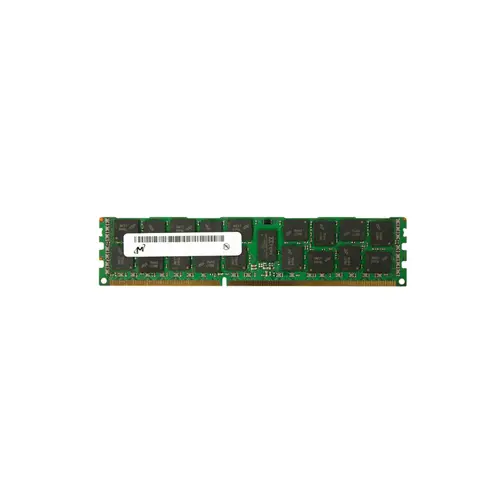
This DDR3L UDIMM with ECC is a server/workstation memory module ideally suited for entry-level servers and single-socket workstations running virtualization, file services, or small memory-resident databases where data integrity is critical. Its dual-rank x8 organization enables rank interleaving for improved sustained bandwidth under concurrent access, while the 1.35V low-voltage operation and unbuffered signaling minimize latency and power draw without compromising the 1600MT/s transfer rate.
1. ECC protection detects and corrects single-bit errors in real time, preventing silent data corruption in always-on microserver and NAS deployments where data integrity is non-negotiable.
2. Low-voltage 1.35V operation reduces power draw and thermal stress in dense small-office server racks, supporting more reliable 24/7 uptime without expensive cooling.
3. Dual rank x8 organization interleaves memory accesses across two internal ranks, boosting sustained bandwidth for concurrent lightweight virtualized workloads and file services.
4. Unbuffered signal topology eliminates register latency, giving cost-optimized server builds faster command-to-data turnaround for latency-sensitive edge computing tasks.
5. A compact 4 GB capacity per stick allows affordable memory population across four DIMM slots, balancing total system memory with budget constraints in entry-level single-socket server setups.
When you are running a virtualized cluster or an in-memory database on a single-socket server, every bit of data integrity and power efficiency matters. The Micron MT18KSF51272AZ-1G6K1 is a 4GB DDR3-1600 UDIMM engineered precisely for these environments, and its four key attributes directly translate into real-world reliability. First, ECC error correction continuously detects and corrects single-bit memory errors caused by background radiation, preventing silent data corruption that could crash a hypervisor or poison financial records in a Redis instance. Second, the 1.35V low-voltage design cuts power draw, reducing thermal load in dense server rooms and lowering your total cost of ownership for 24/7 operations. Third, the dual-rank x8 configuration improves memory interleaving, giving your virtual machines smoother context switching and higher effective bandwidth under heavy consolidation workloads. Finally, the unbuffered architecture keeps latency low for transactional databases where microseconds count. This is not just a stick of memory; it is an insurance policy for your mission-critical data and a smart investment in energy-efficient uptime.
General Virtualization
With only 4 GB per module, this ECC UDIMM is best suited for lightweight hypervisors or single-purpose virtual appliances. Deploy pairs of modules to enable dual‑channel operation and target 16–32 GB total for a small virtualization host running 4–8 low‑resource VMs. Avoid overcommitment on such limited capacity; plan one module per critical VM core to prevent ballooning and swapping.
In-Memory Database
A 4 GB DIMM is extremely constrained for in‑memory workloads, but it can serve development or test instances of Redis or Memcached. Use identical modules in matched sets (2 or 4 DIMMs) to maximize bandwidth via channel interleaving, and do not exceed 16 GB total for trivial datasets. For production, these modules are only appropriate as a boot‑bank or OS‑only tier—keep the database entirely on larger‑capacity DIMMs.
High Performance Computing
HPC nodes demand both capacity and bandwidth; a single 4 GB module is insufficient as a primary compute resource. These DIMMs are viable for dedicated I/O or management nodes where memory requirements are modest. If deployed in a compute node, populate all memory channels with identical dual‑rank x8 DIMMs (e.g., six or eight modules per socket) to sustain 1600 MT/s throughput, but strictly limit models to memory‑light, communication‑heavy MPI ranks.
Rigorously validated for servers: Dell PowerEdge R210 II, T20, HP MicroServer Gen8, Lenovo TS140.
Q: Can I mix this MT18KSF51272AZ-1G6K1 with other memory modules of different brands or speeds?
A: Mixing ECC UDIMMs is not recommended. For stable server operation, all modules should share identical part numbers, rank, and timings. Mismatched DIMMs may force fallback speeds or cause parity errors.
Q: Is this memory compatible with my system?
A: This DDR3 ECC UDIMM works with Intel Xeon E3-1200 v2/v3 series or AMD AM3+ platforms supporting ECC unbuffered memory. Verify your motherboard specifically lists 1.35V ECC UDIMM support.
Q: What is the recommended DIMM population order for optimal performance?
A: Populate identical modules in the slots of the first memory channel (typically blue slots). For dual-channel operation, install matching pairs across channels as specified in your server board's manual.
Q: Does this module support overclocking or XMP profiles?
A: No. This JEDEC-compliant server memory does not support XMP or overclocking. It runs at the fixed JEDEC standard of DDR3-1600 with CL11 timings for maximum uptime reliability.
Q: What warranty and typical failure rate can I expect?
A: This Micron module includes a 1-year warranty. With strict factory testing, the annualized failure rate (AFR) is below 0.3 percent under standard data center operating conditions.