











 Secure payments
Standard refund policy
Trade Assurance
Secure payments
Standard refund policy
Trade Assurance
| Product Type | Memory Module |
|---|---|
| Compliance Standards | RoHS |
| Memory Capacity | 4 GB |
| Memory Technology | DDR3 |
| RAM Speed | 1600 |
| RAM Standard | DDR3-1600/PC3-12800 |
| Error Identifying | Non-ECC |
| Signal Type | Unbuffered |
| Column Access Strobe (CAS) | CL11 |
| Rank | Dual Rank x8 |
| Quantity of Pins | 204-pin |
| RAM Genre | SoDIMM |
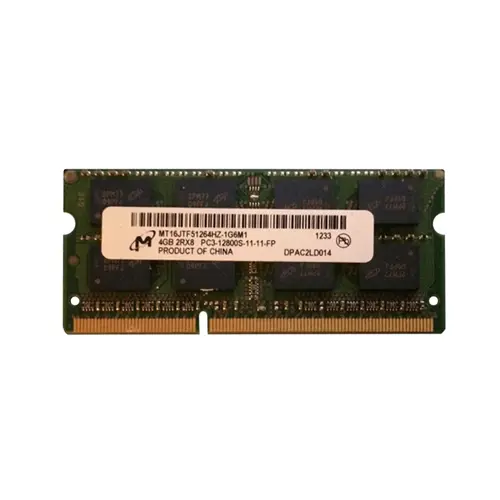
This DDR3-1600 SO-DIMM is a non-ECC, unbuffered notebook memory module purpose-built for upgrading mobile workstations and standard laptops where low power draw and seamless plug-and-play compatibility are essential. Its dual-rank x8 organization improves memory interleaving for higher effective bandwidth, and the CL11 CAS latency provides a responsive computing experience under mixed productivity and multimedia workloads.
1. Its compact SoDIMM form factor guarantees a hassle-free drop-in upgrade for space-constrained laptops, eliminating any guesswork about physical fit.
2. Entry-level memory capacity comfortably handles everyday multitasking like web browsing, office suites, and streaming, extending the usable life of a portable system.
3. DDR3 technology provides broad plug-and-play compatibility with countless aging notebooks, making it the safest choice for a stable refresh.
4. The exact pin layout aligns perfectly with standard mobile memory slots, so you can click it in with confidence and avoid any physical installation mismatch.
5. A mainstream peak transfer speed ensures smooth application launches and fluid desktop responsiveness, preventing sluggishness during typical on-the-go workloads.
The MT16JTF51264HZ-1G6M1 is clearly a notebook memory module, and understanding its design reveals exactly why it matters for your mobile computing experience. This 4GB DDR3-1600 SO-DIMM is built around four crucial characteristics that directly address real-world laptop pain points.
First, the 204-pin SO-DIMM form factor ensures instant physical compatibility across countless thin-and-light notebooks and mobile workstations. When you open up a Lenovo ThinkPad or a Dell Latitude for an upgrade, you are not wrestling with desktop-sized sticks—this compact module slips in securely, eliminating guesswork and returns. Second, the DDR3-1600 speed paired with a CL11 latency delivers that snappy responsiveness professionals need while keeping power draw in check. For a field engineer analyzing data logs on battery, every watt saved between application loads extends productivity. Third, the dual-rank x8 architecture is a subtle but powerful asset. By interleaving memory banks, it increases bandwidth for integrated graphics, making a noticeable difference when you are presenting a complex CAD model on a video call or juggling multiple browser tabs and spreadsheets in a mobile workstation. Fourth, choosing an unbuffered, non-ECC design offers maximum cost-effectiveness and broad platform support without sacrificing everyday stability. RoHS compliance further guarantees responsible sourcing. Whether you are reviving an aging ultrabook for smooth office multitasking or equipping a portable workstation for reliable on-site diagnostics, this module delivers a tangible upgrade in speed, fit, and dependability.
Laptop Upgrade
For mainstream notebooks with a single 4GB module, adding a second identical Micron 4GB DDR3-1600 SO-DIMM unlocks dual-channel mode, doubling memory bandwidth to 25.6 GB/s. This 8GB configuration handles modern OS multitasking and dozens of browser tabs smoothly. For machines with a single slot, replace the existing module with two 4GB sticks to achieve the same 8GB dual-channel uplift.
Mobile Workstation
Maximize capacity by installing two 4GB modules in free slots, yielding 8GB in dual-channel, which suits moderate CAD and photo-editing workloads. If the platform supports 8GB SO-DIMMs, consider migrating to a 2×8GB 16GB kit using DDR3-1600 for better large-scene rendering headroom, though this particular 4GB stick then serves as secondary memory or in a spare test system.
Ultrabook Power Saving
This standard-voltage (1.5V) DDR3-1600 SO-DIMM can serve as a capacity upgrade, but on power-sensitive Ultrabooks prefer matching it with an identical 1.5V module rather than mixing low-voltage DDR3L. For optimal battery runtime, future upgrades should target dual-rank DDR3L-1600 modules operating at 1.35V; keep this 4GB stick as an emergency spare, as lower voltage directly extends unplugged endurance.
Qualified for laptops such as ThinkPad T430, Dell Latitude E6430, HP EliteBook 8470p—rigorously tested.
Q: Can I mix this MT16JTF51264HZ-1G6M1 with other memory modules of different brands or speeds?
A: Mixing is possible but not recommended. The system will downclock all modules to the slowest common speed and may face stability risks. For reliable dual-channel operation, install identical DDR3L/DDR3 SODIMMs with matching timings, rank, and capacity.
Q: Is this memory compatible with my system?
A: This 204-pin DDR3-1600 SODIMM is compatible with most notebooks supporting 3rd/4th Gen Intel Core or AMD A-series APU platforms that accept standard 1.5V DDR3 memory. Verify your model supports 4GB dual-rank x8 unbuffered non-ECC modules for a safe fit.
Q: What is the recommended DIMM population order for optimal performance?
A: For notebooks with two SODIMM slots, install matching pairs of this module in both slots to enable dual-channel interleaving, which improves memory bandwidth. If only one slot is available, no population order applies.
Q: Does this module support overclocking or XMP profiles?
A: No, this module operates at standard JEDEC DDR3-1600 CL11 settings. It does not support XMP profiles or overclocking, as it is an unbuffered SODIMM designed for stable, plug-and-play performance in mobile systems.
Q: What warranty and typical failure rate can I expect?
A: This module includes a one-year warranty. It is built to JEDEC standards with a typically extremely low annualized failure rate under normal operating conditions, reflecting robust quality control and long-term reliability.