











 Secure payments
Standard refund policy
Trade Assurance
Secure payments
Standard refund policy
Trade Assurance
| Product Type | Memory Module |
|---|---|
| Compliance Standards | RoHS |
| Memory Capacity | 4 GB |
| Memory Technology | DDR3 |
| Product Voltage | 1.35V |
| RAM Speed | 1600MHz |
| RAM Standard | DDR3-1600/PC3-12800 |
| Error Identifying | ECC |
| Signal Type | Unbuffered |
| Column Access Strobe (CAS) | CL11 |
| Rank | Dual Rank x8 |
| Quantity of Pins | 240-pin |
| RAM Genre | UDIMM |
This low-voltage (1.35V) DDR3-1600 ECC Unbuffered DIMM is ideally suited for entry-level servers or small NAS systems where data integrity is critical, delivering reliable error correction without the cost of registered memory. Its dual-rank x8 organization provides a good balance of capacity and interleaving performance, ensuring stable 24/7 operation in platforms that support unbuffered ECC memory.
1. ECC memory detects and corrects single-bit errors in real time, preserving data integrity for mission-critical database transactions and financial computations where even a single corrupted bit is unacceptable.
2. Unbuffered signaling eliminates the latency overhead of register chips, making this module well-suited for entry-level server applications that demand snappy response times and straightforward platform compatibility.
3. Low 1.35V operation reduces overall power draw and thermal output, helping cost-conscious data centers extend hardware lifespan and lower cooling expenses in always-on deployments.
4. Dual Rank x8 organization leverages parallel access across two internal rank groups, sustaining memory bandwidth during peak loads to keep virtualized web servers and light container workloads responsive.
5. DDR3 technology delivers a mature, validated ecosystem for existing server fleets, ensuring seamless drop-in upgrades and stable operation without the validation risks of newer, costlier memory standards.
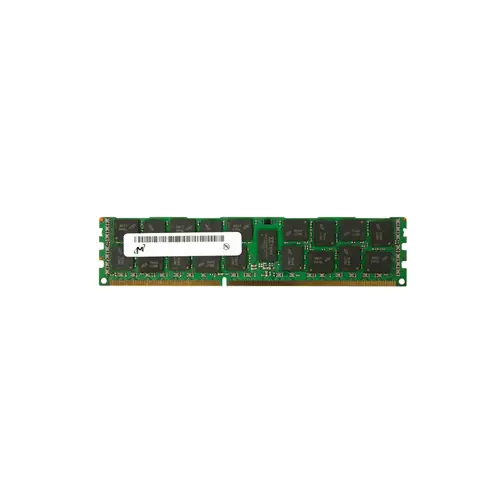
Engineered for entry-level servers and workstations, the Micron MT18KSF51272AZ-1G6 is a 4GB DDR3-1600 UDIMM that brings enterprise-grade dependability to critical workloads. Its ECC error correction actively detects and corrects single-bit memory errors caused by cosmic radiation or electrical noise—an absolute necessity when running a virtualization cluster, where a flipped bit in a hypervisor’s memory space can silently corrupt multiple guest machines and bring down entire services. The dual-rank x8 organization further interleaves memory accesses, increasing effective bandwidth so that in-memory databases like Redis can serve more queries per second without stalling the CPU. You also benefit from the 1.35V low-voltage operation: across a fleet of 24/7 microservers, that reduced power draw translates directly into lower cooling costs and a smaller electrical bill, all without sacrificing stability. For IT professionals managing virtualized infrastructure or lightweight database nodes, this module means fewer crashes, predictable performance, and long-term operational savings in every rack.
This DDR3L-1600 ECC Unbuffered DIMM (240-pin, 1.35 V) targets entry-level servers. Given the 4 GB per module, planning must leverage multiple DIMMs to meet workload demands.
General Virtualization
Populate all memory channels identically with 4 GB DIMMs for maximum bandwidth and reduced NUMA latencies. A 6 × 4 GB (24 GB) configuration comfortably supports 5–8 light VMs on a hypervisor. Always enable ECC to protect against bit errors.
In-Memory Database
For Redis or small SAP HANA instances, install the maximum supported modules—e.g., 8 × 4 GB yielding 32 GB—using every channel. ECC is non-negotiable for data integrity. If database growth exceeds 32 GB, plan to replace with higher-density RDIMMs.
High-Performance Computing
HPC nodes require symmetric memory per CPU for balanced bandwidth. Equip a dual-socket server with three matched 4 GB DIMMs per processor (24 GB total). This fits compute-bound simulations; scale out across many nodes to overcome the limited capacity per node.
Rigorously tested server memory, compatible with Dell PowerEdge R210 II, HP MicroServer Gen8, Lenovo ThinkServer TS140.
Q: Can I mix this MT18KSF51272AZ-1G6 with other memory modules of different brands or speeds?
A: Mixing is not advised. ECC UDIMMs require matched modules to maintain error correction stability. Different brands or speeds may force the memory controller to downclock or disable ECC, risking data integrity.
Q: Is this memory compatible with my Intel or AMD server platform?
A: This DDR3L 1.35V ECC Unbuffered DIMM fits servers supporting Intel Xeon E3/E5 v2/v3 or AMD Opteron 4000/6000 series. Check your board’s memory QVL for 1600MHz, dual-rank x8, and 240-pin UDIMM support.
Q: What is the recommended DIMM population order for optimal performance?
A: Refer to your server board manual. Typically, install in slots DIMM_A1 and DIMM_B1 first to enable dual-channel symmetric mode, then add pairs to consecutive slots. Mismatched populations may reduce bandwidth.
Q: Does this module support overclocking or XMP profiles?
A: No. As a server-grade ECC module, it runs strictly at JEDEC-standard DDR3-1600 with CL11 timing. Overclocking and XMP are not supported, as stability and ECC functionality take priority.
Q: What warranty and typical failure rate can I expect?
A: This module carries a 1-year limited warranty. Its enterprise-grade design achieves an annualized failure rate (AFR) far below 0.5% in typical 24/7 server environments, ensuring dependable long-term operation.