











 Secure payments
Standard refund policy
Trade Assurance
Secure payments
Standard refund policy
Trade Assurance
| Product Type | Memory Module |
|---|---|
| Compliance Standards | RoHS |
| Memory Capacity | 4 GB |
| Memory Technology | DDR3 |
| RAM Speed | 1600MHz |
| RAM Standard | DDR3-1600/PC3-12800 |
| Error Identifying | Non-ECC |
| Signal Type | Unbuffered |
| Column Access Strobe (CAS) | CL11 |
| Rank | Dual Rank x8 |
| Quantity of Pins | 240-pin |
| RAM Genre | UDIMM |
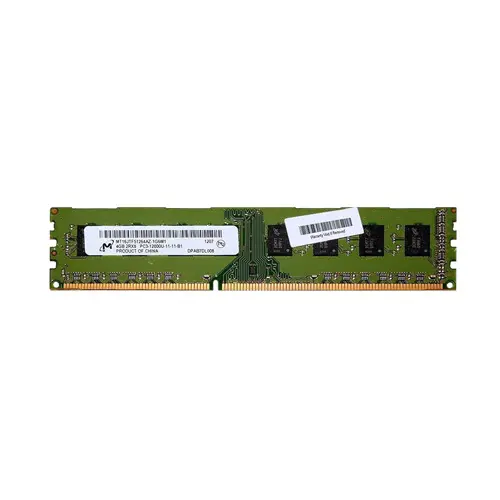
This DDR3-1600 UDIMM is a desktop-class memory module, optimally suited for mainstream productivity desktops, budget gaming rigs, and home theater PCs where a balance of capacity and responsiveness is needed. Its dual-rank x8 organization enhances memory interleaving to improve sustained bandwidth under multi-tasking workloads, while the unbuffered signal path ensures minimal command latency for snappy application launches and smooth system operation at the rated CL11 timing.
1. The DDR3 memory technology delivers proven compatibility with legacy desktop platforms, enabling cost-effective life extension for older workstations still handling everyday productivity tasks.
2. A 1600MHz transfer rate ensures responsive application loading and smooth multi-tab browsing, keeping aging systems surprisingly capable for light content creation.
3. The CL11 timing provides a balance between access latency and stability, offering snappier system feel in routine desktop multitasking without exotic tuning.
4. Dual Rank x8 organization enables rank interleaving, which improves data throughput efficiency and benefits memory-intensive scenarios like photo editing on entry-level creative rigs.
5. The 4 GB capacity serves as an ideal plug-and-play upgrade target for dual-slot deskside configurations, affordably raising total memory to comfortable multitasking levels for home office use.
Engineered for desktops, this 4GB DDR3-1600 UDIMM integrates four specs that solve real-world frustrations. Its unbuffered, non-ECC architecture eliminates register overhead, slashing command latency to the absolute minimum—critical for AAA gaming where shorter delays improve hit registration and reduce micro-stutter. The 1600MHz speed paired with a dual-rank x8 layout enables rank interleaving: while one rank refreshes, the other streams textures and shaders, preventing loading hitches in open-world exploration or real-time 4K video editing in Premiere Pro. A CAS latency of 11 keeps column strobe responsive, so the memory controller never idles during asset fetches. For upgraders reviving an aging desktop, these characteristics translate into seamless game capture, fluid multitasking between rendering and live preview, and consistently stable frame pacing. It's memory where every specification actively works to eliminate the micro-lag that disrupts creative workflows and competitive play.
Gaming Build
A dual-channel kit containing two of these 4GB UDIMMs (8GB total) provides sufficient bandwidth for 1080p gaming at medium-to-high settings. To reach 16GB, populate all four DIMM slots with identical DDR3-1600 CL11 modules—the fully populated dual-rank configuration aids frame-time consistency. For a 32GB target these 4GB sticks are impractical on consumer boards; consider upgrading to 8GB modules instead.
Content Creation
A 64GB workspace for 4K video editing or 3D rendering cannot be built solely with these 4GB modules, as a standard desktop maxes out at 16GB across four slots. Begin with four matched sticks for a 16GB baseline that handles light compositing, then plan a transition to 16GB UDIMMs or a modern DDR4 platform to reach 64GB without overloading the memory controller.
General Productivity
Everyday tasks such as web browsing, document editing, and video calls run comfortably on a 8GB dual-channel pair of these affordable UDIMMs. Heavy multitaskers who keep numerous spreadsheets and browser tabs open should install four modules for a 16GB configuration, which minimizes paging activity and keeps the system responsive while preserving a budget-friendly profile.
Rigorously tested, compatible with desktops like Dell OptiPlex 790, 9010, HP Compaq 8300, and Lenovo ThinkCentre M82.
Q: Can I mix this MT16JTF51264AZ-1G6M1 with other memory modules of different brands or speeds?
A: Mixing is possible but not recommended. The system will run at the lowest common speed and may face stability issues. For guaranteed dual-channel performance, use identical modules with matched capacity, rank, and timings.
Q: Is this memory compatible with my system?
A: This 240-pin DDR3 UDIMM fits desktop motherboards with DDR3 support, such as Intel 6/7/8-series or AMD 900-series chipsets. Please verify your motherboard supports 4GB, dual-rank x8, and 1600MHz non-ECC unbuffered memory.
Q: What is the recommended DIMM population order for optimal performance?
A: Install modules in matched pairs for dual-channel operation, typically populating the same-colored slots first (e.g., DIMM_A2 and DIMM_B2). Refer to the motherboard manual for proper slot mapping to avoid signal reflection and ensure rank symmetry.
Q: Does this module support overclocking or XMP profiles?
A: No, this is a JEDEC-compliant DDR3-1600 CL11 module. It does not carry XMP profiles and is not intended for overclocking. It delivers reliable, validated performance at the default 1600MHz frequency and standard voltage.
Q: What warranty and typical failure rate can I expect?
A: It comes with a 1-year warranty. The module undergoes rigorous 100% production testing to ensure an extremely low annualized failure rate, typically below 0.2% in normal desktop environments, ensuring consistent long-term durability.