











 Secure payments
Standard refund policy
Trade Assurance
Secure payments
Standard refund policy
Trade Assurance
| Product Type | Memory Module |
|---|---|
| Compliance Standards | RoHS |
| Memory Capacity | 4 GB |
| Memory Technology | DDR3 |
| RAM Speed | 1600MHz |
| RAM Standard | DDR3-1600/PC3-12800 |
| Error Identifying | Non-ECC |
| Signal Type | Unbuffered |
| Column Access Strobe (CAS) | CL11 |
| Rank | Dual Rank x8 |
| Quantity of Pins | 240-pin |
| RAM Genre | UDIMM |
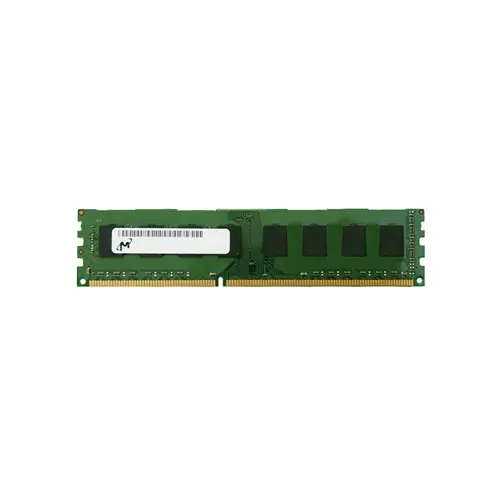
This unbuffered, non-ECC UDIMM is engineered for desktop platforms, ideally suited for gaming, content creation, and general productivity workloads where its dual-rank x8 organization boosts memory bandwidth through rank interleaving. The DDR3-1600 speed at CL11 latency ensures stable, cost-effective performance in legacy systems that demand reliable multitasking without the overhead of error correction.
1. A full 4 GB capacity provides enough headroom for modern desktop multitasking, letting you run a web browser, office suite, and media player simultaneously without hitting the disk-based page file.
2. 1600 MT/s data rate translates to a peak bandwidth of 12.8 GB/s, ensuring smooth texture streaming and faster level loads in mainstream gaming titles.
3. CL11 column access latency keeps read response times tight, delivering snappy system feel and reducing micro-stutter during competitive multiplayer sessions.
4. Dual-rank x8 organization enables rank interleaving that maximizes command bus utilization, giving a tangible boost to content creation workflows like photo batch processing and video rendering.
5. Unbuffered UDIMM architecture strips away buffer register delays, lowering memory access latency for the split-second responsiveness that gamers and overclockers demand from their desktop systems.
Based on the 240-pin UDIMM form factor, unbuffered signal type, and non-ECC error identification, this is distinctly a desktop memory module built for responsiveness rather than server-grade data integrity. The non-ECC, unbuffered architecture means the memory controller talks directly to the DRAM chips without a register buffer or error-checking overhead, shaving off critical nanoseconds of latency. For an enthusiast running the latest AAA title, that translates into faster command execution between your CPU and RAM, keeping minimum frame rates high during sudden particle effects or texture streaming. The dual-rank x8 organization further enables rank interleaving, so while one rank refreshes or completes a read, the other can already be starting the next operation—crucial when you are simultaneously recording gameplay footage or live-streaming. Meanwhile, the CL11 latency at 1600MHz ensures a tight data access response, reducing the micro-stutter that can break immersion. In heavy video rendering workloads, where an application constantly reads and writes layered 4K timelines, the combination of dual-rank parallelism and unobstructed signal path prevents pipeline bubbles. You are not just adding capacity; you are preserving a consistent, low-latency flow that directly impacts how fluid your edits scrub and how quickly final exports complete.
Gaming Build
For a dual-channel gaming configuration, using two identical 4GB UDIMMs delivers 8GB total, which meets minimum requirements for older or entry-level DDR3 gaming rigs running titles that are not memory-hungry. For 16GB, combine four of these 4GB modules across all DIMM slots, while a 32GB kit would necessitate moving to 8GB sticks—these 4GB modules alone cannot practically reach 32GB without an 8-slot board. Dual‑rank x8 design helps sustain decent bandwidth, but 1600MHz CL11 is a modest speed today; it suits budget-conscious builds where matching pairs avoid compatibility issues.
Content Creation
A 64GB capacity for video editing or 3D rendering demands a shift to higher-density DIMMs, as populating four slots with these 4GB UDIMMs yields only 16GB—far below the recommended headroom. In a cost-constrained DDR3 workstation, four 4GB sticks giving 16GB can serve light 1080p timelines, but 4K or complex scenes will suffer from constant paging. For anything approaching 64GB, replace these modules with 8GB or 16GB UDIMMs; existing 4GB parts are better relegated to secondary tasks or a separate low‑load rig.
General Productivity
For office multitasking, web browsing, and lightweight spreadsheets, a pair of these 4GB DDR3-1600 modules in dual-channel mode provides a responsive 8GB system at minimal cost. If the board has four slots, populating two now leaves an upgrade path to 16GB later without discarding the initial investment. Single-rank or dual-rank mix is less critical at this tier, but installing matched 4GB UDIMMs preserves stable dual-channel operation, keeping everyday applications smooth while staying within a tight budget.
This desktop memory has been rigorously tested. Compatible models include Dell OptiPlex 7010, HP EliteDesk 8300, Lenovo ThinkCentre M82.
Q: Can I mix this MT16KTF51264AZ-1G6 with other memory modules of different brands or speeds?
A: Mixing is possible but not recommended. All modules will default to the slowest speed and timings present, potentially compromising performance and stability. For optimal dual-channel operation, install identical kits.
Q: Is this memory compatible with my system?
A: It is a standard DDR3 1600MHz UDIMM for desktops. Verify your motherboard supports 240-pin, non-ECC, unbuffered memory at 1.5V and can accommodate dual-rank x8 modules. Check the board's QVL for confirmation.
Q: What is the recommended DIMM population order for optimal performance?
A: For dual-channel architectures, insert matching modules into slots of the same color (often DIMM_A2 and DIMM_B2 first). Consult your motherboard manual to enable full dual-channel bandwidth and avoid memory errors.
Q: Does this module support overclocking or XMP profiles?
A: No. This module adheres to the JEDEC DDR3-1600 CL11 standard. It does not include XMP profiles and is not engineered for overclocking. It runs reliably at its rated 1600MHz speed with native timings.
Q: What warranty and typical failure rate can I expect?
A: It is backed by a 1-year warranty. Our modules undergo stringent production testing, achieving an extremely low annualized failure rate. You can expect stable, long-term performance under normal operating conditions.