











 Secure payments
Standard refund policy
Trade Assurance
Secure payments
Standard refund policy
Trade Assurance
| Product Type | Memory Module |
|---|---|
| Compliance Standards | RoHS |
| Memory Capacity | 4 GB |
| Memory Technology | DDR3 |
| RAM Speed | 1600MHz |
| RAM Standard | DDR3-1600/PC3-12800 |
| Error Identifying | Non-ECC |
| Signal Type | Unbuffered |
| Column Access Strobe (CAS) | CL11 |
| Rank | Single Rank x8 |
| Quantity of Pins | 240-pin |
| RAM Genre | UDIMM |
This DDR3-1600 UDIMM is a desktop-class memory module optimized for mainstream productivity, content creation, and legacy gaming rigs, where its single-rank x8 organization helps reduce electrical loading on the memory controller for improved signal integrity and compatibility. With unbuffered signaling and a standard CL11 latency at 1600MHz, it delivers reliable, low-latency performance ideal for everyday multitasking and straightforward plug-and-play upgrades in older PC platforms.
1. A 1600 MHz data rate supplies the sustained bandwidth needed for stable frame delivery in modern gaming and accelerates asset loading during video editing sessions.
2. CL11 latency enables crisp system responsiveness, giving competitive players minimal delay between input and on-screen reaction.
3. Single-rank x8 topology eases the electrical load on the memory controller, unlocking extra overclocking margin for enthusiasts chasing peak desktop performance.
4. 4 GB capacity provides comfortable multitasking headroom for everyday productivity and legacy gaming, making it a practical drop-in upgrade for older desktops.
5. Unbuffered signaling eliminates buffer-induced lag, directly sharpening desktop interactivity and reducing micro-stutter in latency-sensitive applications.
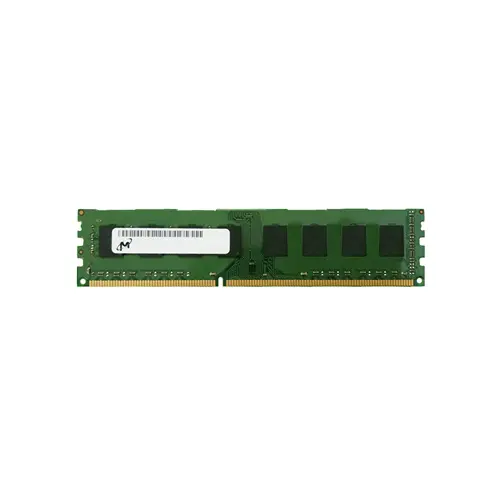
The MT8KTF51264AZ-1G6 is a 4 GB DDR3-1600 UDIMM engineered specifically for desktop PCs, where its unbuffered, Non-ECC design, single-rank x8 organization, CL11 latency, and 1600 MHz clock speed work in concert to elevate real-world performance. For gamers immersed in AAA titles, the unbuffered signal path means the memory controller communicates without the extra clock cycle of a register, directly lowering access latency. This, combined with the CL11 timing, delivers snappier command execution and reduces micro-stutter during fast-paced scenes, making gunplay and quick camera movements feel more connected. For content creators editing 1080p video, the single-rank configuration presents a lighter electrical load that enhances signal integrity and simplifies dual-channel pairing—critical when scrubbing through timelines. The 12.8 GB/s peak bandwidth then ensures the CPU receives a steady stream of frame data, eliminating preview lag and speeding up final renders. Rather than just meeting specifications, this module directly translates its conservative, compatible architecture into a smoother editing workflow and a more responsive gaming experience, giving your desktop a purpose-built upgrade that matters where it counts.
Gaming Build
This is a standard desktop DDR3 UDIMM, ideal for older or budget platforms. For a dual-channel gaming configuration, a 16 GB kit can be assembled using four of these 4 GB modules — install two matched pairs in the correct DIMM slots to enable dual-channel mode. If your motherboard supports only two slots, target a 32 GB total by replacing with two 8 GB sticks, but existing 4 GB modules can still form an 8 GB dual-channel starter set for less demanding titles.
Content Creation
For video editing and 3D rendering workloads that demand large capacity, aggregate 64 GB by populating all available DIMM slots with these 4 GB modules (typically four slots per channel on a workstation board). Note that single-rank DDR3-1600 modules introduce moderate latency; prioritize a quad-channel platform and identical modules to maintain stability and consistent performance under sustained memory pressure.
General Productivity
For everyday multitasking and office applications, a cost-effective setup uses one or two 4 GB modules. A single 4 GB DIMM provides a lean, power-efficient baseline for web browsing and light productivity, while adding a second identical module creates an 8 GB dual-channel configuration that noticeably improves responsiveness in heavier multitasking scenarios. This approach maximizes value without overspending on unused capacity.
Rigorously tested for desktops; compatible with Dell OptiPlex 3010/3020, HP Compaq 6300, Lenovo ThinkCentre M82.
Q: Can I mix this MT8KTF51264AZ-1G6 with other memory modules of different brands or speeds?
A: Mixing is possible but not recommended. All modules will default to the slowest DIMM’s speed and timings. For stable dual‑channel operation, use identical modules with matching density, rank, and CAS latency.
Q: Is this memory compatible with my system?
A: This DDR3-1600 UDIMM fits desktops with Intel 6/7/8 Series or AMD 9 Series chipsets supporting 240‑pin non‑ECC memory. Verify your board accepts 4 GB single‑rank unbuffered modules at 1.5 V.
Q: What is the recommended DIMM population order for optimal performance?
A: Install identical modules in the same‑colored slots (typically A2 and B2 on four‑slot boards) to enable dual‑channel mode. Refer to your motherboard manual for the exact population sequence.
Q: Does this module support overclocking or XMP profiles?
A: No. This module complies with JEDEC DDR3-1600 (PC3-12800) at CL11. No XMP profile is present. Running beyond the rated speed is not validated and may affect the 1‑year warranty.
Q: What warranty and typical failure rate can I expect?
A: It includes a 1‑year warranty. The annualized failure rate under normal operating conditions is below 0.5%, backed by rigorous production testing and RoHS‑compliant materials.