











 Secure payments
Standard refund policy
Trade Assurance
Secure payments
Standard refund policy
Trade Assurance
| Product Type | Memory Module |
|---|---|
| Compliance Standards | RoHS |
| Memory Capacity | 4 GB |
| Memory Technology | DDR3 |
| RAM Speed | 1600MHz |
| RAM Standard | DDR3-1600/PC3-12800 |
| Error Identifying | Non-ECC |
| Signal Type | Unbuffered |
| Column Access Strobe (CAS) | CL11 |
| Rank | Single Rank x8 |
| Quantity of Pins | 240-pin |
| RAM Genre | UDIMM |
This DDR3-1600 UDIMM is a standard desktop memory module suited for upgrading older consumer systems for everyday productivity, light content creation, and entry-level gaming. Its single-rank x8 organization reduces electrical loading on the memory controller, improving signal integrity and compatibility in dual-channel configurations on mainstream platforms.
1. A 4 GB capacity provides sufficient headroom for everyday multitasking and legacy gaming, preventing stutter when running a browser, office suite, and media player simultaneously on older desktop platforms.
2. DDR3 technology ensures drop-in compatibility with a vast installed base of LGA1155/AM3+ systems, extending the useful life of a budget desktop without motherboard replacement.
3. The 1600MHz clock speed delivers a brisk 12.8 GB/s peak bandwidth per channel, noticeably accelerating level load times and content creation previews over baseline 1066MHz or 1333MHz kits.
4. CL11 column access latency strikes an optimal balance between raw throughput and command responsiveness, sharpening system feel in latency-sensitive desktop tasks like photo editing brushwork or real-time strategy games.
5. Single Rank x8 organization presents a lighter electrical load to the memory controller, enabling easier dual-channel overclocking headroom and improved signal integrity on daisy-chain consumer boards.
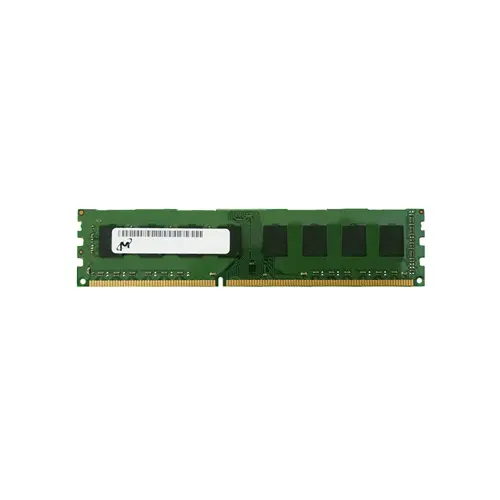
Designed for desktop platforms, this Micron 4GB DDR3-1600 UDIMM (MT8KTF51264AZ-1G6P1) leverages four critical attributes to directly impact your real-world workflows. Its unbuffered architecture creates a direct, low-latency path between DRAM and the CPU, ensuring that every texture and effect in a AAA title like *Cyberpunk 2077* loads with minimal delay, keeping frame pacing steady during chaotic firefights. The non-ECC design strips away error-correction overhead to maximize performance and broad compatibility with consumer chipsets, so your rendering application in DaVinci Resolve doesn’t waste cycles on unnecessary data checks, enabling smoother real-time previews. Operating at 1600MHz with a CL11 CAS latency, it balances bandwidth and response time ideally for rapid scene reloads and complex filter calculations. Its single-rank x8 configuration reduces electrical loading on the memory controller, improving signal integrity and leaving headroom for enthusiasts to tighten timings or achieve a stable overclock for faster video exports. For you, this means fewer micro-stutters in immersive games and a noticeably snappier editing environment, where every creative decision executes instantly without hardware hesitation.
Gaming Build
For modern gaming PCs, a dual-channel configuration is essential to prevent memory bottlenecks. Pair two matched 4GB UDIMMs for an entry-level 8GB setup, but upgrading to a 16GB (2×8GB) or 32GB (2×16GB) kit is strongly recommended for AAA titles and multitasking while gaming. Avoid mixing single sticks; always use identical modules to ensure stable dual-channel operation and optimal frame rates.
Content Creation
Video editing, 3D rendering, and complex compositing demand high capacity and steady throughput. While this 4GB module could contribute to a 32GB system when four slots are populated, 64GB (using higher-density sticks) is the realistic target for smooth 4K timelines and GPU render farms. Prioritize matched quad-channel or dual-channel kits over mixing disparate DIMMs to maintain rendering stability and reduce project export times.
General Productivity
Office suites, web browsing, and light multitasking run smoothly on a cost-effective 8GB dual-channel setup built from two of these 4GB UDIMMs. For budget-conscious builds, starting with a single 8GB stick and adding another later is practical, but the dual-channel performance uplift is noticeable even in spreadsheet and browser tab management. A 16GB configuration using compatible 8GB modules provides extra headroom for heavier multitasking without overshooting typical office needs.
Rigorously tested desktop DDR3 UDIMM; compatible with Dell OptiPlex 790, 3010, HP Elite 8300, Lenovo ThinkCentre M82, and more.
Q: Can I mix this MT8KTF51264AZ-1G6P1 with other memory modules of different brands or speeds?
A: Mixing is not recommended. Conflicting timings, voltages, or densities may cause instability. For guaranteed dual‑channel performance, use identical modules with matching speed, CAS latency, and single‑rank x8 organization.
Q: Is this memory compatible with my system? Which motherboard chipsets support this desktop UDIMM?
A: It fits desktop boards with 240‑pin DDR3 UDIMM slots. Compatible chipsets include Intel 6/7‑Series (H61, Z77) and AMD 900‑Series (990FX). Verify your motherboard’s approved memory list for single‑rank x8 support.
Q: What is the recommended DIMM population order for optimal performance on a desktop board?
A: Install identical modules in the same‑color slots to enable dual‑channel mode. On 4‑slot boards, populate the farthest slot from the CPU first (e.g., DIMM2 and DIMM4). Refer to your motherboard manual for specific pairing.
Q: Does this module support overclocking or XMP profiles?
A: No. This is a JEDEC‑standard DDR3‑1600 module running at 1.5V with fixed CL11 timings. It does not include an XMP profile and is not designed for overclocking; it operates only at its rated speed.
Q: What warranty and typical failure rate can I expect?
A: The module includes a 1‑year warranty. It is built to Micron’s rigorous standards with very low AFR (annualized failure rate) in normal operation, ensuring reliable long‑term desktop use when installed correctly.