











 Secure payments
Standard refund policy
Trade Assurance
Secure payments
Standard refund policy
Trade Assurance
| Product Type | Memory Module |
|---|---|
| Memory Capacity | 4 GB |
| Memory Technology | DDR3 |
| Product Voltage | 1.5V |
| RAM Speed | 1866MHz |
| RAM Standard | DDR3-1866/PC3-14900 |
| Error Identifying | ECC |
| Signal Type | Registered |
| Column Access Strobe (CAS) | CL13 |
| Rank | Single Rank x4 |
| Quantity of Pins | 240-pin |
| RAM Genre | RDIMM |
This DDR3-1866 Registered ECC RDIMM with single-rank x4 organization delivers superior signal stability and data integrity for legacy server environments, making it ideal for virtualization and memory-intensive database workloads. Its CL13 low latency and hardware error correction ensure deterministic performance and 24/7 reliability in mission-critical deployments.
1. ECC protection detects and corrects single-bit memory errors in real time, guaranteeing data integrity for mission-critical database operations and preventing silent data corruption in always-on server environments.
2. Registered signal buffering stabilizes command and address lines, enabling high-capacity memory configurations without signal degradation, which is vital for scaling virtualization density in multi-socket servers.
3. 1866MHz clock speed delivers high memory throughput, reducing latency for in-memory caching and accelerating simultaneous query processing across virtual machines.
4. Single Rank x4 organization uses x4-wide DRAM components to support advanced memory reliability features like Chipkill, significantly lowering the risk of system failure from multi-bit faults in enterprise workloads.
5. 4GB capacity per DIMM provides a fine-grained building block for memory interleaving, allowing balanced channel population that sustains predictable bandwidth under moderate consolidation ratios.
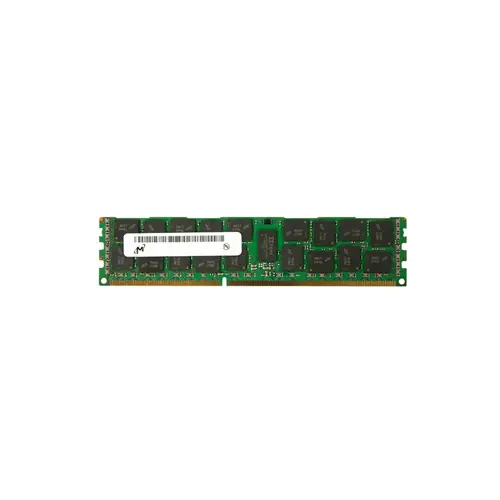
The Micron MT18JSF51272PZ-1G9K1KE is a 4GB DDR3-1866 Registered DIMM built for server environments where uptime and data integrity are non‑negotiable. Its four defining characteristics directly address the real‑world pain points of IT infrastructure managers. The ECC engine is your silent guardian against single‑bit memory errors caused by background radiation; in a virtualized cluster running dozens of VMs on one hypervisor, one uncorrected bit flip can crash a production database or corrupt transactional records. Registered signal buffering lets you fully populate memory channels without degrading command‑bus stability, a critical advantage when scaling an in‑memory database like Redis or SAP HANA across multiple DIMMs — you gain capacity without sacrificing reliability under heavy load. Operating at 1866MHz with a CAS latency of 13, this module delivers responsive data access for latency‑sensitive workloads, ensuring that concurrent query execution in a multi‑tenant database farm remains snappy. And because it features a single‑rank x4 organization, it works interoperably with diverse server chipsets while minimizing electrical loading, giving you the flexibility to mix modules in legacy and modern platforms without compromising the memory interleave scheme. For a virtualized data center or a dedicated database node, these four traits translate into fewer outages, smoother peak‑hour performance, and a lower total cost of risk.
Capacity Planning
This 4GB DDR3-1866 ECC Registered RDIMM is engineered for servers, delivering reliability and data integrity required by enterprise workloads. Proper module quantity and configuration are critical to balance capacity, bandwidth, and cost.
General Virtualization
Virtualized environments depend on ample memory headroom for multiple VMs. With 4GB DIMMs, populate all available channels evenly to maximize interleaving and bandwidth—typically six or eight identical modules per CPU socket. Aim for at least 48GB (12 DIMMs) per host to comfortably run a dozen light-to-medium VMs; scale to 64GB or more for heavier consolidation.
In-Memory Database
In-memory databases demand both high capacity and low latency under ECC protection. Populate every DIMM slot uniformly across all memory controllers to achieve balanced access. A configuration of 16 identical 4GB RDIMMs (64GB total) suits small-to-midsize datasets, while platforms supporting 24 slots can reach 96GB. Keep modules identical to avoid timing penalties.
High-Performance Computing (HPC)
HPC clusters prioritize memory bandwidth per core. Use one DIMM per channel for peak throughput—on a dual-socket server, eight matched 4GB RDIMMs (32GB) deliver optimal transfer rates. If capacity is insufficient for working sets, move to dual-rank or higher-density modules, but avoid mixing, as mismatched ranks degrade performance in tightly coupled parallel jobs.
This server memory has been rigorously tested and is compatible with Dell PowerEdge R720, R620, and HPE ProLiant DL380p Gen8.
Q: Can I mix this MT18JSF51272PZ-1G9K1KE with other memory modules of different brands or speeds?
A: Mixing different brands or speeds is not recommended for server environments. ECC Registered DIMMs require identical part numbers to ensure signal integrity and memory reliability. Mixing may cause POST failures or system instability.
Q: Is this memory compatible with my system?
A: This 4GB DDR3-1866 ECC Registered DIMM is designed for servers using Intel Xeon E5-1600/2600 v1/v2 series or AMD Opteron 6300/4300 platforms with C602/C204 chipsets. Verify that your motherboard supports 1.5V RDIMMs at 1866MHz.
Q: What is the recommended DIMM population order for optimal performance?
A: For optimal performance, populate DIMMs per channel starting with the slot farthest from the CPU. Typically, fill blue or black slots first according to your server board’s manual for balanced memory interleaving across channels.
Q: Does this module support overclocking or XMP profiles?
A: No, this server-grade RDIMM adheres to JEDEC DDR3-1866 CL13 specifications and does not support overclocking or XMP profiles. It operates only at its rated speed of 1866MHz with fixed timings for stability.
Q: What warranty and typical failure rate can I expect?
A: This module comes with a 1-year warranty. Enterprise ECC RDIMMs have a very low annualized failure rate (typically below 0.2%), owing to strict screening and error correction, ensuring high reliability in 24/7 server operations.