











 Secure payments
Standard refund policy
Trade Assurance
Secure payments
Standard refund policy
Trade Assurance
| Product Type | Memory Module |
|---|---|
| Memory Capacity | 4 GB |
| Memory Technology | DDR3 |
| Product Voltage | 1.5V |
| RAM Speed | 1866MHz |
| RAM Standard | DDR3-1866/PC3-14900 |
| Error Identifying | ECC |
| Signal Type | Registered |
| Column Access Strobe (CAS) | CL13 |
| Rank | Single Rank x4 |
| Quantity of Pins | 240-pin |
| RAM Genre | RDIMM |
This RDIMM with ECC and registered signaling is optimized for server environments requiring high data integrity, making it well-suited for virtualization and in-memory database workloads. Its single-rank x4 organization paired with a tight CL13 latency enhances memory controller efficiency and ensures stable operation under sustained heavy loads.
1. ECC protection silently detects and corrects single-bit errors, preserving data integrity for financial transactions and mission-critical databases that cannot tolerate silent corruption.
2. Registered signal buffering stabilizes high-capacity memory channels, allowing dense server deployments to scale up without risking signal degradation or system instability.
3. A 4 GB capacity serves as an efficient building block for moderate virtualization workloads, giving IT administrators the flexibility to right-size memory without overprovisioning.
4. High-frequency DDR3 operation delivers elevated memory bandwidth, accelerating real-time analytics and reducing latency spikes when multiple virtual machines contend for resources.
5. Single Rank x4 organization streamlines command scheduling and minimizes load on the memory controller, yielding predictable access latencies under sustained enterprise workloads.
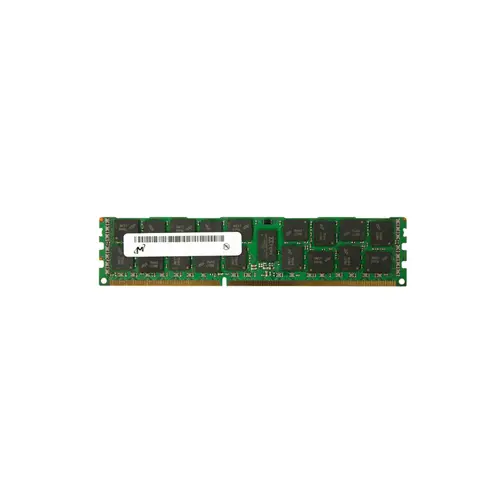
The Micron MT18JSF51272PZ-1G9K1KF is a server-grade DDR3-1866 RDIMM engineered for mission-critical enterprise environments, and its four defining characteristics translate directly into tangible reliability where downtime is not an option. The module’s Error-Correcting Code protection actively detects and corrects single-bit memory errors, a silent threat that can corrupt financial transactions or snapshots in an in-memory database like SAP HANA. Equally vital is its Registered signal architecture, which buffers the command and address lines to stabilize the electrical load when you populate all channels in a dense virtualization cluster; this means your hypervisor can confidently host dozens of VMs without random crashes caused by signal degradation during live migrations. Operating at 1866MHz with a CAS latency of 13, the single-rank x4 organization excels at streaming predictable, low-latency workloads—accelerating real-time analytics queries where every nanosecond of fetch delay compounds across thousands of concurrent users. A standard 1.5V operating voltage further ensures broad compatibility and controlled thermals inside blade servers, letting your data center maintain consistent performance without throttling. In short, this DIMM secures your data integrity, scales your virtual infrastructure, and sustains the deterministic speed that business-critical applications depend on.
General Virtualization
For light to moderate virtualization hosts, populate at least four of these 4 GB RDIMMs across all memory channels to reach a 16 GB baseline per socket, enabling smooth operation of 10–15 low‑resource VMs. Registered ECC ensures data integrity during live migrations and prolonged uptime, while 1866 MHz provides low‑latency memory access for hypervisor overhead. Scale by adding identical modules to maintain balanced channel distribution.
In-Memory Database
In‑memory databases thrive on both capacity and reliability, making this ECC RDIMM a solid building block for smaller cache tiers or entry‑level nodes. Deploy eight or more modules per socket to construct a 32–64 GB footprint for Redis or Memcached instances, and leverage the 1.5 V registered design to keep electrical load stable inside dense server chassis. Single‑rank x4 organization helps maintain consistent access times under heavy key‑value workloads.
High-Performance Computing
HPC clusters that require guaranteed error‑free computation benefit from the registered ECC nature of this memory when assembling cost‑optimized worker nodes. Populate all memory channels with a minimum of eight 4 GB DIMMs per socket to achieve 32 GB, satisfying memory‑bound scientific simulations and MPI jobs while keeping thermals predictable. For nodes running OpenMP or threaded codes, use identical single‑rank modules to avoid timing skew and maximize 1866 MHz throughput across the memory bus.
Rigorously tested, compatible with Dell R720, HP DL380p Gen8, Lenovo x3650 M4, and more.
Q: Can I mix this MT18JSF51272PZ-1G9K1KF with other memory modules of different brands or speeds?
A: Mixing is not recommended for server environments. To maintain ECC integrity and signal stability, use identical registered DIMMs with the same speed, rank, and voltage. Mixed configurations may cause instability or silent data errors.
Q: Is this memory compatible with my server platform?
A: This DDR3-1866 registered ECC DIMM is compatible with select Intel Xeon E5-2600 v2/v3 and AMD Opteron 6300/8300 platforms. Verify your motherboard's qualified vendor list (QVL) to ensure support for 4GB single-rank RDIMMs.
Q: What is the recommended DIMM population order for optimal performance?
A: Populate this single-rank x4 RDIMM in balanced configurations across memory channels. Follow your server board's manual, typically starting with the first slot of each channel. Symmetrical population ensures optimal interleaving and bandwidth.
Q: Does this module support overclocking or XMP profiles?
A: No. This is a server-grade registered ECC module operating strictly at JEDEC standard DDR3-1866 CL13. Overclocking and XMP are not supported to guarantee data integrity and 24/7 reliability in mission-critical operations.
Q: What warranty and typical failure rate can I expect?
A: This module carries a 1-year warranty. Premium Micron RDIMMs like this one typically exhibit an annualized failure rate (AFR) below 0.1%, designed for sustained, error-free operation in enterprise environments.