











 Secure payments
Standard refund policy
Trade Assurance
Secure payments
Standard refund policy
Trade Assurance
| Product Type | Memory Module |
|---|---|
| Compliance Standards | RoHS |
| Memory Capacity | 4 GB |
| Memory Technology | DDR3 |
| Product Voltage | 1.5V |
| RAM Speed | 1866MHz |
| RAM Standard | DDR3-1866/PC3-14900 |
| Error Identifying | ECC |
| Signal Type | Registered |
| Column Access Strobe (CAS) | CL13 |
| Rank | Single Rank x4 |
| Quantity of Pins | 240-pin |
| RAM Genre | RDIMM |
1
1. Registered signal buffering stabilizes command and address lines across fully loaded server memory channels, ensuring reliable operation in high-density rack configurations.
2. ECC error correction detects and corrects single-bit memory faults in real time, preventing silent data corruption that could compromise transactional integrity in database servers.
3. 1866 MT/s transfer rate delivers 14.9 GB/s peak bandwidth per channel, sustaining concurrent virtual machine workloads and accelerating in-memory analytics.
4. Single-rank x4 organization uses narrower DRAM devices to strengthen signal integrity while enabling balanced DIMM loading for consistent data access in multi-slot server boards.
5. A 4GB capacity provides a cost-efficient building block for memory-optimized virtualized environments, allowing granular scaling of VM density without overspending on underutilized RAM.
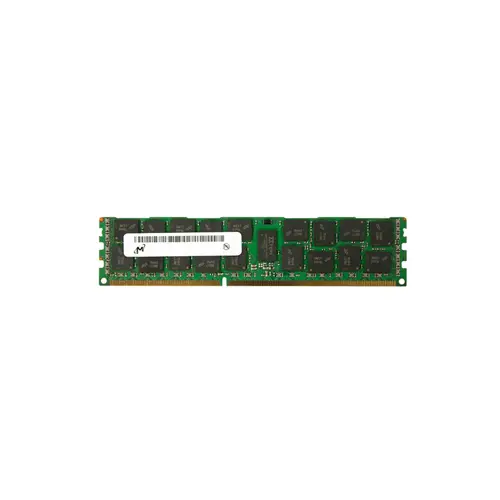
In a server environment, the Micron MT18JSF51272PZ-1G9K1 RDIMM is engineered to eliminate the kind of silent data corruption that can cascade into financial loss or database inconsistency. Its ECC capability continuously detects and corrects single-bit errors caused by background radiation or electrical noise, a non-negotiable safeguard for financial transaction logs or a virtualized SQL cluster where every query must return pristine results. The registered buffer acts as a signal amplifier, stabilizing command and address lines so you can densely populate a 2U virtualization host without timing degradation—this means your hypervisor can confidently manage dozens of VMs even under saturated memory bus loads. With a 1866MHz clock speed and single-rank x4 organization, the module balances low latency and high bandwidth, dramatically accelerating in-memory analytics like a Redis cache where microsecond delays directly impact user-facing response times. When a node in your VMware farm is hosting both the domain controller and a live CRM database, these four traits transform a standard DIMM into an reliability anchor, ensuring peak transactional throughput without compromising uptime.
General Virtualization
For a general virtualization host, install this 4 GB registered ECC module in pairs across memory channels — typically eight or sixteen modules to reach 32–64 GB. This balanced population ensures symmetric memory access, consistently low latency, and full ECC protection for 10–20 light VMs. Avoid mixing different ranks or speeds to maintain stability.
In-Memory Database
In-memory databases such as Redis or Memcached require high capacity and maximum bandwidth. Fully populate all available memory channels with these 4 GB RDIMMs, achieving 48–96 GB with 12 or 24 modules in a triple‑channel platform. The wide parallelism minimizes access latency, while ECC corrects any soft errors in live data.
High-Performance Computing
HPC workloads prioritize memory bandwidth per core over raw capacity. Install one 4 GB RDIMM per channel (for example, six modules for 24 GB in a hexa‑channel system) to deliver uniform bandwidth and avoid NUMA bottlenecks. This cost‑effective setup is ideal for MPI‑based simulations that do not require large per‑node memory.
Rigorously tested server memory compatible with Dell PowerEdge R720/R620, HP ProLiant DL380p Gen8, Lenovo ThinkServer RD630.
Q: Can I mix this MT18JSF51272PZ-1G9K1 with other memory modules of different brands or speeds?
A: Mixing RDIMMs with different brands or speeds is not recommended. This DDR3-1866 registered ECC module will downclock to the slowest installed speed, which may compromise signal integrity and system stability in server environments.
Q: Is this memory compatible with my server? Which Intel or AMD platforms support it?
A: This 240-pin DDR3-1866 registered ECC module is designed for server platforms using Intel Xeon E5-2600 v2 series or equivalent AMD Opteron processors. Verify your motherboard's qualified vendor list (QVL) for compatibility.
Q: What is the recommended DIMM population order for optimal performance?
A: For optimal performance, populate identical DIMMs per channel, beginning with the slots farthest from the CPU. Follow your server board's manual for balanced memory configurations to enable multi-channel interleaving.
Q: Does this module support overclocking or XMP profiles?
A: No, this is a server-grade RDIMM that adheres to JEDEC DDR3-1866 specifications. It does not support overclocking or XMP profiles, as reliability and error correction take priority over tunable memory frequencies.
Q: What warranty and typical failure rate can I expect?
A: This module includes a one-year warranty. Enterprise RDIMMs typically exhibit an annualized failure rate (AFR) well below 0.5% under specified operating conditions, ensuring high reliability for critical workloads.