











 Secure payments
Standard refund policy
Trade Assurance
Secure payments
Standard refund policy
Trade Assurance
| Product Type | Memory Module |
|---|---|
| Compliance Standards | RoHS |
| Memory Capacity | 4 GB |
| Memory Technology | DDR3 |
| Product Voltage | 1.5V |
| RAM Speed | 1866MHz |
| RAM Standard | DDR3-1866/PC3-14900 |
| Error Identifying | ECC |
| Signal Type | Registered |
| Column Access Strobe (CAS) | CL13 |
| Rank | Single Rank x4 |
| Quantity of Pins | 240-pin |
| RAM Genre | RDIMM |
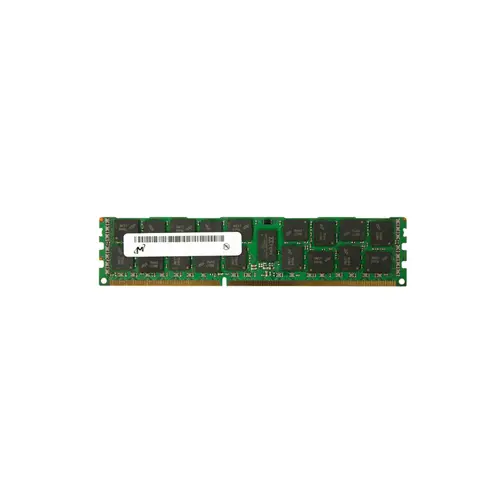
This Micron RDIMM is a server-class DDR3 module engineered for enterprise platforms, ideally suited for virtualization, in-memory databases, and any workload demanding uncompromising data integrity. Its registered signal design with ECC and single-rank x4 organization ensures stable operation at 1866 MHz, delivering both low CL13 latency and minimal electrical loading for reliable, high-density deployments.
1. ECC memory actively detects and corrects single-bit errors, ensuring data integrity in 24/7 server environments where silent corruption can undermine transactional accuracy.
2. Registered signal buffering stabilizes command and address lines across high-density memory configurations, allowing large-scale virtualization hosts to maintain rock-solid uptime.
3. High-bandwidth DDR3 operation supplies the throughput needed to feed multi-core server processors, reducing memory bottlenecks during simultaneous virtual machine launches.
4. Single Rank x4 organization strengthens advanced error containment at the chip level, enabling mission-critical systems to sustain operation through hardware-level fault resilience.
5. Tightly tuned CAS latency accelerates data fetches for in-memory databases, delivering the responsiveness required for real-time analytics and online transaction processing.
The Micron MT18JSF51272PZ-1G9K1HE is an RDIMM purpose-built for server architectures where compromise is unacceptable. Its four defining characteristics—1866MHz speed, ECC, registered buffering, and a single-rank x4 configuration—directly translate into tangible business resilience. In a virtualized VMware or Hyper-V cluster hosting dozens of guest machines, the registered buffer stabilizes signal timing across fully populated memory channels, allowing you to scale capacity without unpredictable crashes during live migration. Simultaneously, ECC silently detects and corrects single-bit errors, preventing undetected data corruption from cascading into a financial ledger or a patient database—a silent guardian that turns fatal bit flips into non-events. For real-time in-memory caches like Redis or Memcached, the 1866MHz clock and PC3-14900 bandwidth cut through latency, delivering data with the consistency that thousands of simultaneous user sessions demand. The single-rank design further minimizes bank conflicts and lightens the memory controller load, shaving crucial microseconds off query responses. Operating at the standard 1.5V, this module blends throughput and stability, making it a trustworthy backbone for your mission-critical data center operations.
General Virtualization
This 4GB DDR3-1866 RDIMM suits small-scale virtualization hosts running light services or legacy hypervisors. For efficient multi-VM operation, aim for at least six identical modules (24GB) in balanced channels to avoid memory contention. Registered ECC ensures data integrity under sustained uptime, critical for multi-tenant environments.
In-Memory Database
In-memory datasets demand low latency and fault tolerance. Deploy this module in sets of eight (32GB) or more, populating all memory channels evenly to maximize bandwidth for real-time analytics. The CL13 latency and 1866MHz speed deliver responsive lookups, while ECC prevents silent corruption in transactional caches.
High-Performance Computing
HPC clusters benefit from the reliable synchronization of registered DIMMs. Configure compute nodes with fully populated memory banks—twelve or sixteen modules per node—to feed many-core CPUs with steady throughput. ECC and ranked addressing stabilize long-running parallel workloads, though capacity-hungry simulations may require higher-density kits as a baseline.
Rigorously tested for servers: compatible with Dell PowerEdge R720, HP ProLiant DL380p Gen8, and similar DDR3 ECC RDIMM systems.
Q: Can I mix this MT18JSF51272PZ-1G9K1HE with other memory modules of different brands or speeds?
A: Mixing is not recommended. Registered ECC modules require identical specifications for stable operation. Different brands or speeds may cause signal integrity issues and system instability on server platforms.
Q: Is this memory compatible with my system?
A: This RDIMM is designed for DDR3-based servers using Intel Xeon E5-2600 v1/v2 or AMD Opteron 6300 series platforms. Verify your motherboard supports Registered ECC 1866MT/s memory at 1.5V.
Q: What is the recommended DIMM population order for optimal performance?
A: Populate identical DIMMs per channel, starting with the slot farthest from the CPU. For single-rank x4 modules like this, follow your server board's manual for balanced memory configuration to maximize bandwidth.
Q: Does this module support overclocking or XMP profiles?
A: No. This is a JEDEC-compliant server memory module operating at standard DDR3-1866 specifications. It does not support XMP profiles or overclocking, ensuring 24/7 mission-critical reliability.
Q: What warranty and typical failure rate can I expect?
A: This module carries a 1-year warranty. Enterprise-grade RDIMMs exhibit extremely low annualized failure rates (typically under 0.5%) when operated within specified voltage and temperature limits.