











 Secure payments
Standard refund policy
Trade Assurance
Secure payments
Standard refund policy
Trade Assurance
| Product Type | Memory Module |
|---|---|
| Compliance Standards | |
| Memory Capacity | 4 GB |
| Memory Technology | DDR3 |
| Product Voltage | 1.5V |
| RAM Speed | 1866MHz |
| RAM Standard | DDR3-1866/PC3-14900 |
| Error Identifying | ECC |
| Signal Type | Registered |
| Column Access Strobe (CAS) | CL13 |
| Rank | Single Rank x8 |
| Quantity of Pins | 240-pin |
| RAM Genre | RDIMM |
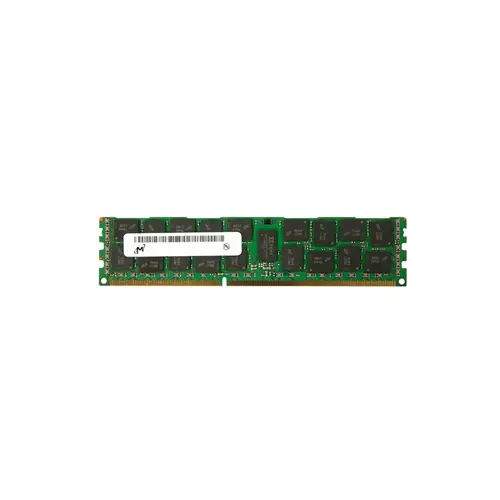
This RDIMM leverages registered signal technology and ECC to ensure critical data integrity in high-density server environments. Its 1866MHz speed with tight CL13 latency and single-rank x8 configuration makes it particularly well-suited for memory-intensive virtualization and in-memory database workloads that demand consistent, low-latency access to error-free data.
1. ECC protection silently corrects single-bit errors in real time, preventing data corruption in financial databases and critical virtualization workloads that cannot afford unplanned downtime.
2. Registered signal buffering stabilizes high-density memory configurations, enabling the server to scale RAM capacity reliably across multiple DIMMs for heavy in-memory analytics.
3. 1866 MHz data rate delivers strong throughput for concurrent request streams, reducing latency in web server farms and speeding up large dataset processing.
4. CL13 column access strobe latency keeps cache misses fast and predictable, which sharpens responsiveness for latency-sensitive applications like real-time bidding platforms.
5. Single Rank x8 architecture presents a lighter electrical load on the memory bus, helping maintain high clock stability in fully populated server nodes and reducing thermal stress.
As a server memory module, the MT9JSF51272PZ-1G9E2 is engineered for environments where every bit matters. Its ECC technology catches single-bit errors caused by cosmic radiation or electrical noise—essential when a flipped bit could crash a VM or corrupt an in-memory Redis transaction. The Registered buffer strengthens signal integrity across fully populated DIMM slots, allowing dense VMware clusters to run dozens of virtual machines stably without memory-related boot failures. With 1866MHz speed and CL13 low latency, memory-bound workloads like SQL Server queries and Memcached operations see noticeably faster response times. The reliable 1.5V supply ensures steady power delivery under 24/7 operation, avoiding voltage droop that often triggers errors in long-running database instances. For virtualization farms and in-memory databases, this RDIMM delivers the data accuracy, scalability, and performance your infrastructure demands.
General Virtualization
This 4GB DDR3-1866 ECC Registered RDIMM is suited for small-scale virtualization hosts or legacy hypervisor deployments. For lightweight VM workloads, populate six to eight identical modules across triple-channel or quad-channel architectures to reach 24GB–32GB, ensuring ECC protection for stable multi-tenant operation. Always install matched sets to maintain memory interleaving and minimize performance penalties.
In-Memory Database
In-memory databases like Redis or Memcached demand capacity and fault resilience, making this ECC RDIMM a building block for caching layers. Deploy at least 12 modules (48GB) in a dual-socket server to hold substantial datasets, and leverage registered signaling for stable high-density configurations. Plan for headroom by populating all available channels with identical 4GB sticks to keep latency low under heavy read/write pressure.
High-Performance Computing
HPC clusters processing large datasets benefit from the bandwidth of DDR3-1866 when modules are installed symmetrically across all memory channels. For compute nodes, use eight or sixteen 4GB RDIMMs (32GB–64GB total) in a balanced quad-channel layout to maximize throughput. Stick to validated vendor lists and identical single-rank x8 DIMMs to avoid NUMA imbalances and ensure deterministic performance during parallel jobs.
Rigorously tested, compatible with Dell PowerEdge R720/R620, HP DL380p Gen8, and Lenovo ThinkServer RD630.
Q: Can I mix this MT9JSF51272PZ-1G9E2 with other memory modules of different brands or speeds?
A: Mixing is not recommended. For stable server operation, always match identical part numbers, ranks, and timings. Mixing brands or speeds risks POST failures and memory errors.
Q: Is this memory compatible with my system?
A: This 4GB DDR3-1866 ECC RDIMM supports various Intel Xeon E5/E3 and AMD Opteron platforms. Please verify your server or motherboard supports registered DDR3 memory and 1.5V operation.
Q: What is the recommended DIMM population order for optimal performance?
A: Populate identical DIMMs per channel following your server board's slot numbering: typically blue slots first, then black. Consult your system manual for balanced memory configurations.
Q: Does this module support overclocking or XMP profiles?
A: No, enterprise RDIMMs run at JEDEC-standard speeds only. Overclocking and XMP are unsupported and could compromise system stability and data integrity.
Q: What warranty and typical failure rate can I expect?
A: This module includes a one-year warranty. Enterprise DDR3 RDIMMs exhibit extremely low annualized failure rates, typically below 0.2% under normal operating conditions.