











 Secure payments
Standard refund policy
Trade Assurance
Secure payments
Standard refund policy
Trade Assurance
| Product Type | Memory Module |
|---|---|
| Compliance Standards | RoHS |
| Memory Capacity | 4 GB |
| Memory Technology | DDR3 |
| Product Voltage | 1.5V |
| RAM Speed | 1866MHz |
| RAM Standard | DDR3-1866/PC3-14900 |
| Error Identifying | ECC |
| Signal Type | Registered |
| Column Access Strobe (CAS) | CL13 |
| Rank | Single Rank x8 |
| Quantity of Pins | 240-pin |
| RAM Genre | RDIMM |
This DDR3-1866 RDIMM with ECC and a registered signal type is ideally suited for legacy server platforms running memory-intensive workloads such as virtualization and in-memory databases, where 1866 MHz speed and CL13 latency help maintain responsive performance. Its single-rank x8 configuration ensures lower electrical loading on the memory bus, enhancing signal integrity and allowing stable operation even in fully populated server boards that demand uncompromised data integrity.
1. The 4 GB capacity provides a dense enough memory payload for lightweight virtualized nodes or dedicated network appliance roles, keeping per‑gigabyte power and cost predictable in scale‑out server farms.
2. Operating at 1866 MHz, this module sustains higher memory bandwidth per channel, helping transactional databases and mid‑tier web servers handle concurrent requests with visibly lower queuing delays.
3. ECC error correction radically raises system uptime by detecting and fixing single‑bit flips, a must‑have safeguard for financial ledgers, medical records, and any workload where silent data corruption is unacceptable.
4. The registered signal type buffers command and address buses via an onboard register, permitting servers to populate all memory slots without signal integrity collapse and thus achieve maximum capacity for memory‑hungry virtualization hosts.
5. A CAS latency of 13 cycles shortens the memory access gap, improving per‑thread responsiveness in sensitive workloads such as in‑memory caching and high‑frequency trading engines where every cycle counts.
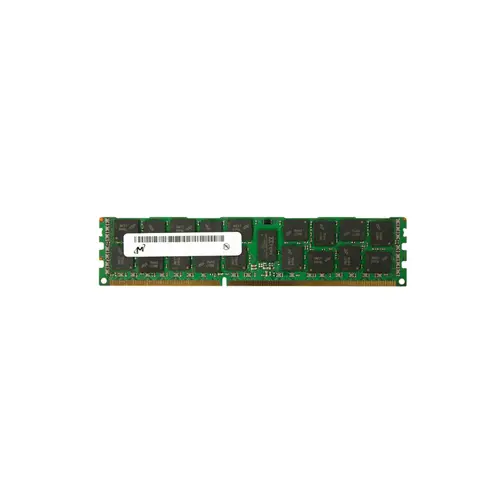
Designed for server and enterprise workloads, the Micron MT9JSF51272PZ-1G9E2HI is a DDR3‑1866 Registered DIMM whose four core attributes directly solve real‑world infrastructure challenges. Its ECC protection silently corrects single‑bit memory errors, preventing silent data corruption that would otherwise crash virtualized workloads or poison financial transactions inside an in‑memory database. The registered buffer isolates electrical loads from the memory controller, allowing you to populate all channels without signal degradation—this scalability is non‑negotiable when a virtualization cluster demands terabytes of stable address space across dozens of VMs. The 1866MHz clock speed, paired with a Single‑Rank x8 configuration, delivers optimized bandwidth and low access latency specifically for latency‑sensitive analytics workloads. Single Rank also reduces command bus loading, ensuring crisp response times under heavy consolidation. Together, these traits provide a hypervisor host running critical databases with bulletproof transactional integrity and continuous uptime, turning a memory module into a strategic asset against costly, unexplained outages.
General Virtualization
For a typical hypervisor hosting multiple VMs, populate at least six to eight identical 4 GB RDIMMs per socket to enable balanced memory interleaving and adequate density. This provides 24–32 GB per CPU, which suits moderate consolidation of web servers, domain controllers and light application VMs without excessive overcommit.
In-Memory Database
Latency-sensitive in-memory databases (e.g., Redis, Memcached) require high capacity and peak bandwidth, so fill all memory channels with these 1866 MHz single-rank DIMMs. Aim for a minimum of 12–16 modules (48–64 GB) per node to hold large working sets entirely in RAM and sustain high transaction rates with ECC protection.
High-Performance Computing (HPC)
HPC workloads demand maximum memory bandwidth. Install one 4 GB RDIMM per channel across all available channels to leverage the full memory bus width, typically using eight or twelve modules per dual-socket server. Registered ECC memory ensures data integrity during multi-day simulation runs, while the 1866 MT/s speed balances cost and throughput for moderately compute-bound clusters.
Rigorously tested for Dell PowerEdge R720, R620, HP DL380p Gen8, IBM x3650 M4, and more.
Q: Can I mix this MT9JSF51272PZ-1G9E2HI with other memory modules of different brands or speeds?
A: Mixing RDIMMs in servers is not recommended. Registered ECC memory requires identical ranks, timings, and organization. Mismatched DIMMs may cause POST failures, instability, or uncorrectable memory errors in mission-critical environments.
Q: Is this memory compatible with my system's Intel or AMD server platform?
A: This DDR3-1866 Registered ECC DIMM is compatible with Intel Xeon E5-2600 v2/v3 and AMD Opteron 6300/4300 series platforms that support 1.5V RDIMMs. Verify your motherboard’s QVL for specific server model support.
Q: What is the recommended DIMM population order for optimal performance?
A: Populate identical DIMMs per memory channel, starting with the farthest slot from the CPU. Follow your server board’s memory configuration guide. Balance channels evenly to maximize throughput and maintain ECC effectiveness.
Q: Does this module support overclocking or XMP profiles?
A: No. This is a JEDEC-compliant server RDIMM running at standard 1866MHz with CL13. It does not support XMP or overclocking. Stability and data integrity take priority over frequency tuning in enterprise environments.
Q: What warranty and typical failure rate can I expect?
A: This module includes a one-year warranty. When operated within specified voltage, temperature, and ESD guidelines, enterprise RDIMMs typically exhibit an annualized failure rate (AFR) well below 1%.