











 Secure payments
Standard refund policy
Trade Assurance
Secure payments
Standard refund policy
Trade Assurance
| Product Type | Memory Module |
|---|---|
| Compliance Standards | RoHS |
| Memory Capacity | 4 GB |
| Memory Technology | DDR3 |
| Product Voltage | 1.5V |
| RAM Speed | 1866MHz |
| RAM Standard | DDR3-1866/PC3-14900 |
| Error Identifying | ECC |
| Signal Type | Registered |
| Column Access Strobe (CAS) | CL13 |
| Rank | Single Rank x8 |
| Quantity of Pins | 240-pin |
| RAM Genre | RDIMM |
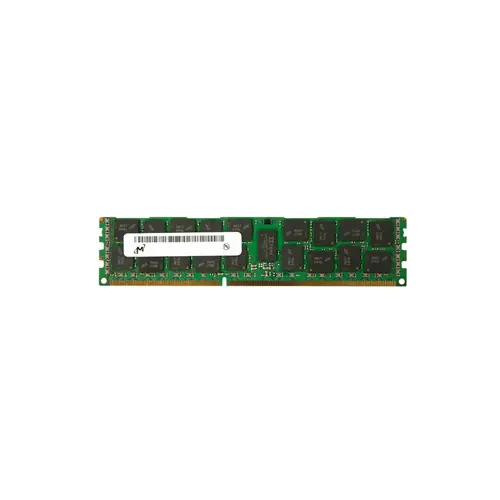
Designed as a registered DDR3-1866 RDIMM with ECC, this 4GB module is purpose-built for entry-level servers and small virtualization hosts where data integrity is critical. Its single-rank x8 organization and CL13 latency ensure stable, low-latency signal integrity in registered memory configurations, making it well-suited for lightweight memory databases and virtualized workloads that demand reliable, error-corrected operation.
1. ECC protection silently corrects single-bit memory errors in real time, safeguarding financial transactions and preventing silent data corruption in long-running virtualization hosts.
2. Registered signal buffering decouples the DIMMs from the CPU memory bus, stabilizing high-density server platforms and allowing full population of all channels without sacrificing reliability.
3. 1866 MHz clock speed provides sufficient per-channel throughput to keep latency-sensitive caching engines and mid-scale database instances fed without I/O stalls.
4. Single Rank x8 organization minimizes electrical loading and access conflicts, ensuring predictable access latencies under the heavy, randomized request patterns of consolidated virtual machines.
5. 4 GB module capacity enables granular memory provisioning for small-footprint application servers or dedicated management nodes, optimizing software licensing cost per socket.
For enterprise servers powering virtualization clusters and in-memory databases, the MT9JSF51272PZ-1G9 RDIMM’s four defining characteristics translate directly into operational resilience and performance. First, its ECC technology continuously detects and corrects single-bit errors, preventing the silent data corruption that could crash a hypervisor or corrupt a Redis dataset without warning. Second, the Registered signal buffer stabilizes the command and address bus, allowing you to populate all memory channels with multiple DIMMs — a decisive advantage for dense VMware ESXi hosts where massive RAM pools must remain absolutely reliable under heavy consolidation loads. Third, the single-rank x8 organization delivers lower latency and superior signal integrity compared to dual-rank modules, yielding faster data access and higher bandwidth efficiency for latency-sensitive workloads like SAP HANA. Finally, the 1866MHz speed with CL13 timing strikes an optimal balance between throughput and responsiveness, accelerating real-time database queries and seamless live virtual machine migration. This module means fewer application failures, consistent response times, and uncompromised data integrity across your 24/7 mission-critical infrastructure.
General Virtualization
This 4 GB DDR3-1866 RDIMM is best deployed in moderate-density virtualization hosts. For a hypervisor running 10–15 light VMs, populate at least four identical modules per socket to enable quad-channel memory interleaving and maximize throughput. Avoid mixing single-rank modules with dual-rank DIMMs in the same channel to maintain stable signal integrity.
In-Memory Database
In-memory databases like Redis or Memcached demand capacity and latency balance. Use multiple 4 GB RDIMMs to build a 32 GB or 64 GB pool, keeping CAS latency at CL13 for predictable sub-10 ns response. Deploy identical single-rank x8 DIMMs across all memory channels to prevent rank skew and ensure the entire dataset fits in DRAM for key-value acceleration.
High-Performance Computing
For HPC nodes running MPI workloads, this registered ECC module provides error resilience at 1866 MT/s. Configure six or eight DIMMs per dual-socket server to saturate memory bandwidth while retaining headroom for burst computations. Leverage the 1.5 V operating voltage to control thermals in dense clusters, and always install in matched sets to preserve symmetric multi-channel performance.
Rigorously tested server memory, compatible with Dell PowerEdge R720, HP DL380p Gen8, Lenovo ThinkServer RD530, and more.
Q: Can I mix this MT9JSF51272PZ-1G9 with other memory modules of different brands or speeds?
A: Mixing is strongly discouraged. Different brands, speeds, or ranks can cause signal conflicts and system instability with Registered ECC memory. For mission-critical servers, always install identical modules.
Q: Is this memory compatible with my system?
A: This is a DDR3-1866 Registered ECC RDIMM. It requires a server board supporting Intel Xeon E5 v1/v2 or select AMD Opteron platforms with 240-pin slots. Confirm 1.5V JEDEC compliance before purchase.
Q: What is the recommended DIMM population order for optimal performance?
A: Follow your motherboard manual. Generally, populate each channel with identical DIMMs starting from the slot farthest from the CPU. Balancing channels enables multi-channel interleaving and maximizes throughput.
Q: Does this module support overclocking or XMP profiles?
A: No. This server-grade Registered ECC module strictly follows JEDEC standards and does not support overclocking or XMP. It operates at a fixed 1866MHz with CL13 timings to ensure 24/7 stability.
Q: What warranty and typical failure rate can I expect?
A: This module includes a 1-year warranty. Enterprise Registered ECC memory typically exhibits an annualized failure rate (AFR) well below 0.5%, delivering exceptional reliability for continuous server workloads.