











 Secure payments
Standard refund policy
Trade Assurance
Secure payments
Standard refund policy
Trade Assurance
| Product Type | Memory Module |
|---|---|
| Compliance Standards | RoHS |
| Memory Capacity | 4 GB |
| Memory Technology | DDR3 |
| Product Voltage | 1.5V |
| RAM Speed | 1866MHz |
| RAM Standard | DDR3-1866/PC3-14900 |
| Error Identifying | ECC |
| Signal Type | Registered |
| Column Access Strobe (CAS) | CL13 |
| Rank | Single Rank x8 |
| Quantity of Pins | 240-pin |
| RAM Genre | RDIMM |
This RDIMM is engineered for legacy server platforms requiring moderate capacity with high data integrity, where its registered signal type and ECC functionality ensure stable operation under fully populated memory channels. Its single-rank x8 configuration and CL13 latency make it well-suited for memory-sensitive workloads like virtualized environments and in-memory databases that benefit from consistent access times and reduced bus loading.
1. Registered buffer architecture stabilizes command and address signals, enabling reliable operation even when server memory banks are fully populated.
2. On-die error correction silently catches and repairs single-bit failures, safeguarding data integrity for financial transactions and virtualized workloads.
3. High clock throughput sustains steady channel saturation, reducing latency in database query pipelines and in-memory analytics.
4. Single-rank design lightens the electrical load on the memory bus, allowing the server to maintain tighter command timings during sustained multi-threaded access.
5. Modest module density fits purpose-built edge nodes and lightweight virtual appliances where power budget and cost per socket take priority over raw capacity.
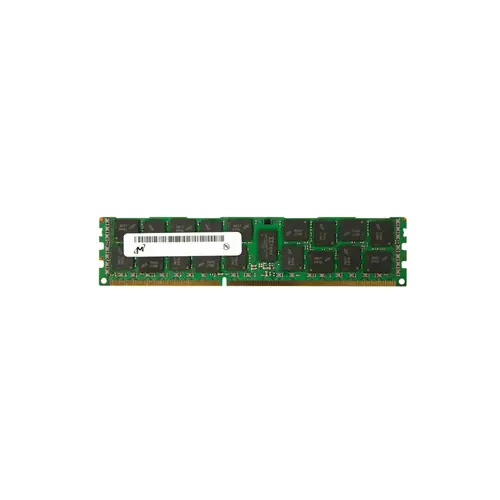
Designed for servers and workstations, the Micron MT9JSF51272PZ-1G9E2HF is a 4GB DDR3-1866 Registered DIMM that addresses the relentless demands of data-center reliability. Its four defining characteristics translate directly into operational confidence. The ECC technology detects and corrects single-bit memory errors automatically — in a virtualized cluster hosting dozens of VMs, a cosmic-ray-induced bit flip can corrupt a live database transaction silently; ECC eliminates that risk, preserving data integrity round the clock. The registered buffer stabilizes signal distribution across the memory bus, which means you can populate multiple DIMMs per channel without sacrificing electrical stability, essential when scaling up to 384GB or more in a 2U virtualization host. Running at 1866MHz with a CAS latency of 13, this RDIMM delivers low-latency, high-throughput access — a direct performance booster for in-memory databases like Redis or SAP HANA, where retrieving a customer profile microseconds faster multiplies across millions of queries per second. Meanwhile, the single-rank x8 organization optimizes command scheduling efficiency, reducing oversubscription penalties in NUMA-aware hypervisors. Together, these features form a memory subsystem that keeps mission-critical workloads responsive and error-free, directly protecting revenue and user experience.
General Virtualization
For virtualized environments, capacity and reliability are critical. Deploy this 4GB Registered ECC DIMM symmetrically across all memory channels per CPU to maximize bandwidth and sustain ECC integrity. In a dual‑socket server with three or four channels per processor, start with one 4GB module per channel, then scale to two per channel (64–128 GB total) to support a high density of virtual machines comfortably.
In-Memory Database
In-memory databases demand maximum capacity. Populate every available memory slot with these 4GB RDIMMs to reach the platform’s upper limit—for example, a 24‑slot dual‑processor system can deliver 96 GB. Use identical single‑rank modules across all channels to avoid electrical imbalance, and consider memory mirroring or spare rank for added resilience in caching layers.
High Performance Computing (HPC)
HPC workloads prioritize bandwidth over raw capacity. Install a single 4GB DDR3‑1866 RDIMM per memory channel to run all modules at the full 1866 MT/s speed without downclocking. In a dual‑socket system with quad‑channel architecture, eight modules provide a balanced 32 GB with peak bandwidth, ideal for simulation, CFD, and computational science.
Rigorously tested, compatibility verified for servers like Dell PowerEdge R720/R730, HPE ProLiant DL380p Gen8/DL380 Gen9, and Lenovo ThinkSystem RD450.
Q: Can I mix this MT9JSF51272PZ-1G9E2HF with other memory modules of different brands or speeds?
A: Mixing registered ECC modules of different brands or speeds is not recommended; the memory controller will downclock all modules to the lowest common speed, potentially undermining stability and performance in server environments.
Q: Is this memory compatible with my Intel Xeon E5-2600 v2 or AMD Opteron 6300 series server platform?
A: This 4GB DDR3-1866 Registered ECC RDIMM is compatible with dual-processor platforms supporting Intel Xeon E5-2600 v2 or AMD Opteron 6300 series CPUs, provided the motherboard uses C602 or SR5690 chipsets.
Q: What is the recommended DIMM population order for optimal performance with this module?
A: For optimal performance, populate identical RDIMMs in sets of identical capacity per memory channel following the server board’s population sequence—typically slots 1A, 2A, and 1B first, as per the platform’s technical manual.
Q: Does this module support overclocking or XMP profiles?
A: No, this server-grade registered ECC DDR3 module operates at standard JEDEC profiles. XMP and manual overclocking are not supported, as stability and data integrity are prioritized over frequency tuning.
Q: What warranty and typical failure rate can I expect for this memory?
A: This module is covered by a one-year warranty. As enterprise-class RDIMMs, it exhibits a very low annualized failure rate (AFR) under 0.5% when operated within specified voltage and thermal limits.