











 Secure payments
Standard refund policy
Trade Assurance
Secure payments
Standard refund policy
Trade Assurance
| Product Type | Memory Module |
|---|---|
| Compliance Standards | RoHS |
| Memory Capacity | 4 GB |
| Memory Technology | DDR3 |
| Product Voltage | 1.5V |
| RAM Speed | 1866MHz |
| RAM Standard | DDR3-1866/PC3-14900 |
| Error Identifying | ECC |
| Signal Type | Unbuffered |
| Column Access Strobe (CAS) | CL13 |
| Rank | Dual Rank x8 |
| Quantity of Pins | 240-pin |
| RAM Genre | UDIMM |
Designed for entry-level servers and workstations, this unbuffered ECC UDIMM ensures data integrity in critical applications such as file hosting and light virtualization. The dual-rank x8 configuration enhances memory bandwidth efficiency, while the CL13 latency at 1866MHz delivers responsive performance for always-on systems.
1. A 4 GB capacity provides just enough headroom for dedicated appliance OS instances and lightweight containerized tasks, improving density and cost-per-node efficiency in microserver deployments.
2. PC3-14900 bandwidth keeps data movement fluid during simultaneous client access, sustaining smooth file service and web caching performance in small office servers.
3. ECC error correction silently repairs single-bit memory faults, eliminating the risk of undetected data corruption that could crash a 24/7 unattended hypervisor or database.
4. The unbuffered UDIMM architecture shaves critical nanoseconds off access latency, directly accelerating response times in low-latency edge computing and real-time telemetry servers.
5. Dual rank x8 organization leverages rank interleaving to boost transaction throughput, helping a virtualized firewall or load balancer maintain packet processing rates under spike loads.
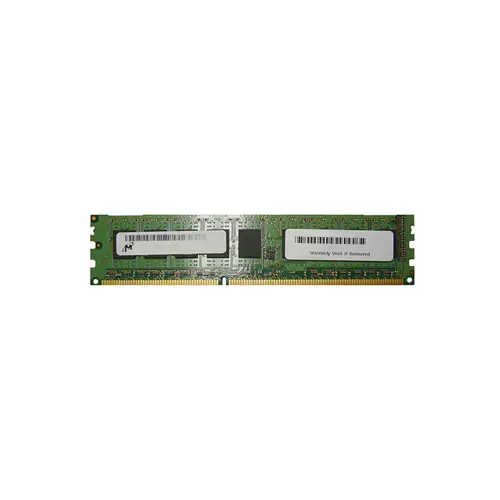
The Micron MT18JSF51272AZ-1G9 is a DDR3-1866 ECC Unbuffered DIMM engineered for small-business servers and critical workstations where data corruption is not an option. In a hypervisor running multiple virtual machines, ECC silently corrects single-bit memory errors caused by background radiation or signal noise; without ECC, a lone bit flip could silently corrupt a database transaction or crash a guest VM. The Unbuffered design eliminates the extra clock cycle penalty of registered memory, directly lowering read latency for in-memory caches like Redis. At the same time, the dual-rank x8 organization and 1866MHz clock speed enable rank interleaving, allowing the memory controller to keep both ranks busy and sustain higher bandwidth under heavy concurrent loads—imagine a file server handling dozens of simultaneous requests without stalling. For you, this memory module delivers the foundation for stable virtualized services and responsive data applications, balancing cost and reliability without the premium of registered DIMMs.
Memory Type Assessment: This is a server memory module (DDR3 ECC Unbuffered UDIMM). The presence of Error Correcting Code (ECC) combined with Unbuffered DIMM form factor and 240-pin design makes it suitable for single-socket servers, entry-level workstations, and microservers where data integrity is critical but registered memory is not required.
General Virtualization
With only 4 GB per stick, building a virtualization host demands high module density. Populate all available DIMM slots with multiple identical modules to achieve at least 32 GB total capacity, ensuring memory is evenly distributed across CPU memory channels. This allows simultaneous operation of several lightweight VMs without swapping, though modern hypervisors may still feel constrained by the DDR3 throughput ceiling.
In-Memory Database
In-memory databases thrive on capacity and fault tolerance, but 4 GB ECC modules force a trade-off. Install six to eight modules for 24–32 GB to hold modest datasets fully in RAM while ECC corrects single-bit errors silently. For larger datasets, this capacity quickly becomes a bottleneck; consider this configuration only for small-scale caching or development instances where data corruption cannot be tolerated.
High-Performance Computing
HPC workloads often prioritize memory bandwidth. Populate all memory channels with identical 4 GB modules in a balanced configuration to maximize interleaved memory access. Dual-rank x8 modules already benefit from rank interleaving, so pair them symmetrically per channel — four modules in a quad-channel server deliver improved throughput for memory-bound scientific simulations, though capacity limits may necessitate careful job scheduling.
Rigorously tested 4GB DDR3-1866 ECC UDIMM for Dell T20, R220, HP ML10 Gen9, Lenovo TS140.
Q: Can I mix this MT18JSF51272AZ-1G9 with other memory modules of different brands or speeds?
A: Mixing is not recommended. Although the module adheres to JEDEC standards, combining different brands or speeds can force the entire channel to the slowest common timing and may cause stability issues, especially with ECC UDIMMs in server environments.
Q: Is this memory compatible with my system?
A: This 4GB DDR3-1866 ECC Unbuffered DIMM is designed for single-socket Intel Xeon E3 series and select AMD AM3+ workstations. Verify your server board specifically supports unbuffered ECC UDIMMs, as it is not compatible with Registered DIMM or non-ECC desktop platforms.
Q: What is the recommended DIMM population order for optimal performance?
A: Install identical modules in matched sets across memory channels, typically populating blue slots first for the primary channel, then black slots for the second channel. Consult your motherboard manual for the exact balanced configuration to enable dual-channel interleaving and maintain ECC efficiency.
Q: What warranty and typical failure rate can I expect?
A: This module includes a one-year warranty. Modern JEDEC-standard ECC UDIMMs demonstrate a very low annualized failure rate (AFR) below 0.5% under normal operating conditions, provided the system is adequately cooled and operated within specified voltage and thermal limits.
Q: Does this module support overclocking or XMP profiles?
A: No, server-grade ECC UDIMMs do not support XMP or overclocking. This memory runs strictly at its JEDEC-standard profile of DDR3-1866 with CL13 timings at 1.5V to guarantee data integrity and stability required by always-on workstation and entry-level server platforms.