











 Secure payments
Standard refund policy
Trade Assurance
Secure payments
Standard refund policy
Trade Assurance
| Product Type | Memory Module |
|---|---|
| Compliance Standards | RoHS |
| Memory Capacity | 4 GB |
| Memory Technology | DDR3 |
| RAM Speed | 1866 |
| RAM Standard | DDR3-1866/PC3-14900 |
| Error Identifying | Non-ECC |
| Signal Type | Unbuffered |
| Column Access Strobe (CAS) | CL13 |
| Rank | Single Rank x8 |
| Quantity of Pins | 204-pin |
| RAM Genre | SoDIMM |
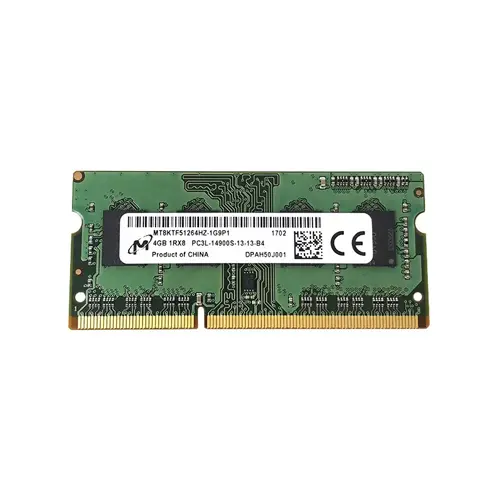
This SoDIMM is a notebook-class DDR3-1866 module designed for upgrading ultrabooks, small-form-factor desktops, and mobile workstations that require energy-efficient operation. Its single-rank x8 configuration and CL13 low-latency timing at 1866MT/s deliver responsive multitasking performance with minimal power draw, ensuring broad compatibility with systems supporting PC3-14900 unbuffered non-ECC memory.
1. A 4 GB capacity provides just enough headroom for essential multitasking on a lightweight notebook, keeping basic productivity suites and browser tabs responsive without triggering excessive swap usage.
2. DDR3 technology guarantees broad electrical and mechanical compatibility across a wide range of aging laptop platforms, making it a hassle-free plug-and-play upgrade for extending system lifespan.
3. The 1866 MT/s transfer rate sharpens application loading and file-open responsiveness, translating directly into less waiting during everyday mobile workflows.
4. A CL13 timing tightens the gap between command and data delivery, delivering perceptibly snappier UI feedback when toggling between multiple lightweight apps on the go.
5. Single-rank x8 construction draws minimal power from the battery rail, which helps reduce heat buildup inside cramped notebook chassis and prolongs runtime during untethered use.
The MT8KTF51264HZ-1G9P1 is a 4GB DDR3-1866 SODIMM built for notebooks and small-form-factor mobile workstations. Its 204-pin, single-rank x8 design and unbuffered, non-ECC architecture directly address the pain points of portable system users: limited physical space, strict power budgets, and the need for responsive everyday performance. In a thin-and-light laptop upgrade scenario, the narrow SODIMM form factor slides easily into cramped memory slots, while unbuffered signaling keeps electrical load low and ensures plug-and-play compatibility across a wide range of OEM platforms without BIOS tuning. For professionals running multiple virtual machines or large spreadsheets on a mobile workstation, the 1866 MT/s speed and CL13 latency deliver crisp window switching and faster data scrubbing—you experience a visibly snappier workflow rather than a laggy bottleneck. Because the module omits ECC and registers, it draws less standby power, helping preserve battery life between charges. This means you can finish a presentation or compile code on the move without the abrupt shutdown that cheaper, mismatched memory can cause. In practice, the MT8KTF51264HZ-1G9P1 turns a sluggish older notebook into a heat‑conscious, reliable daily driver, giving mobile users exactly what they value most: sustained responsiveness and true installation simplicity.
Laptop Upgrade
A single 4 GB DDR3‑1866 SoDIMM is an affordable way to refresh an older notebook. Pair it with an identical module to enable dual‑channel operation and reach 8 GB, greatly improving multitasking on basic operating systems. For a simple capacity‑doubling path, replace both slots with matched 8 GB sticks to achieve 16 GB.
Mobile Workstation
Demanding workloads like CAD and virtualization quickly exhaust single‑rank 4 GB modules. To run professional software, populate both SO‑DIMM slots with the maximum supported density—typically 8 GB per module for DDR3 platforms—so you obtain at least 16 GB. Leaving a 4 GB stick in place creates an immediate bottleneck.
Ultrabook Power Saving
Battery life benefits strongly from low‑voltage memory. This 1.5 V DDR3 module draws more power than a 1.35 V DDR3L equivalent; if your ultrabook supports it, opt for a DDR3L‑1866 SoDIMM to lower energy consumption and heat. Even when upgrading with the same 4 GB size, the low‑voltage variant extends runtime without sacrificing dual‑channel performance.
Rigorously tested DDR3-1866 SoDIMM for laptops: Dell Latitude E7440, Lenovo ThinkPad X250, HP EliteBook 840 G1.
Q: Can I mix this MT8KTF51264HZ-1G9P1 with other memory modules of different brands or speeds?
A: Mixing is not recommended for notebooks. Mismatched specs often cause instability or prevent booting. For optimal reliability, install identical modules with the same speed, timing, and rank.
Q: Is this memory compatible with my laptop?
A: This DDR3L SoDIMM fits notebooks with 204-pin slots supporting PC3-14900 at 1.35V. Please verify your system's maximum capacity, chipset generation, and native speed support—some Intel 4th/5th Gen platforms are ideal.
Q: What is the recommended DIMM population order for optimal performance?
A: To enable dual-channel mode, populate both slots with identical modules whenever possible. If using a single module, install it in the primary slot as indicated in your laptop's service manual.
Q: Does this module support overclocking or XMP profiles?
A: No. Standard notebook DDR3 SoDIMMs run at JEDEC default timings and do not support XMP or overclocking. The CL13 specification operates natively at the rated 1866 MT/s.
Q: What warranty and typical failure rate can I expect?
A: This Micron module includes a 1‑year warranty. Annualized failure rates for non‑ECC unbuffered DRAM are typically well below 0.5% under normal operating conditions.