











 Secure payments
Standard refund policy
Trade Assurance
Secure payments
Standard refund policy
Trade Assurance
| Product Type | Memory Module |
|---|---|
| Compliance Standards | RoHS |
| Memory Capacity | 4 GB |
| Memory Technology | DDR3 |
| RAM Speed | 1866MHz |
| RAM Standard | DDR3-1866/PC3-14900 |
| Error Identifying | Non-ECC |
| Signal Type | Unbuffered |
| Column Access Strobe (CAS) | CL13 |
| Rank | Single Rank x8 |
| Quantity of Pins | 240-pin |
| RAM Genre | UDIMM |
This DDR3-1866 UDIMM kit is optimized for desktop performance, delivering responsive multitasking and smooth productivity in gaming and content creation rigs. Its Single Rank x8 configuration with CL13 latency ensures high command rate efficiency and low access delays for consistent frame pacing.
1. Unbuffered signal type provides a direct data path to the CPU, minimizing access latency and giving budget-minded gamers a smoother frame delivery in older esports titles.
2. The 1866MHz clock on this DDR3 module elevates memory bandwidth, helping content creation apps juggle multiple high-resolution assets without hitching during video scrubbing.
3. CL13 column access strobe latency fine-tunes read response intervals, resulting in a noticeably snappier desktop feel when rapid-launching productivity suites and browser tabs.
4. Single Rank x8 organization reduces electrical loading on the memory controller, which can translate into higher one-rank overclocking margins for enthusiasts chasing legacy benchmark scores.
5. A 4 GB capacity fits as a straightforward drop-in upgrade for aging dual-channel systems, enabling passable multitasking headroom for light office work and HD media streaming.
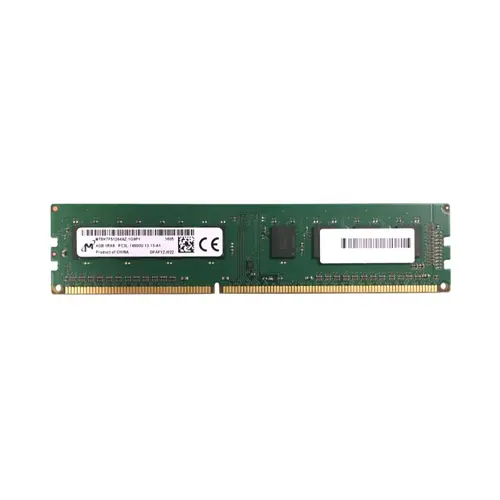
The MT8KTF51264AZ-1G9P1 is a desktop memory module, evident from its 240-pin UDIMM form factor, unbuffered signal type, and non-ECC design. For users running demanding desktop applications, these specifications directly translate into measurable real-world advantages.
First, the unbuffered architecture eliminates the latency introduced by register chips, allowing the memory controller to communicate with the DRAM directly. In fast-paced AAA gaming, this means every frame request arrives without unnecessary delays, helping to minimize stutter during split-second reactions. Second, the DDR3-1866 speed paired with a tight CL13 latency delivers a sharp 13.9-nanosecond response window. When you are rendering a 4K video timeline, that low latency keeps the processor fed with a constant stream of texture and effect data, preventing the timeline from stalling during heavy compositing. Third, the single-rank x8 configuration reduces the electrical load on the memory channel, giving your motherboard a wider margin of stability when all DIMM slots are populated—critical for a full 32GB upgrade in an aging workstation. Finally, even at 4GB, the strict adherence to RoHS and JEDEC standards ensures that this module will drop into an older office PC or legacy test bench without BIOS conflicts, extending the useful life of your desktop investment reliably.
Gaming Build
For a responsive gaming rig, deploy a dual‑channel configuration using two 4 GB UDIMMs for an 8 GB total. This pairs well with mid‑range GPUs and prevents bandwidth bottlenecks at 1866 MHz CL13. If aiming for a 16 GB environment, replace the modules with an 8 GB×2 kit rather than populating all four slots, preserving dual‑rank interleaving and leaving room for future expansion.
Content Creation
Video editing and 3D rendering thrive on large, unified memory pools. Given these are single‑rank 4 GB modules, a 64 GB configuration demands sixteen DIMMs, which is only feasible on HEDT platforms with ample slots. On mainstream motherboards, opt for a set of four identical modules to achieve 16 GB in dual‑channel mode as a practical minimum, then upgrade to higher‑capacity DIMMs when the workflow outgrows it.
General Productivity
Office multitasking and web work benefit from a cost‑effective dual‑channel setup. Populate two slots with the same 4 GB UDIMMs to enable 8 GB of interleaved access—ample for spreadsheets, email, and video calls. This avoids the slight performance penalty of a single stick while keeping total cost low, and it is easily doubled later by adding a second matched pair.
Factory-tested for reliability, this 4GB DDR3-1866 desktop UDIMM is compatible with Dell OptiPlex 9020, HP EliteDesk 800 G1, Lenovo M93p.
Q: Can I mix this MT8KTF51264AZ-1G9P1 with other memory modules of different brands or speeds?
A: Mixing is physically possible, but not recommended. The system will default to the slowest speed and timings, potentially causing instability. For reliable dual-channel, use identical modules.
Q: Is this memory compatible with my system? I have a desktop with an Intel 7 Series chipset.
A: Yes, this DDR3-1866 non-ECC UDIMM is compatible with most Intel 7 Series (e.g., Z77, H77) and AMD 900-series chipset motherboards. Verify 240-pin support and check your board’s QVL for this specific Micron part.
Q: What is the recommended DIMM population order for optimal performance?
A: For dual-channel performance, install modules in pairs into same-colored slots, typically slots A2 and B2 (2nd and 4th from the CPU). Single modules can go into A1 or A2. Consult your motherboard manual.
Q: Does this module support overclocking or XMP profiles?
A: No, this is a JEDEC-compliant DDR3-1866 module (PC3-14900) operating at its native CL13 without an XMP profile. Manual overclocking is possible but not validated; it is designed for rated speed.
Q: What warranty and typical failure rate can I expect?
A: This Micron memory comes with a 1-year warranty. The module has an extremely low annualized failure rate under normal operating conditions, backed by rigorous factory testing and RoHS compliance.