











 Secure payments
Standard refund policy
Trade Assurance
Secure payments
Standard refund policy
Trade Assurance
| Product Type | Memory Module |
|---|---|
| Compliance Standards | RoHS |
| Memory Capacity | 4 GB |
| Memory Technology | DDR3 |
| Product Voltage | 1.5V |
| RAM Speed | 1866MHz |
| RAM Standard | DDR3-1866/PC3-14900 |
| Error Identifying | ECC |
| Signal Type | Unbuffered |
| Column Access Strobe (CAS) | CL13 |
| Rank | Dual Rank x8 |
| Quantity of Pins | 240-pin |
| RAM Genre | UDIMM |
This DDR3-1866 ECC Unbuffered UDIMM targets entry-level servers and small-business NAS systems where data integrity is critical for virtualization and light in-memory database workloads. Its dual-rank x8 organization with CL13 latency enables interleaved command scheduling for improved bandwidth utilization, while ECC single-bit error correction and multi-bit detection guard against silent data corruption in platforms that mandate error-free operation.
1. ECC protection silently detects and corrects single-bit memory errors, preventing silent data corruption in long-running virtualization hosts and critical database servers.
2. Unbuffered signal architecture reduces latency overhead for microservers and edge computing nodes, ensuring responsive performance without compromising data integrity.
3. DDR3-1866 operation delivers elevated bandwidth per channel, accelerating in-memory analytics and reducing contention in multi-tenant virtualized environments.
4. CL13 low-latency timing tightens the gap between CPU requests and memory response, boosting transactional throughput for high-query enterprise applications.
5. Dual Rank x8 organization maximizes capacity per UDIMM slot, enabling denser memory configurations on entry-level server boards while keeping Rank Interleaving active for sustained bandwidth under heavy loads.
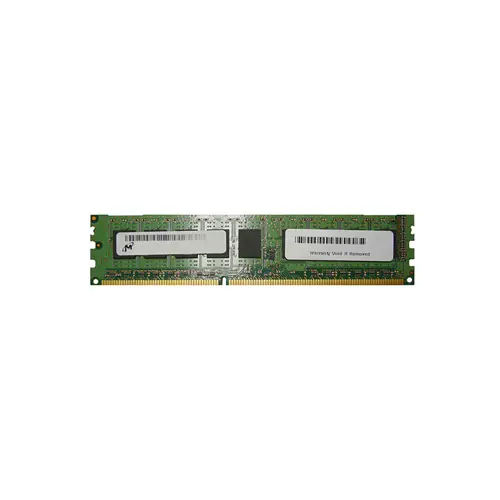
The Micron MT18JSF51272AZ-1G9K1 is a 4GB DDR3 UDIMM with ECC, engineered for entry-level servers, microservers, and NAS appliances where data integrity defines uptime. Its ECC protection is decisive for virtualized environments: a single flipped bit in a guest OS kernel can silently corrupt records or crash multiple VMs, but this module instantly corrects those errors, keeping hypervisors and SQL databases stable through uninterruptible workloads. For in-memory caches like Redis, the 1866 MHz clock and tight CL13 latency translate directly into sub-millisecond response—every tick saved scales across thousands of queries, keeping customer-facing dashboards snappy. The dual-rank x8 organization amplifies interleaving, sustaining higher bandwidth when simultaneous backup streams and real-time analytics hit the memory bus, preventing the throughput dips that frustrate capacity planning. Operating at the standard 1.5 V, it keeps power draw predictable in always-on server racks without sacrificing signal integrity. For administrators who treat silent data corruption as an unacceptable risk, this UDIMM delivers the error-free trust that protects transactions, caches, and long-running services alike.
This module is an Unbuffered ECC DDR3-1866 UDIMM, typically deployed in entry-level servers, small business servers, and workstations that require data integrity. The capacity planning guidance below targets common server workloads using these 4 GB modules.
General Virtualization
For light virtualization hosts, start with four identical modules (16 GB total) to run a handful of virtual machines with ECC protection. As consolidation grows, populate eight modules (32 GB) in a balanced dual- or quad-channel arrangement, which supplies adequate memory headroom and maintains stable interleaved performance.
In-Memory Database
In-memory databases such as Redis or Memcached demand both capacity and reliability. Fill all available DIMM slots with these 4 GB ECC UDIMMs; a typical single-socket board holding eight modules delivers 32 GB, which suits cache-heavy or small dataset scenarios. Symmetric population leverages ECC scrubbing and minimizes access latency, preserving data accuracy under sustained loads.
High-Performance Computing (HPC)
HPC nodes rely on memory bandwidth as much as capacity. Install one 4 GB module per memory channel—four or eight modules per CPU—to enable fully symmetric multi-channel interleaving. A dual-socket node with sixteen modules (64 GB) achieves strong DDR3-1866 throughput and provides a balanced memory-per-core ratio for MPI or OpenMP workloads, while ECC sustains long-running simulation stability.
This rigorously tested server memory is compatible with Dell PowerEdge T20, T110 II, HP MicroServer Gen8, and Lenovo ThinkServer TS140.
Q: Can I mix this MT18JSF51272AZ-1G9K1 with other memory modules of different brands or speeds?
A: Mixing ECC UDIMMs is not recommended; mismatched speeds or timings can cause instability and disable error correction. For reliable operation, always use identical modules from the same validated kit.
Q: Is this memory compatible with my Intel or AMD server platform?
A: This DDR3-1866 ECC UDIMM is designed for single-socket Intel Xeon E3 v2/v3 or AMD Opteron 3000 platforms. Verify board support for 4GB Dual Rank x8 modules and check the system QVL list.
Q: What is the recommended DIMM population order for optimal performance?
A: Install identical modules in pairs per channel, starting with the blue slots (channel 1) first. Follow the server manual; balancing memory across CPU-integrated memory controllers ensures symmetric multi-channel access.
Q: Does this module support overclocking or XMP profiles?
A: No. This is a JEDEC-compliant server memory module. It does not support XMP or user overclocking, as stability and data integrity are prioritized over frequency manipulation in server environments.
Q: What warranty and typical failure rate can I expect?
A: This module carries a 1-year warranty. Typical annualized failure rate (AFR) is below 0.5% under specified operating conditions, reflecting industrial-grade ECC UDIMM reliability for mission-critical applications.