











 Secure payments
Standard refund policy
Trade Assurance
Secure payments
Standard refund policy
Trade Assurance
| Product Type | Memory Module |
|---|---|
| Memory Capacity | 4 GB |
| Memory Technology | DDR4 |
| Product Voltage | 1.2V |
| RAM Speed | 2133MHz |
| RAM Standard | DDR4-2133/PC4-17000 |
| Error Identifying | ECC |
| Signal Type | Unbuffered |
| Column Access Strobe (CAS) | CL15 |
| Rank | Single Rank x8 |
| Quantity of Pins | 288-pin |
| RAM Genre | UDIMM |
This unbuffered ECC UDIMM is designed for entry-level servers and professional workstations requiring data integrity, making it ideal for light virtualization or file-serving workloads where error-free operation is critical. Its single-rank x8 organization and CL15 latency promote stable signal integrity and consistent performance at 1.2V, while ECC actively corrects single-bit memory errors to safeguard in-memory data.
1. ECC error correction detects and corrects single-bit memory errors in real time, safeguarding transactional data integrity for always-on server workloads where even silent corruption is unacceptable.
2. Unbuffered architecture eliminates the register latency, giving microservers and edge compute nodes faster access to memory for latency-sensitive applications.
3. DDR4 technology operating at 1.2V reduces power draw per DIMM, allowing higher memory density within fixed thermal envelopes typical of dense rack deployments.
4. Single Rank x8 organization presents a single load per channel, ensuring stable signal integrity and easier validation in 24/7 operating environments with limited memory slots.
5. A conservative CAS 15 latency at this frequency provides deterministic response times, which aligns with the predictability demanded by real-time control systems and entry-level virtualization hosts.
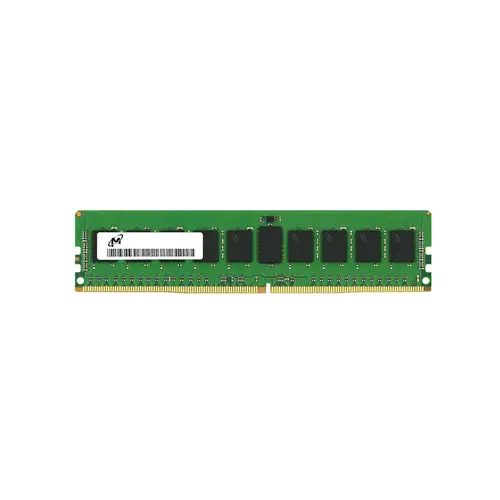
The Micron MTA9ASF51272AZ-2G1B1ZG is an unbuffered DDR4 UDIMM with ECC, purpose-built for entry-level servers and workstations where data integrity and responsive performance are non-negotiable. For the IT manager running a virtualisation cluster, ECC is your silent guardian. In a multi-tenant environment where dozens of VMs share physical memory, a single background bit-flip from cosmic radiation can corrupt a database transaction or silently poison a filesystem. ECC detection and correction turns that potential catastrophe into a logged, corrected event, preventing hours of outage and data remediation. For the developer relying on an in-memory database like Redis or memcached, the unbuffered architecture means the memory controller speaks directly to the DRAM chips without the latency penalty of a register clock. Combined with a tight Column Access Strobe latency of 15 cycles, this module delivers the low, predictable response times that key-value stores crave under bursty query loads. Finally, the 1.2V operating voltage reduces thermal waste inside your 1U chassis. Lower power draw per DIMM means less strain on cooling, higher rack density, and a lower total cost of ownership over years of 24/7 uptime.
General Virtualization
This ECC UDIMM is suited for entry-level single-socket servers running hypervisors. For a modest host with 4–6 light VMs, install four 4 GB modules in a balanced quad-channel configuration to reach 16 GB total, ensuring error correction and adequate memory bandwidth. Avoid mixing ranks; stick to identical single-rank x8 DIMMs for stable, validated performance.
In-Memory Database
In-memory databases like Redis or SAP HANA express edition demand both reliability and low latency. Deploy multiple 4 GB ECC UDIMMs across all available channels—ideally four modules for 16 GB—to saturate memory bandwidth while protecting against bit flips. For larger datasets, consider upgrading to higher-capacity registered DIMMs, as 4 GB unbuffered modules quickly become a density bottleneck.
High-Performance Computing
In memory-bandwidth-sensitive HPC tasks, populate every memory channel with one 4 GB module (up to four DIMMs on typical platforms) to deliver 16 GB of quad-channel throughput. The single-rank x8 organization helps keep command rates low, marginally improving latency. If node redundancy is critical, add a second identical set for a total of 32 GB, ensuring all modules match in speed, rank, and CAS latency.
This server memory has been rigorously tested and is compatible with Dell PowerEdge T140, HPE ML30 Gen10, Lenovo ST250.
Q: Can I mix this MTA9ASF51272AZ-2G1B1ZG with other memory modules of different brands or speeds?
A: Mixing ECC UDIMMs with different brands or speeds is not recommended. It may cause signal integrity issues and system instability, undermining the server's reliability. Always use identical modules.
Q: Is this memory compatible with my system?
A: This ECC UDIMM is compatible with Intel Xeon E3/E-2100/2200 series or AMD AM4 platforms (e.g., Ryzen PRO) that support unbuffered DDR4 ECC memory. Verify your motherboard's ECC support.
Q: What is the recommended DIMM population order for optimal performance?
A: Refer to your server motherboard manual. Generally, populate the first slot in each memory channel (often blue slots) to balance interleaving. Evenly distribute identical DIMMs across CPU memory controllers.
Q: Does this module support overclocking or XMP profiles?
A: No. As a server-grade ECC UDIMM, it adheres strictly to JEDEC DDR4-2133 specifications. Overclocking or XMP is disabled to guarantee data integrity and mission-critical stability.
Q: What warranty and typical failure rate can I expect?
A: This module comes with a one-year warranty. Engineered for enterprise reliability, it achieves a typical annualized failure rate (AFR) below 0.5%, ensuring minimal downtime in critical applications.