

 Secure payments
Standard refund policy
Trade Assurance
Secure payments
Standard refund policy
Trade Assurance
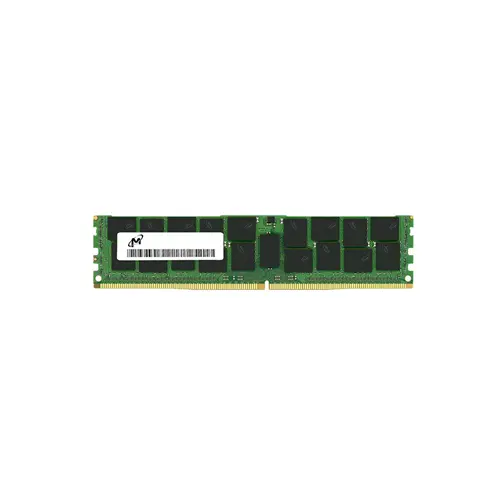
| Product Type | Memory Module |
|---|---|
| Compliance Standards | RoHS |
| Memory Capacity | 4 GB |
| Memory Technology | DDR4 |
| Product Voltage | 1.2V |
| RAM Speed | 2400MHz |
| RAM Standard | DDR4-2400/PC4-19200 |
| Error Identifying | ECC |
| Signal Type | Registered |
| Column Access Strobe (CAS) | CL17 |
| Rank | Single Rank x8 |
| Quantity of Pins | 288-pin |
| RAM Genre | RDIMM |
This DDR4-2400 Registered ECC DIMM is purpose-built for server platforms that demand data integrity and 24/7 reliability, making it ideally suited for virtualization, in-memory databases, and enterprise workloads where memory errors are unacceptable. The registered signal type stabilizes high-capacity configurations by reducing electrical load on the memory controller, while ECC actively corrects single-bit errors and the single-rank x8 organization optimizes latency and thermal performance for dense multi-DIMM deployments.
1. Registered signal buffering stabilizes high-density memory arrays, ensuring consistent uptime for virtualization hosts running dozens of VMs without signal integrity drift.
2. ECC error correction silently intercepts and repairs single-bit errors, preserving data accuracy essential for financial ledgers, inventory databases, and scientific computations.
3. DDR4 memory technology shifts the performance-per-watt curve, allowing modern server racks to pack greater compute density without exceeding power or cooling budgets.
4. 2400MHz transfer rate provides a balanced throughput sweet spot for mid-tier enterprise workloads, keeping response times low during concurrent user spikes.
5. 1.2V ultra-low voltage shrinks overall server energy draw, directly lowering total cost of ownership across hyperscale deployments through reduced electricity and thermal management overhead.
As a server-class Registered DIMM, the MTA9ASF51272PZ-2G3B1 is engineered for data centers where reliability and uptime are not merely desirable—they are mandatory. The module’s ECC capability silently corrects single-bit memory errors, which directly prevents silent data corruption in financial transaction logs or hypervisor memory spaces; without it, a random cosmic particle could flip a bit and crash a virtual machine or mangle a database index with no warning. Its registered architecture buffers address and command signals, stabilizing the memory bus when populating all channels in a virtualization cluster—this means you can deploy dozens of VMs per host without performance degradation or unpredictable reboots under heavy consolidation loads. With a single-rank x8 organization, the 4 GB capacity delivers consistent and predictable bandwidth, a critical advantage for in-memory databases like Redis or SAP HANA that demand uniform latency spikes. Lastly, the 1.2 V DDR4 design slashes power consumption per DIMM, reducing both operating costs and thermal stress in dense rack deployments, so a full-scale deployment remains stable and energy-efficient 24/7. These four pillars work in concert to keep your data accurate, your services available, and your total cost of ownership under control where it matters most.
General Virtualization
This 4GB DDR4-2400 ECC Registered DIMM is suited for entry-level virtualization hosts where total memory is built from multiple identical modules. For hypervisors running lightweight VMs, populate all channels symmetrically—install six or eight of these modules in a balanced configuration to ensure maximum memory bandwidth and reliable error correction. Avoid mixing ranks or capacities to maintain stable NUMA performance.
In-Memory Database
In-memory databases demand large capacity and low latency, so a single 4GB RDIMM is only a building block. Deploy a fully populated server using numerous identical 4GB RDIMMs to reach the required memory footprint while leveraging ECC to protect data integrity. To optimize throughput, fill each memory channel with identical single‑rank x8 modules and keep CAS latency (CL17) consistent across all DIMMs.
HPC
For HPC clusters running tightly-coupled parallel workloads, memory configuration must balance capacity per node and bandwidth. Use sets of these 4GB Registered DIMMs to populate all memory channels uniformly on each compute node, achieving optimal sustained bandwidth. Standardize on this single‑rank module across the cluster to simplify sparing, guarantee identical timing parameters, and avoid performance variations caused by mixed DIMM types.
Validated server memory. Compatible with Dell PowerEdge R740, HPE ProLiant DL380 Gen10, Lenovo ThinkSystem SR650.
Q: Can I mix this MTA9ASF51272PZ-2G3B1 with other memory modules of different brands or speeds?
A: Mixing RDIMMs with different speeds or brands is not recommended. The system will default to the lowest common speed, and combining registered with unbuffered memory may cause instability or prevent booting in server platforms.
Q: Is this memory compatible with my Intel Xeon or AMD EPYC server platform?
A: This DDR4-2400 ECC Registered RDIMM is compatible with Intel Xeon E5-2600 v3/v4 and select AMD EPYC 7001 series platforms. Verify your board supports 288-pin RDIMM and 1.2V registered ECC memory.
Q: What is the recommended DIMM population order for optimal performance with this module?
A: Populate identical RDIMMs per memory channel, starting with the furthest slot from the CPU. Follow your server motherboard's manual for balanced configurations to maintain optimal interleaving and avoid performance loss.
Q: Does this module support overclocking or XMP profiles?
A: No. This is a server-grade Registered ECC DIMM designed for stability at JEDEC standard DDR4-2400. It does not support XMP or overclocking, as reliability takes priority in enterprise environments.
Q: What warranty and typical failure rate can I expect with this memory?
A: This module includes a one-year warranty. Enterprise RDIMMs typically have an AFR below 1%. Actual reliability depends on proper cooling and adherence to the vendor's validated system environment.