











 Secure payments
Standard refund policy
Trade Assurance
Secure payments
Standard refund policy
Trade Assurance
| Product Type | Memory Module |
|---|---|
| Memory Capacity | 4 GB |
| Memory Technology | DDR4 |
| Product Voltage | 1.2V |
| RAM Speed | 2400MHz |
| RAM Standard | DDR4-2400/PC4-19200 |
| Error Identifying | ECC |
| Signal Type | Registered |
| Column Access Strobe (CAS) | CL17 |
| Rank | Single Rank x8 |
| Quantity of Pins | 288-pin |
| RAM Genre | RDIMM |
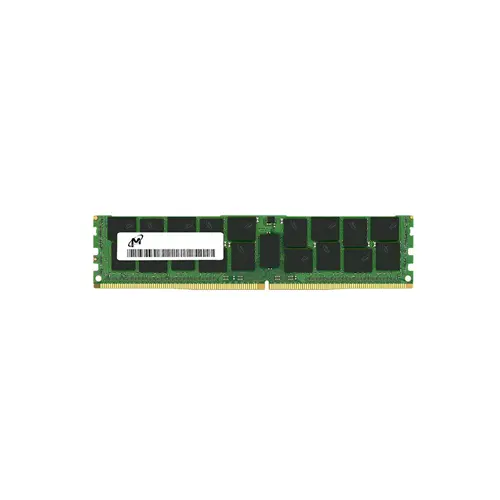
Designed as a DDR4-2400 Registered ECC module, this 4GB RDIMM is engineered for server platforms where data integrity is non-negotiable, making it ideal for virtualization hosts and in-memory database caching. Its single-rank x8 configuration with CL17 latency ensures consistent signal integrity under sustained load, while the registered architecture and ECC actively correct single-bit errors to prevent silent data corruption in 24/7 operating environments.
1. Error Correction Code detects and fixes single-bit memory faults in real time, safeguarding transactional databases and financial computations from silent data corruption.
2. Registered signal buffering stabilizes high-capacity memory configurations, enabling dense server farms to scale memory without sacrificing signal integrity.
3. 2400 MT/s data rate provides 19.2 GB/s peak bandwidth per channel, smoothing concurrent VM and container workloads in virtualized environments.
4. Column Access Strobe latency of 17 cycles balances fast wordline retrieval with stability, reducing memory access delays for latency-sensitive enterprise applications.
5. 1.2V ultra-low operating voltage drives down power consumption and cooling overhead, a decisive factor for total cost of ownership in hyperscale data centers.
Engineered for server environments, the Micron MTA9ASF51272PZ-2G3B1QK is a 4GB DDR4-2400 RDIMM that combines ECC, registered buffering, single-rank agility, and a 1.2V low-power design to directly address the reliability and latency demands of virtualization clusters and in-memory databases. ECC silently corrects single-bit errors, preventing bit-flips that could corrupt your VM state or transactional records and trigger unplanned outages. The on-board register buffers the command and address bus, so you can confidently deploy multiple DIMMs per channel for higher VM density without risking signal integrity. Its single-rank x8 organization running at 2400MHz with CL17 latency delivers snappy read performance—crucial when serving thousands of queries per second in a Redis cache or accelerating database lookup tables. Meanwhile, the 1.2V operating voltage cuts power consumption and cooling overhead across your server farm, directly lowering operating expenses. This memory turns technical specifications into business continuity, predictable multi-tenancy, and lower total cost of ownership for your most sensitive workloads.
General Virtualization
For a virtualization host running multiple VMs, 4 GB RDIMMs are too small to build dense memory configurations efficiently. It is strongly recommended to use higher-capacity modules (16 GB or 32 GB) to populate the available DIMM slots and maximize memory channels. If these 4 GB sticks must be used, deploy them in identical pairs per channel to maintain balanced interleaving and ensure ECC protection is fully operational.
In-Memory Database
In-memory databases demand the lowest possible latency and the highest capacity within a single server. A single 4 GB module is grossly insufficient—this technology targets hundreds of gigabytes to terabytes. With these modules you could only build a minimal test bed; for any real workload, replace them with 32 GB or 64 GB Registered ECC DDR4 DIMMs and populate all memory channels symmetrically to avoid performance cliffs.
High-Performance Computing (HPC)
HPC clusters rely on maximum memory bandwidth per node. Using 4 GB RDIMMs forces you to fill every slot to reach practical capacities, which increases power consumption and reduces potential frequency headroom. A better approach is to deploy 16 GB or 32 GB modules, one per channel at a minimum, to sustain dual‑rank or multi‑rank bandwidth benefits. If these modules are all you have, install them in balanced configurations across all memory channels to retain full memory interleaving and ECC functionality.
Server-grade DDR4 RDIMM; rigorously tested and compatible with Dell PowerEdge R740, HPE ProLiant DL380 Gen10, and Lenovo ThinkSystem SR650.
Q: Can I mix this MTA9ASF51272PZ-2G3B1QK with other memory modules of different brands or speeds?
A: Mixing different brands or speeds is strongly discouraged. ECC Registered memory requires matched modules for reliable synchronization. Mismatched DIMMs can cause system instability and memory errors. Always use identical modules for server deployments.
Q: Is this memory compatible with my Intel or AMD server platform?
A: This DDR4-2400 registered ECC module is compatible with servers supporting that standard, such as Intel Xeon E5-2600 v3/v4, Scalable, and AMD EPYC platforms. Please verify your motherboard’s QVL for validated configurations.
Q: What is the recommended DIMM population order for optimal performance?
A: For optimal performance, populate identical DIMMs per channel following your server manual. Typically, install in designated slots to enable balanced interleaving, achieving proper multi-channel operation and avoiding performance penalties.
Q: Does this module support overclocking or XMP profiles?
A: No, this module is JEDEC-compliant and does not support XMP or overclocking. Server memory prioritizes stability, ECC data integrity, and 24/7 reliability, making overclocking unsuitable and potentially harmful.
Q: What warranty and typical failure rate can I expect?
A: This memory includes a one-year warranty. Built with server-grade components and rigorous validation, its annualized failure rate is extremely low—typically below 0.5%—ensuring dependable operation in demanding data center environments.