











 Secure payments
Standard refund policy
Trade Assurance
Secure payments
Standard refund policy
Trade Assurance
| Product Type | Memory Module |
|---|---|
| Memory Capacity | 4 GB |
| Memory Technology | DDR4 |
| RAM Speed | 2666 |
| RAM Standard | DDR4-2666/PC4-21300 |
| Error Identifying | Non-ECC |
| Signal Type | Unbuffered |
| Column Access Strobe (CAS) | CL19 |
| Rank | Single Rank x16 |
| Quantity of Pins | 260-pin |
| RAM Genre | SoDIMM |
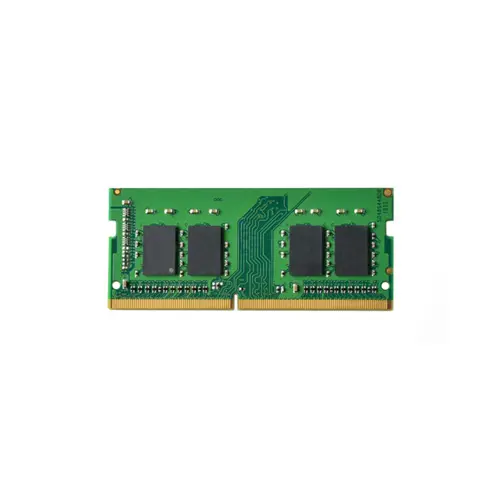
This unbuffered, Non-ECC DDR4 2666 MT/s SODIMM leverages a single-rank x16 organization and standard 1.2 V low‑voltage operation to minimize power consumption, making it an ideal plug-and-play upgrade for mobile workstations and thin‑and‑light notebooks where thermal headroom and broad platform compatibility are critical. Its balanced 4 GB capacity and CL19 latency deliver reliable connectivity over the 260‑pin interface, ensuring stable performance for sustained productivity workloads and everyday multitasking.
1. SoDIMM form factor guarantees a drop-in upgrade for slim notebook chassis, eliminating compatibility concerns during memory expansion.
2. DDR4 technology operates at just 1.2V, noticeably lowering power draw and heat generation for longer battery life during mobile productivity.
3. 4 GB capacity covers essential office multitasking and web browsing smoothly, keeping entry-level notebooks responsive without overspending.
4. 2666 MT/s data rate accelerates application loading and file access, delivering a snappier everyday computing experience.
5. CL19 latency strikes an optimal balance between speed and stability, ensuring consistent system performance under typical thermal constraints.
The Micron MTA4ATF51264HZ-2G6E3 is a DDR4 2666 SODIMM purpose-built for modern notebooks. Its non-ECC, unbuffered, single-rank layout minimizes voltage demand and heat output, directly translating to extended battery endurance when you are finalizing a report on a cross-country flight away from an outlet. In a mobile workstation, the 2666 MT/s speed and CL19 latency keep asset management software and multiple browser-based dashboards instantly responsive, eliminating the freeze-ups that disrupt field audits. The 4 GB module leverages a standard 260-pin footprint for effortless tool-free installation into an ultrabook’s vacant socket; once seated, it activates dual-channel architecture with onboard memory, noticeably sharpening integrated graphics for seamless video conferencing during client presentations. IT administrators benefit from broad plug-and-play compatibility across Dell, HP, and Lenovo fleets, removing trial-and-error from hardware refreshes. This module delivers the efficiency, speed, and simplicity that mobile professionals depend on daily.
Laptop Upgrade
This is a standard DDR4-2666 non-ECC unbuffered SoDIMM, typical for mainstream notebooks. If your system currently has a single 4 GB module, the most immediate upgrade is to add a matching 4 GB stick (same speed, CL19, single-rank) to enable dual-channel mode, doubling bandwidth and improving integrated graphics performance. Alternatively, replace the 4 GB module with an 8 GB or 16 GB SoDIMM to reach 8–16 GB total, which remains the sweet spot for responsive multitasking in modern operating systems.
Mobile Workstation
Professional applications like CAD, 3D rendering, and large dataset analysis demand maximum capacity. Populate both SoDIMM slots with the highest supported density—typically a 32 GB kit (2 x 16 GB) or a 64 GB kit (2 x 32 GB) of DDR4-2666 or faster, matching the platform’s limit. This configuration ensures smooth handling of complex assemblies and prevents disk swapping, though always verify the chipset’s maximum per-slot capacity before purchasing.
Ultrabook Power Saving
Many ultrabooks use soldered memory, but if upgrading a socketed thin-and-light, prioritize a single high-density module (e.g., 1 x 8 GB or 1 x 16 GB) to fill one slot and keep the second empty when possible, minimizing active DRAM power draw. Select modules with the standard 1.2V operating voltage—DDR4’s low baseline already aids battery life, and avoiding overclocked, higher-voltage kits prevents unnecessary consumption. Combining capacity with the native CAS latency of CL19 yields a balanced, efficient setup that extends runtime during productivity tasks on battery.
Rigorously tested for compatibility with DDR4 2666 SODIMM laptops including Dell Latitude 5300, HP EliteBook 840 G6, Lenovo ThinkPad T490.
Q: Can I mix this MTA4ATF51264HZ-2G6E3 with other memory modules of different brands or speeds?
A: Mixing is possible but not recommended. Mismatched modules may default to the lowest common speed and timing, risking instability. For best results, use identical DDR4-2666 CL19 SO-DIMMs.
Q: Is this memory compatible with my system?
A: This 260-pin DDR4 SO-DIMM suits laptops supporting DDR4-2666. Verify your model's DDR4 generation and maximum capacity. It commonly works with Intel 8th Gen or AMD Ryzen 3000 mobile platforms and newer.
Q: What is the recommended DIMM population order for optimal performance?
A: For single-channel, populate the primary slot (often DIMM0). For dual-channel, install matched pairs in designated slots per your laptop's service manual to enable full bandwidth.
Q: Does this module support overclocking or XMP profiles?
A: No, it adheres to JEDEC DDR4-2666 standards without XMP. Overclocking is not supported. It operates at a fixed 2666MT/s with CL19, prioritizing stability and efficient power usage in mobile systems.
Q: What warranty and typical failure rate can I expect?
A: This Micron module includes a 1-year warranty. Built to tight tolerances, its annualized failure rate is extremely low, typically under 0.5%, delivering reliable long-term performance.