











 Secure payments
Standard refund policy
Trade Assurance
Secure payments
Standard refund policy
Trade Assurance
| Product Type | Memory Module |
|---|---|
| Memory Capacity | 4 GB |
| Memory Technology | DDR4 |
| RAM Speed | 3200 |
| RAM Standard | DDR4-3200/PC4-25600 |
| Error Identifying | Non-ECC |
| Signal Type | Unbuffered |
| Column Access Strobe (CAS) | CL22 |
| Rank | Single Rank x16 |
| Quantity of Pins | 260-pin |
| RAM Genre | SoDIMM |
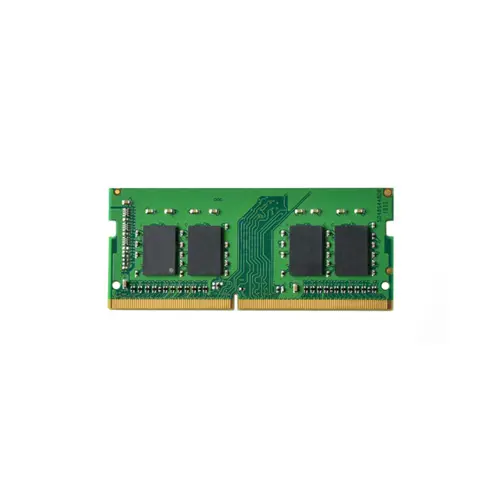
Designed as a DDR4-3200 260-pin SODIMM, this 4 GB module is ideal for upgrading thin-and-light notebooks and mobile workstations, where its non-ECC unbuffered architecture and single-rank x16 configuration help maintain low power consumption and broad platform compatibility. The JEDEC-standard CL22 latency delivers reliable plug-and-play operation at 3200 MT/s without requiring manual tuning, making it a pragmatic choice for extending the lifecycle of business and consumer laptops that demand consistent performance per watt.
1. SoDIMM form factor guarantees a straightforward, tool-free upgrade in compact notebooks, allowing instant capacity boosts without motherboard compatibility concerns.
2. DDR4 technology operates at a low voltage, extending battery runtime and curbing heat buildup during extended productivity sessions.
3. 3200 MT/s speed accelerates data throughput, reducing application load times and keeping multiple browser tabs smoothly responsive.
4. Single Rank x16 architecture draws minimal power and generates less heat, preserving thermal headroom in slim, passively cooled laptop chassis.
5. Unbuffered signal type eliminates additional register latency and power draw, delivering lean, efficient memory access ideal for long-lasting mobile use.
Based on the 260-pin SO-DIMM form factor, this Micron memory module (MTA4ATF51264HZ-3G2E1) is engineered for notebooks and mobile workstations. Its four defining characteristics—Non-ECC, Unbuffered signaling, true DDR4-3200 speed at CL22, and a Single Rank x16 organization—directly address the real-world frustrations of mobile users.
For the road-warrior running a mobile workstation, every watt matters. The Non-ECC, Unbuffered design strips away the buffering and error‑correcting circuitry that draws extra power in servers. This lowers the memory controller load and idle power consumption, meaning you gain precious extra minutes of battery life during a long flight while parsing large datasets or hosting a local virtual machine. In an ultrabook upgrade scenario, the compact SO-DIMM footprint and Single Rank x16 configuration ensure drop-in compatibility with the tightest chassis. There is no physical interference from tall heat spreaders or double‑sided chips, making the installation effortless. The DDR4-3200 speed with CL22 latency delivers a decisive snappiness when multitasking between browser tabs, office suites, and video calls—the system wastes no time waiting for data, yet operates at the efficient 1.2V standard to keep thermals in check. Instead of a sluggish machine that throttles under an inflated memory rank, you experience sustained responsiveness and cooler palm rests, transforming an aging notebook into a capable daily driver.
The given specifications—260-pin, non‑ECC, unbuffered, SoDIMM—identify this as laptop memory.
Laptop Upgrade
For a system currently running a single 4 GB stick, simply adding a second identical module activates dual‑channel mode, lifting total capacity to 8 GB and significantly improving integrated graphics and everyday multitasking. If the target is 16 GB, purchase a matching 2×8 GB kit and repurpose the original 4 GB stick as an emergency spare or in a secondary device.
Mobile Workstation
This 4 GB module is far too small for sustained professional workloads such as CAD, 3D rendering, or scientific computing. A mobile workstation should be configured with at least two 16 GB SoDIMMs (32 GB), and ideally two 32 GB modules for 64 GB; the 4 GB stick has no place in these capacity‑hungry builds and should be retired.
Ultrabook Power Saving
When battery endurance is paramount, a single 4 GB SoDIMM minimizes the active memory channel count and idle power overhead. Its standard 1.2 V DDR4 operation and modest density help thin‑and‑light notebooks achieve longer runtimes during web browsing, document editing, and video streaming. In systems that combine soldered RAM with one open slot, adding this module yields an economical dual‑channel boost without a measurable battery‑life penalty.
Rigorously tested, this DDR4 SO-DIMM fits laptops like Dell Latitude 5430, Lenovo ThinkPad T14 Gen 2, HP EliteBook 840 G8.
Q: Can I mix this MTA4ATF51264HZ-3G2E1 with other memory modules of different brands or speeds?
A: Mixing is possible but not recommended. Unmatched modules may default to the slowest speed and timings, potentially causing system instability. Identical modules ensure reliable dual-channel operation.
Q: Is this memory compatible with my system?
A: This is a standard DDR4-3200 SoDIMM for notebooks or mini PCs. Verify your device supports 260-pin DDR4, 1.2V, and a maximum of 4GB per slot. Please consult the specific model's QVL or service guide.
Q: What is the recommended DIMM population order for optimal performance?
A: For dual-channel capable laptops, install identical modules in both slots, typically slot 0 first. If mixing capacities, install the larger module in the primary slot (often the bottom slot) to maximize available memory.
Q: Does this module support overclocking or XMP profiles?
A: No, this module operates at standard JEDEC timings (DDR4-3200 CL22). It does not support XMP or manual overclocking, as it is designed for strict compatibility and reliability in mobile platforms.
Q: What warranty and typical failure rate can I expect?
A: This Micron module includes a one-year warranty. Typical annualized failure rate (AFR) for JEDEC-compliant DRAM is well below 0.5%, ensuring high long-term reliability under normal operating conditions.