











 Secure payments
Standard refund policy
Trade Assurance
Secure payments
Standard refund policy
Trade Assurance
| Product Type | Memory Module |
|---|---|
| Compliance Standards | RoHS |
| Memory Capacity | 4 GB |
| Memory Technology | DDR3 |
| Product Voltage | 1.35V |
| RAM Speed | 1333MHz |
| RAM Standard | DDR3-1333/PC3-10600 |
| Error Identifying | ECC |
| Signal Type | Registered |
| Column Access Strobe (CAS) | CL9 |
| Rank | Single Rank x4 |
| Quantity of Pins | 240-pin |
| RAM Genre | VLP RDIMM |
Ideal for virtualization and memory-intensive database workloads, this 4GB DDR3-1333 ECC registered VLP low-profile module provides reliable data integrity in space-constrained server environments. Its single-rank x4 organization combined with low CL9 latency and 1.35V operation ensures balanced signal loading, reduced command bus contention, and energy-efficient stability in dense rack deployments.
1. ECC error correction actively detects and fixes single-bit memory faults, preserving transactional integrity and eliminating silent data corruption in always-on enterprise databases and financial processing nodes.
2. Registered signal buffering stabilizes the address and command buses, allowing fully populated memory channels to scale without compromising signal quality in high-density virtualization hosts.
3. VLP RDIMM form factor minimizes the physical height of the module, unlocking critical airflow clearance and cooler operation in compact 1U rack and blade server enclosures.
4. Low 1.35V operating voltage significantly reduces energy draw and thermal output per DIMM, directly improving power usage effectiveness and lowering operational expense in hyperscale deployments.
5. Single Rank x4 architecture balances memory bank access with reduced electrical loading on the memory channel, sustaining consistent latency and bandwidth for predictable virtual machine responsiveness under heavy consolidation.
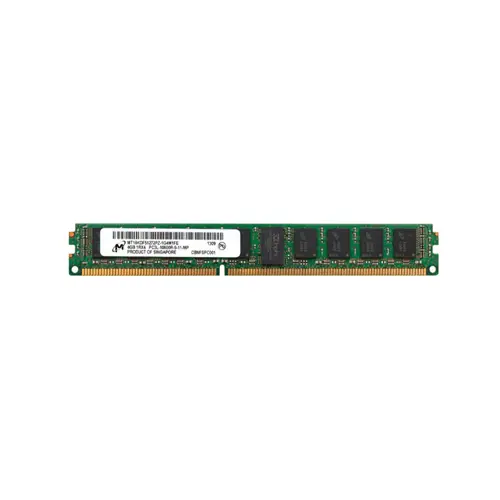
The Micron MT18KDF51272PZ-1G4M1FE is a server memory module, engineered as a DDR3L-1333 VLP RDIMM with ECC and registered buffering. In a virtualization cluster hosting business-critical workloads, its ECC capability is non-negotiable. It corrects random single-bit errors caused by background radiation, preventing silent data corruption that could crash hypervisors or corrupt virtual disks. The registered buffer amplifies command and address signals, ensuring rock-solid stability when all 24 DIMM slots are populated—a common scenario in dense 2U servers. For in-memory databases like SAP HANA or Redis, this module’s 1.35V ultra-low voltage slashes power consumption and heat output, drastically reducing cooling costs across a data center. Meanwhile, its Very Low Profile design fits into the tight confines of 1U blade chassis, solving clearance issues without sacrificing performance. The single-rank x4 organization with CL9 latency strikes a balance between bandwidth and controller load, keeping database transactions responsive even under sustained load.
General Virtualization
For lightweight hypervisors hosting multiple VMs, populate a minimum of six 4 GB VLP RDIMMs (24 GB total) across triple-channel memory banks to balance density and cost. Distribute modules evenly per CPU socket, and leave at least two DIMM slots free for future scale-out. This configuration prevents memory ballooning while maintaining reasonable overcommit ratios.
In-Memory Database
Latency-sensitive datasets demand the largest possible capacity within a single server node. Fully populate all memory channels with identical 4 GB Registered ECC modules—aim for 64 GB or higher across two sockets—to maximize interleaving and sustain high throughput. Keep spare DIMMs configured as hot-spare ranks to protect data integrity in event of uncorrectable errors.
High-Performance Computing
HPC clusters require uniform, high-bandwidth memory per compute node. Install six or twelve identical 4 GB RDIMMs per dual-socket node, filling at least one DIMM per channel to guarantee balanced memory access and peak bandwidth. The 1.35 V low-voltage design reduces thermal load in dense racks, enabling sustained clock speeds during long-running parallel jobs.
Rigorously tested, compatible with Dell PowerEdge R710, HP ProLiant DL380 G7, Lenovo ThinkServer RD330.
Q: Can I mix this MT18KDF51272PZ-1G4M1FE with other memory modules of different brands or speeds?
A: Mixing different brands or speeds is not recommended for registered server memory. It may lead to instability or failure to POST. Always use identical modules with the same rank, timing, and ECC configuration to ensure data integrity.
Q: Is this memory compatible with my Intel Xeon E5 server platform?
A: Yes, this VLP RDIMM with DDR3-1333 and ECC Registered signaling is compatible with many Intel Xeon E5-2400/2400 v2 and selected E5-2600 v1/v2 platforms. Verify your board’s qualified vendor list for 1.35V low‑voltage support.
Q: What is the recommended DIMM population order for optimal performance?
A: For optimal performance, populate memory channels evenly starting with the slots farthest from the CPU per channel. On a typical dual‑socket server, install one DIMM per channel (blue slots first) to enable full interleaving.
Q: Does this module support overclocking or XMP profiles?
A: No, this registered server memory does not support overclocking or XMP profiles. It operates strictly at JEDEC standard DDR3-1333 (PC3-10600) timings to guarantee 24/7 reliability in enterprise environments.
Q: What warranty and typical failure rate can I expect?
A: This module comes with a 1‑year warranty. Typical annualized failure rate (AFR) for such proven DDR3 RDIMMs is under 0.5% under specified operating conditions, backed by rigorous OEM‑grade testing.