











 Secure payments
Standard refund policy
Trade Assurance
Secure payments
Standard refund policy
Trade Assurance
| Product Type | Memory Module |
|---|---|
| Compliance Standards | RoHS |
| Memory Capacity | 4 GB |
| Memory Technology | DDR3 |
| Product Voltage | 1.35V |
| RAM Speed | 1333MHz |
| RAM Standard | DDR3-1333/PC3-10600 |
| Error Identifying | ECC |
| Signal Type | Registered |
| Column Access Strobe (CAS) | CL9 |
| Rank | Single Rank x4 |
| Quantity of Pins | 240-pin |
| RAM Genre | RDIMM |
This RDIMM is engineered for server-class platforms, delivering robust data integrity through ECC and enhanced signal stability via registered logic, making it ideal for virtualization, in-memory databases, and mission-critical enterprise workloads. Its 1.35V low-voltage DDR3-1333 operation and single-rank x4 configuration optimize power efficiency and memory channel loading, ensuring reliable 24/7 performance in dense rack and blade server deployments.
1. ECC error correction transparently detects and resolves single-bit memory faults, preventing in-memory data corruption that could crash virtual machines or silently compromise transactional integrity in always-on servers.
2. Registered signal buffering decouples the memory controller from direct chip loads, so multiple DIMMs per channel stay reliable under heavy population, directly expanding headroom for consolidation and virtualization density.
3. Single Rank x4 configuration presents a lighter electrical load per channel, preserving clean signal integrity when servers are fully populated and reducing the risk of rank-switching latency during memory-intensive consolidation workloads.
4. 1333 MHz clock speed provides consistent bandwidth headroom for sustained database queries and simultaneous web serving, matching the steady throughput demands of entry-level and mid-range enterprise workloads.
5. 1.35 V low voltage operation meaningfully cuts per-DIMM power draw, which scales into lower datacenter cooling overhead and energy cost without trading off the registered ECC protection hosting platforms require.
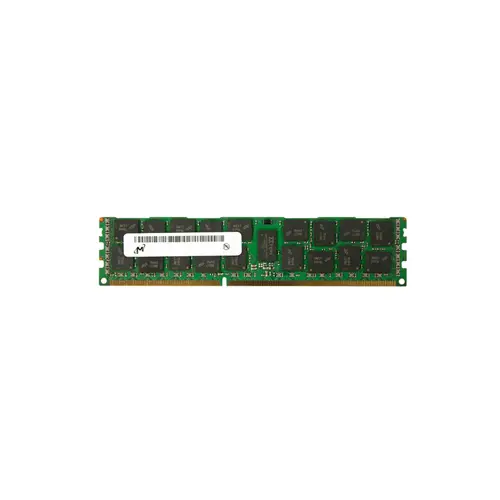
The Micron MT18KSF51272PZ-1G4M1FF is an RDIMM engineered for server environments where uptime, data integrity, and energy efficiency directly impact business outcomes. Its four defining characteristics translate into real-world reliability that IT managers cannot afford to overlook.
First, ECC memory actively detects and corrects single-bit errors caused by background radiation or electrical noise. In a heavily utilized in-memory database like Redis or SAP HANA, a silent bit flip can corrupt transactional records or financial calculations without warning—ECC eliminates that existential risk. Second, the registered design buffers command and address signals, which stabilizes high-density memory configurations. When you populate a virtualization cluster running dozens of VMs per node, signal integrity becomes paramount; this RDIMM allows you to scale to large capacities without intermittent crashes caused by electrical loading.
Third, the 1.35V low-voltage operation directly reduces power draw and thermal output across a rack of servers. In a 24/7 colocation facility, lower energy per DIMM means tangible savings on both electricity and cooling infrastructure, while also extending component lifespan. Finally, the single-rank x4 organization optimizes bandwidth efficiency under concurrent workloads. It delivers the predictable memory bandwidth that hypervisors demand when scheduling multiple guest operating systems simultaneously, preventing latency spikes that would otherwise degrade user experience. For a virtualized SQL Server farm or a dense private cloud, this memory configuration ensures that throughput remains consistent under pressure, making it a strategic component rather than a commodity part.
General Virtualization
For a DDR3-era server using these 4 GB registered ECC modules, populate all memory channels symmetrically to maximize interleaving and VM density. A practical starting point is eight modules (two per channel in a quad-channel platform) for 32 GB total, enabling a dozen light VMs or several moderate instances. Plan for a minimum of 2 GB per VM core and scale module count by adding identical sticks in matched pairs per channel to preserve memory riser balance and ECC integrity.
In-Memory Database
In-memory databases demand the largest possible capacity and low latency. Fill every DIMM slot with identical 4 GB RDIMMs, typically three modules per channel on a server rated for triple-rank-per-channel operation, to reach 48 GB on a quad-channel board. Pair modules in rank-interleaved configuration (two single-rank x4 sticks appearing as dual-rank) to improve row-buffer hit rates without exceeding electrical loading limits. Monitor 1.35 V power budgets and active cooling, as a fully loaded chassis increases thermal output.
High-Performance Computing (HPC)
HPC workloads favour bandwidth over raw capacity, so install at least one module per memory channel (e.g., four identical 4 GB sticks for quad-channel) to keep all interleaved banks active at the rated 1333 MT/s. When a single module per channel provides insufficient capacity for tightly-coupled datasets, scale to two modules per channel (8×4 GB) while strictly matching ranks and timings; this yields dual-rank access and better stream throughput. Always verify platform-specific Registered DIMM population order to avoid signal degradation in highly parallel jobs.
Rigorously tested DDR3 RDIMM, compatible with Dell PowerEdge R720, HP ProLiant DL380p Gen8, Lenovo ThinkServer RD630.
Q: Can I mix this MT18KSF51272PZ-1G4M1FF with other memory modules of different brands or speeds?
A: Mixing RDIMMs is not recommended. Different brands, speeds, or ranks may cause signal integrity issues and system instability. All modules in a channel should share identical timings and ECC configuration to ensure reliability.
Q: Is this memory compatible with my Intel or AMD server platform?
A: This DDR3L-1333 RDIMM is designed for servers using Intel Xeon E5 series or similar platforms with 240-pin sockets. Verify your motherboard's QVL and ensure 1.35V ECC Registered support before ordering.
Q: What is the recommended DIMM population order for optimal performance?
A: Follow your server board's manual. Generally, populate identical DIMMs per channel starting from the blue or farthest slot. For single-rank x4 modules like this, balanced channel distribution maximizes memory bandwidth.
Q: Does this module support overclocking or XMP profiles?
A: No. This server-class RDIMM adheres strictly to JEDEC standards (DDR3-1333) and does not support overclocking or XMP profiles to guarantee 24/7 data integrity in mission-critical environments.
Q: What warranty and typical failure rate can I expect?
A: This module includes a 1-year warranty. Typical field failure rates are well under 0.1% annually when operated within specified voltage and thermal limits, backed by rigorous production testing.