











 Secure payments
Standard refund policy
Trade Assurance
Secure payments
Standard refund policy
Trade Assurance
| Product Type | Memory Module |
|---|---|
| Memory Capacity | 4 GB |
| Memory Technology | DDR3 |
| Product Voltage | 1.35V |
| RAM Speed | 1333MHz |
| RAM Standard | DDR3-1333/PC3-10600 |
| Error Identifying | ECC |
| Signal Type | Unbuffered |
| Column Access Strobe (CAS) | CL9 |
| Rank | Dual Rank x8 |
| Quantity of Pins | 240-pin |
| RAM Genre | UDIMM |
This ECC Unbuffered DDR3 module is ideally suited for entry-level servers and small business NAS systems where data integrity is critical. The dual-rank x8 configuration and low 1.35V operating voltage enhance memory bandwidth efficiency while reducing power consumption, complementing the error-correcting capability for reliable 24/7 operation.
1. ECC protection safeguards data integrity by detecting and correcting single-bit errors, essential for financial transactions or database servers where memory errors can corrupt critical records.
2. Dual Rank x8 organization increases memory access parallelism, enabling higher sustained bandwidth under heavy multi-threaded workloads like virtualization platforms with dozens of VMs.
3. Low 1.35V operating voltage reduces power draw per DIMM, lowering overall server rack thermals and cooling costs in always-on enterprise environments.
4. 1333MHz clock speed delivers sufficient memory throughput per channel for typical mid-range servers hosting multiple concurrent business applications without bottlenecking the CPU.
5. CL9 timings provide tighter latency than slower JEDEC bins, improving memory response times for latency-sensitive enterprise services such as in-memory caches or user-facing web servers.
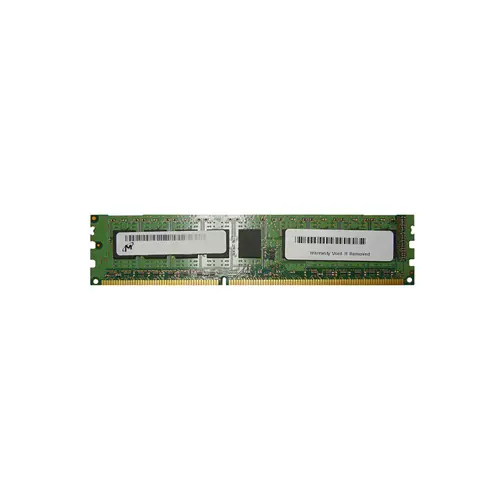
Based on the 240-pin UDIMM form factor, ECC error correction, and 1.35V low-voltage design, this module is clearly built for entry-level servers, small business NAS devices, and always-on professional workstations where data integrity matters more than raw clock speed. The Micron MT18KSF51272AZ-1G4K1ZE brings four critical capabilities together to solve real-world pain points.
The ECC protection means single-bit memory errors are detected and corrected on the fly. In a ZFS-based file server storing years of client documents or a PostgreSQL database serving your inventory system, a silent bit-flip can corrupt an entire record without warning; ECC prevents that invisible data decay, which standard non-ECC desktop memory cannot do. The 1.35V low-voltage operation cuts heat and power draw substantially, a direct financial benefit when your virtualization host or surveillance NVR runs 24/7 and every watt of energy savings lowers the monthly bill and reduces fan noise in a cramped office. Its unbuffered architecture keeps latency low for responsive application performance, while dual-rank x8 organization uses bank interleaving to lift effective bandwidth. In a light hypervisor hosting a domain controller and web server simultaneously, that translates into noticeably smoother multi-VM responsiveness compared to single-rank alternatives. This combination of silent error correction, energy efficiency, and balanced throughput turns a seemingly modest 4GB module into a reliability lifeline for systems where uptime and data consistency are not optional.
General Virtualization
For a DDR3-1333 ECC UDIMM server, populate all available channels with identical 4 GB modules to maximize memory bandwidth while retaining error correction. Aim for at least 16–32 GB total across four or six slots to comfortably host multiple light VMs. Avoid mixing ranks or speeds—use dual-rank x8 UDIMMs exclusively for stable, balanced performance under moderate consolidation ratios.
In-Memory Database
In-memory workloads demand the lowest latency and highest reliability. Install a full set of six or eight 4 GB UDIMMs, yielding 24–32 GB, to run Redis or Memcached instances with headroom for dataset growth. ECC is non-negotiable here; the unbuffered design keeps access latency slightly lower than registered DIMMs, which benefits small yet latency-sensitive caches when every nanosecond counts.
High-Performance Computing
HPC nodes often combine capacity per core with sustained throughput. Populate all memory channels with matching 4 GB ECC UDIMMs to leverage parallel memory access—typically 32–48 GB across eight slots for dual-socket systems. Dual-rank x8 modules provide a slight bandwidth advantage in streaming computations. Consistency is critical, so deploy identical part numbers across the cluster to guarantee repeatable performance and error behavior during long-running MPI jobs.
Rigorously tested, compatible with Dell PowerEdge R210 II, T110 II, HPE ProLiant ML310e Gen8, and more.
Q: Can I mix this MT18KSF51272AZ-1G4K1ZE with other memory modules of different brands or speeds?
A: Mixing this ECC UDIMM with modules of different brands or speeds is not recommended. It may cause system instability or disable ECC functionality. For reliable server operation, install identical modules with the same part number.
Q: Is this memory compatible with my Intel or AMD server platform?
A: This DDR3-1333 ECC UDIMM is compatible with single-socket servers and workstations using Intel Xeon E3-1200 v2/v3 or AMD AM3+ platforms that support 1.35V unbuffered ECC memory. Verify your board’s memory QVL for specific support.
Q: What is the recommended DIMM population order for optimal performance?
A: For optimal dual-channel performance, install identical modules in matching color-coded DIMM slots as specified in your server motherboard's manual. Typically, populate one module per channel first, then fill remaining slots symmetrically.
Q: Does this module support overclocking or XMP profiles?
A: No, this server-grade ECC module runs at standard JEDEC timings (DDR3-1333 CL9) and does not support overclocking or XMP profiles. It is designed for reliable, error-corrected operation at rated specifications.
Q: What warranty and typical failure rate can I expect?
A: This module is covered by a 1-year warranty. As an ECC UDIMM with fixed JEDEC operation, its typical failure rate is very low under normal server environments, ensuring long-term data integrity and stability.