











 Secure payments
Standard refund policy
Trade Assurance
Secure payments
Standard refund policy
Trade Assurance
| Product Type | Memory Module |
|---|---|
| Compliance Standards | RoHS |
| Memory Capacity | 4 GB |
| Memory Technology | DDR3 |
| Product Voltage | 1.35V |
| RAM Speed | 1333MHz |
| RAM Standard | DDR3-1333/PC3-10600 |
| Error Identifying | ECC |
| Signal Type | Unbuffered |
| Column Access Strobe (CAS) | CL9 |
| Rank | Dual Rank x8 |
| Quantity of Pins | 240-pin |
| RAM Genre | UDIMM |
This DDR3-1333 ECC Unbuffered DIMM is purpose-built for entry-level servers and small-business workstations, ensuring critical data integrity in light virtualization and memory-sensitive workloads. Its dual-rank x8 organization boosts interleaved memory throughput, while the 1.35V low-voltage operation and CL9 latency maintain energy-efficient, stable error correction.
1. ECC protection silently corrects single-bit memory errors, safeguarding data integrity for entry-level servers and workstations that handle financial records or critical small-business databases.
2. Low-voltage 1.35V operation cuts energy draw and thermal stress in always-on microserver deployments, directly lowering cooling overhead in dense rack environments.
3. A four-gigabyte capacity suits lightweight virtualization hosts or dedicated appliance roles, keeping memory provisioning lean and cost-efficient for single-purpose Linux containers.
4. Dual Rank x8 organization alternates between internal rank groups, maximizing bank-level parallelism so memory bandwidth holds steady under multiple concurrent requests from a hypervisor.
5. The 1333 mega-transfers-per-second data rate delivers predictable throughput for legacy enterprise applications, avoiding I/O stalls when modest transactional workloads spike.
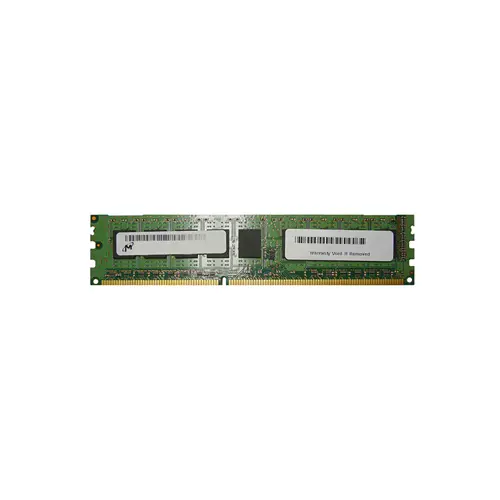
As a server memory module, the MT18KSF51272AZ-1G4M1ZE is a 4GB DDR3-1333 ECC Unbuffered DIMM built for entry-level servers. Its four defining characteristics directly address real operational headaches. First, Error-Correcting Code (ECC) eliminates silent data corruption, a critical safeguard when running a virtualized cluster or an in-memory database like Redis where a bit-flip can crash VMs or corrupt analytics. Second, the low 1.35V operating voltage reduces power consumption and heat, cutting electricity costs and improving long-term reliability in always-on microserver deployments. Third, the dual-rank x8 organization interleaves memory banks to uplift bandwidth, smoothing performance when multiple VMs compete for resources. Finally, the DDR3-1333 speed with CL9 latency strikes an optimal balance between responsiveness and affordability, keeping your database query times swift without overspending. Together, they make this module the dependable backbone for cost-conscious IT teams running virtualized environments and memory-intensive applications.
General Virtualization
For lightweight virtualized environments, install four matched 4 GB UDIMMs across all memory channels to achieve a balanced 16 GB pool while avoiding channel contention. This ECC, low-voltage (1.35V) memory safeguards guest state, making it ideal for hosting 3–4 small VMs. Scale to eight modules (32 GB) to handle moderate consolidation without resorting to disk swap.
In-Memory Database
Populate every available slot with these dual-rank x8 UDIMMs to maximize capacity while preserving ECC protection for data integrity. A 64 GB configuration (sixteen modules) can support small Redis or Memcached datasets entirely in RAM, and the uniform dual-rank structure improves bank-level parallelism. Keep the modules identical to maintain stable command timing under sustained in-memory workloads.
High-Performance Computing
Achieve peak memory bandwidth by installing one 4 GB module per channel in a multi-channel server, ensuring symmetric interleaving for floating-point throughput. A common eight-module, 32 GB layout leverages the dual-rank design to deliver responsive pre-fetching for MPI tasks. The 1.35V UDIMMs reduce thermal stress in dense node clusters, benefiting reliability during long-running simulations.
Our rigorously tested DDR3 ECC UDIMM fits servers like Dell PowerEdge R210 II, HP ProLiant MicroServer Gen8, Lenovo ThinkServer TS140.
Q: Can I mix this MT18KSF51272AZ-1G4M1ZE with other memory modules of different brands or speeds?
A: Mixing is not recommended for server environments. Different brands, speeds, or ranks can cause instability, ECC errors, or system hangs. Populate with identical modules to ensure validated reliability.
Q: Is this memory compatible with my system?
A: It is compatible with servers/workstations supporting DDR3L UDIMM ECC, such as Intel Xeon E3/E5 or AMD Opteron platforms. Verify 1.35V, 1333MHz, and UDIMM support on your board’s QVL before purchase.
Q: What is the recommended DIMM population order for optimal performance?
A: Populate identical modules per channel starting with the slot closest to the CPU (often A1, B1). For dual-processor boards, balance channels across both CPUs. Always consult your server’s manual for the correct sequence.
Q: Does this module support overclocking or XMP profiles?
A: No. It operates strictly at JEDEC-standard DDR3-1333 CL9 timings. ECC UDIMMs do not support overclocking or XMP profiles, as they are engineered for error-free stability in mission-critical systems.
Q: What warranty and typical failure rate can I expect?
A: This module carries a 1-year warranty. Built with Micron DRAM and rigorous screening, the typical failure rate is extremely low (MTBF over 2 million hours), ensuring dependable long-term operation in server environments.