











 Secure payments
Standard refund policy
Trade Assurance
Secure payments
Standard refund policy
Trade Assurance
| Product Type | Memory Module |
|---|---|
| Compliance Standards | RoHS |
| Memory Capacity | 4 GB |
| Memory Technology | DDR3 |
| Product Voltage | 1.5V |
| RAM Speed | 1333MHz |
| RAM Standard | DDR3-1333/PC3-10600 |
| Error Identifying | ECC |
| Signal Type | Unbuffered |
| Column Access Strobe (CAS) | CL9 |
| Rank | Dual Rank x8 |
| Quantity of Pins | 240-pin |
| RAM Genre | UDIMM |
This UDIMM with ECC is engineered for entry-level servers and workstations where data integrity is critical for tasks like light virtualization or memory-sensitive databases, and its Dual Rank x8 organization enhances memory bandwidth by enabling interleaving across ranks. The unbuffered ECC design delivers reliable single-bit error correction with a low-latency CL9 response at 1333MHz, ensuring stable, accurate operation in 24/7 environments without the cost overhead of registered memory.
1. ECC protection silently corrects single-bit memory errors in real time, safeguarding financial transactions and database integrity from silent data corruption in always-on server environments.
2. Unbuffered UDIMM design eliminates the register clock cycle penalty, reducing latency for microservices that demand rapid access to in-memory caches.
3. Dual Rank x8 organization interleaves memory pages across two internal ranks, keeping the DDR3 channel busy and lifting effective bandwidth for moderate virtualization workloads.
4. The 4 GB capacity provides a cost-optimized memory footprint for dedicated lightweight Linux containers or branch-office infrastructure tasks where oversubscription is not a factor.
5. DDR3-1333 speed delivers a stable 10.6 GB/s throughput per channel, which matches the needs of legacy storage appliances that prioritize sustained streaming performance over peak burst rates.
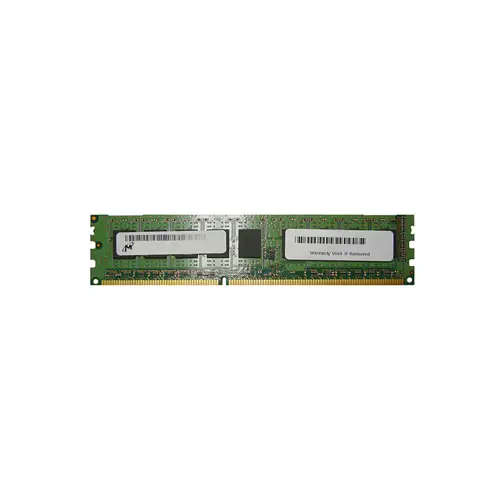
When you depend on a virtualization cluster or an in-memory database, silent data corruption is your worst enemy. The Micron MT18JSF51272AZ-1G4M1 is a server UDIMM purpose-built to eliminate that risk. Its ECC engine detects and corrects single-bit errors caused by background radiation or voltage noise, so a flipped bit will not quietly crash a hypervisor host or poison a Redis cache, keeping your services online and your transactions accurate. Because it is an unbuffered module, every memory access bypasses the extra register clock latency found in RDIMMs, giving latency-sensitive virtual machines and real-time analytics a tangible responsiveness edge. The dual-rank x8 organization enables rank interleaving, allowing the memory controller to pipeline commands across ranks and sustain higher bandwidth when multiple VMs compete for resources or when a memcached cluster absorbs a storm of queries. Operating at a standard 1.5V with proven DDR3-1333 CAS 9 timings, this 240-pin UDIMM drops seamlessly into existing servers, delivering a stable, cost-effective upgrade that extends asset life without introducing power or cooling headaches. For IT teams running legacy platforms, this is the reliable backbone that turns aging hardware into a still-profitable workhorse.
Server Memory Identified: This is an ECC Unbuffered DDR3 4GB UDIMM, suited for entry-level servers and workstations requiring data integrity. Capacity planning must account for the 4GB module size and 1333MHz speed.
General Virtualization
A single 4GB module is inadequate for modern hypervisors. For light virtualization (2–3 VMs), populate at least four modules (16GB) in balanced channels to ensure ECC protection and memory interleaving. Scale to 32GB using eight identical modules for moderate VM density, strictly avoiding mixed capacities to maintain dual-rank symmetry.
In-Memory Database
In-memory databases demand both capacity and reliability. A 4GB module limits feasibility; aggregate 64GB or more using 16 identical ECC UDIMMs across all memory channels. Dual-rank x8 modules improve bank-level parallelism, but capacity ceiling often forces migration to RDIMM platforms for datasets exceeding 128GB. Prioritize identical rank and CAS latency across all populated slots.
High-Performance Computing
HPC workloads benefit from ECC to prevent silent data corruption during long-running simulations. Deploy a minimum of 64GB using the maximum supported identical 4GB modules to saturate memory channels. The dual-rank design aids bandwidth efficiency, but the 1333MT/s speed is a bottleneck; compensate by populating all channels evenly to maximize aggregate throughput in memory-bound codes.
Rigorously tested server memory, compatible with Dell PowerEdge R710, HP ProLiant DL380 G7, Lenovo ThinkServer TS140, Fujitsu PRIMERGY TX300 S6.
Q: Can I mix this MT18JSF51272AZ-1G4M1 with other memory modules of different brands or speeds?
A: Mixing is not recommended for server environments. To maintain signal integrity and ECC reliability, use identical modules with matching speed, rank, and voltage to avoid instability.
Q: Is this memory compatible with my Intel Xeon E3 or AMD Ryzen Pro server platform?
A: This DDR3 ECC UDIMM is designed for Intel Xeon E3-1200 series and select AMD AM3+ server boards. Verify your motherboard supports unbuffered ECC and 240-pin DDR3-1333.
Q: What is the recommended DIMM population order for optimal performance?
A: Populate memory channels symmetrically, starting with the slots farthest from the CPU. For dual-processor boards, balance modules equally per CPU to maintain full memory bandwidth.
Q: Does this module support overclocking or XMP profiles?
A: No. As an enterprise-grade ECC UDIMM, it runs strictly at JEDEC-standard DDR3-1333 with CL9 timing. Overclocking or XMP is not supported to ensure data integrity.
Q: What warranty and typical failure rate can I expect?
A: This module includes a one-year warranty. Engineered for 24/7 operation, it offers an exceptionally low annualized failure rate, backed by rigorous testing and Micron quality standards.